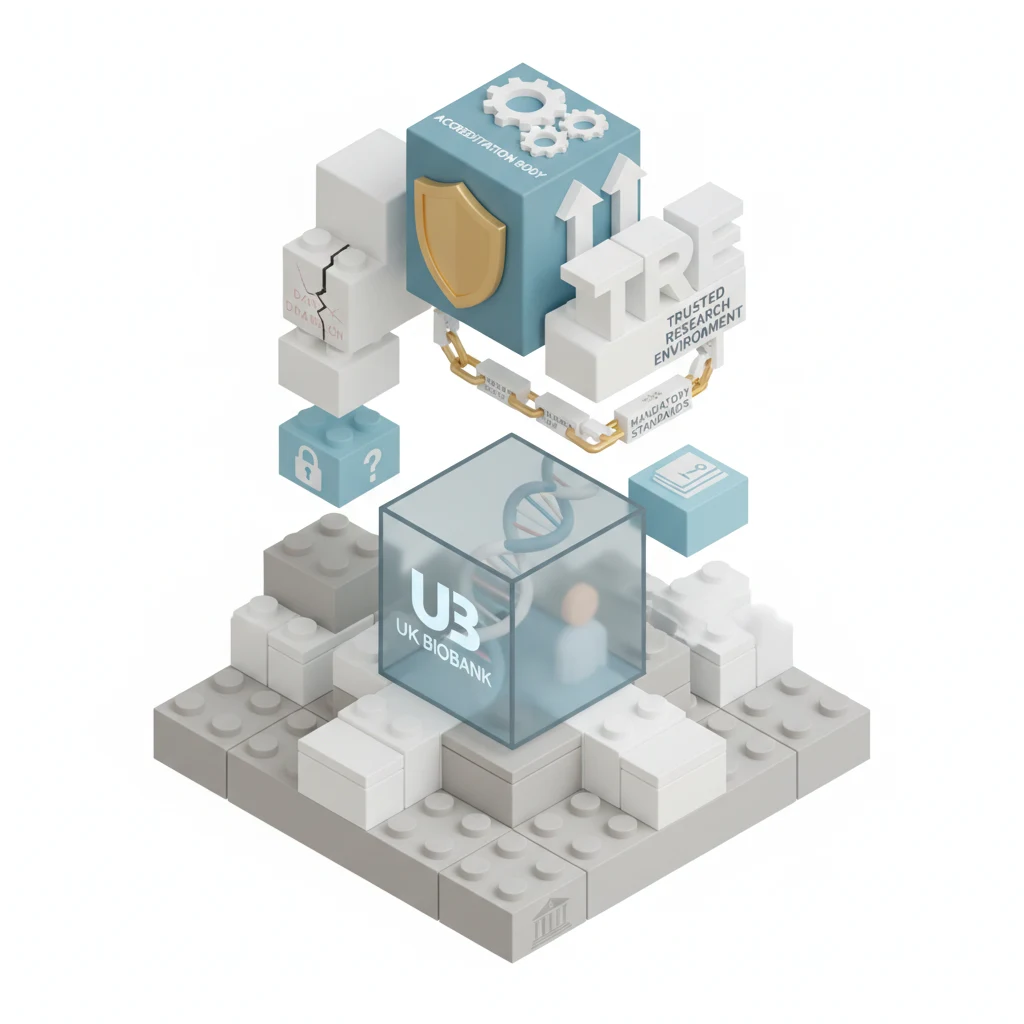

The secure handling of sensitive patient data within trusted research environments (TREs) is paramount for maintaining public trust and research integrity. A recent case involving the UK Biobank has brought to light significant vulnerabilities, indicating that voluntary compliance with data security standards is insufficient. Mandatory accreditation of TREs is now proposed as an essential measure to safeguard patient information and uphold the ethical conduct of medical research.1
Trusted research environments (TREs) are designed to provide secure access to sensitive datasets for approved researchers, facilitating medical advancements while protecting patient privacy. The UK Biobank, a large-scale biomedical database, operates as a TRE, providing de-identified data to researchers globally. The integrity of such environments relies heavily on robust security protocols and adherence to best practices. However, a recent incident involving the UK Biobank has exposed gaps in the current system, prompting a re-evaluation of the regulatory framework governing TREs.1
The UK Biobank Case and its Implications
A detailed analysis of the UK Biobank case, published in the BMJ, revealed specific vulnerabilities within its trusted research environment. While the exact nature of the breach or vulnerability is not detailed in the provided abstract, the authors, Jefferson E and Smith C, conclude that this case highlights a systemic issue. The incident underscores that even well-established and respected TREs can be susceptible to security lapses if accreditation is not mandatory. The paper argues that the current reliance on voluntary adherence to security standards is insufficient to protect the vast amounts of sensitive patient data held within these environments.1
The authors advocate for a shift towards a mandatory accreditation model for all TREs. This would involve a standardised, independent assessment of a TRE's security infrastructure, operational procedures, and compliance with data protection regulations. Such a model would ensure that all TREs meet a consistent baseline of security, thereby reducing the risk of data compromise. The absence of mandatory accreditation leaves room for variability in security practices, potentially exposing patient data to undue risk. The paper suggests that a robust accreditation scheme would provide a clear framework for accountability and transparency, fostering greater public confidence in the use of health data for research.1
The implications extend beyond individual TREs to the broader landscape of medical research. If public trust in data security is eroded, it could significantly impact patient willingness to contribute data to biobanks and other research initiatives. This, in turn, could impede scientific progress and the development of new therapies. Therefore, the call for mandatory accreditation is not merely a technical recommendation but a strategic imperative for the future of evidence-based medicine.1
The Path Towards Mandatory Accreditation
Implementing a mandatory accreditation framework for TREs presents several practical considerations. Firstly, defining the scope of accreditation will be crucial. This includes determining which types of data environments fall under the mandatory scheme and establishing clear criteria for what constitutes a "trusted research environment." Secondly, the development of a standardised assessment methodology is paramount. This methodology must be comprehensive, covering technical security controls, governance structures, staff training, incident response protocols, and continuous monitoring capabilities. Independent bodies with expertise in cybersecurity, data privacy, and health informatics would be best placed to conduct these assessments, ensuring impartiality and technical rigor.
Furthermore, the accreditation process should not be a one-time event but rather an ongoing cycle of assessment, improvement, and re-accreditation. This continuous loop would ensure that TREs adapt to evolving cyber threats and technological advancements, maintaining a high level of security over time. The associated costs of implementing and maintaining such a system, including audit fees and necessary infrastructure upgrades, will need careful consideration and potentially government or research funding support to avoid disproportionately burdening smaller research institutions or those in developing nations. However, these costs must be weighed against the potentially far greater financial and reputational damage resulting from a data breach.
The UK Biobank case serves as a critical reminder that even with sophisticated infrastructure and dedicated teams, vulnerabilities can emerge. By moving towards a system of mandatory, independently verified accreditation, the scientific community can collectively strengthen the security posture of TREs. This proactive approach will not only safeguard sensitive patient data but also reinforce public trust, ensuring the continued flow of invaluable health information necessary for groundbreaking medical research and the advancement of global health outcomes. The long-term benefits of robust data security, including accelerated discovery and improved patient care, far outweigh the initial investment in a comprehensive accreditation scheme.
The UK Biobank case serves as a stark reminder that the infrastructure supporting medical research is as critical as the research itself. For clinicians, the integrity of patient data within TREs directly impacts the validity and trustworthiness of the evidence informing their practice. If the security of these environments is compromised, the very foundation of evidence-based medicine begins to crack. It is not enough for data to be de-identified; the systems housing it must be impenetrable, and the current voluntary framework clearly falls short.
The industry, particularly those involved in developing and managing TREs, must recognise that a reactive approach to data security is unsustainable. Mandatory accreditation, while potentially increasing initial overheads, will ultimately streamline compliance and foster a more secure ecosystem. This move would also provide a competitive advantage to those TREs that proactively invest in robust security, differentiating them from less secure alternatives. Furthermore, it sets a clear standard for pharmaceutical companies and academic institutions relying on these datasets, ensuring the provenance and integrity of the data they use for drug discovery and clinical trial design.
From a patient perspective, the call for mandatory accreditation is a non-negotiable step towards safeguarding their most personal information. Patients contribute their data with the understanding that it will be used responsibly and securely for the greater good. Any breach of this trust, as highlighted by the UK Biobank case, undermines the social contract between patients and researchers. Mandatory accreditation offers a tangible mechanism to restore and maintain that trust, ensuring that the altruistic act of data donation does not inadvertently expose individuals to risk. It is a necessary evolution in data governance, reflecting the increasing volume and sensitivity of health data being leveraged for scientific advancement.
- The Pivot Voluntary compliance for trusted research environments (TREs) is inadequate for data security.
- The Data The UK Biobank case revealed specific vulnerabilities requiring a systemic solution.1
- The Action Policymakers should implement mandatory accreditation for all TREs to ensure consistent data protection.
ART-2026-660
·10/26
Drafted with AI assistance and checked by automated style rules. Not individually read by an editor. This publication is intended for healthcare professionals, researchers, and life science industry professionals. Content is provided for informational and educational purposes only and does not constitute medical advice.

I cover life sciences: drug approvals, trial readouts, regulatory decisions, and the AI reshaping clinical practice. Based in Greater London, contributing to The Life Science Feed since 2026.
Cite This Article
Voss M, Lopes W. UK biobank case highlights need for mandatory TRE accreditation. The Life Science Feed. Published July 27, 2026. Updated October 5, 2026. Accessed October 26, 2026. https://thelifesciencefeed.com/healthcare-sys-and-biz/health-policy/policy/uk-biobank-case-highlights-need-for-mandatory-tre-accreditation.
Editorial & AI Standards
Content is drafted with AI tools from peer-reviewed, open-access sources such as published trial data, clinical guidelines, and regulatory filings. This article is checked by automated style rules but is not individually read by an editor, so check the cited source before relying on a figure.
Source citations are listed in the References section. This content does not represent the views of any pharmaceutical company, medical device manufacturer, or healthcare provider.
Licence & Rights
© 2026 The Life Science Feed. All rights reserved. Unless otherwise indicated, all content is the property of The Life Science Feed and may not be reproduced, distributed, or transmitted in any form or by any means without prior written permission.
Medical Disclaimer
The information provided on The Life Science Feed is for educational and informational purposes only. It is not intended as a substitute for professional medical advice, diagnosis, or treatment. Always seek the advice of your physician or other qualified healthcare provider regarding any medical condition or treatment decision. Never disregard professional medical advice or delay in seeking it because of something you have read on this website.
References
1. Jefferson E, Smith C. UK Biobank case reveals the need for mandatory accreditation of trusted research environments. BMJ. 2026.