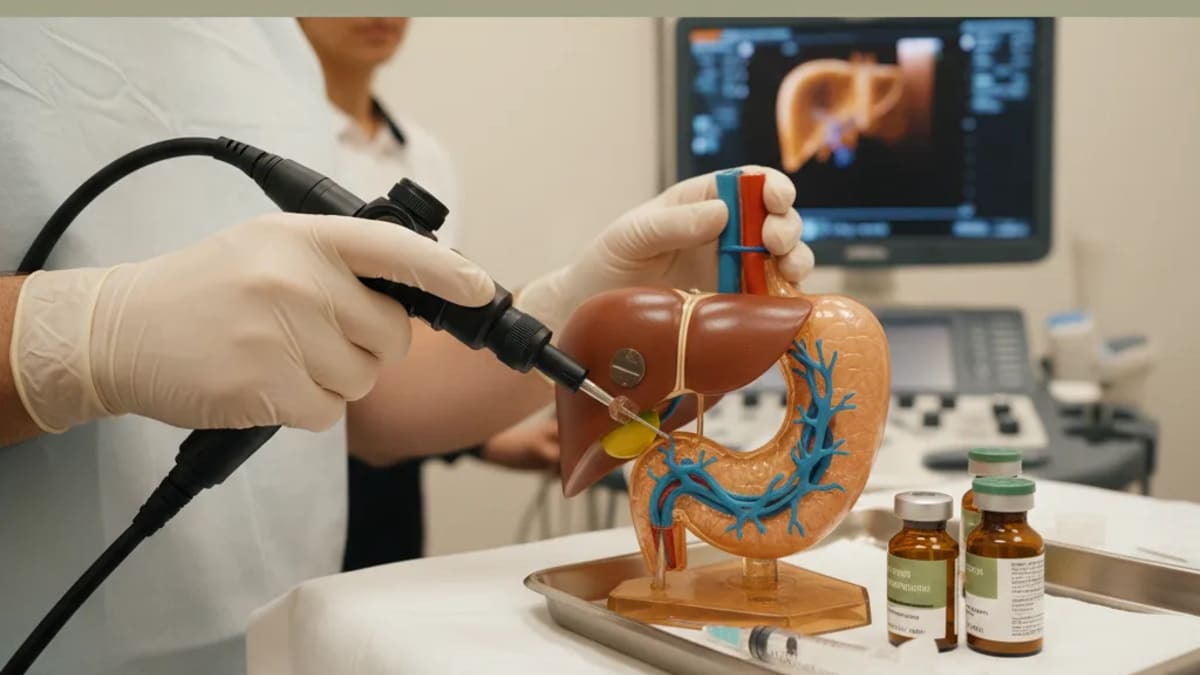

Variceal bleeding remains a critical complication of portal hypertension, associated with significant morbidity and mortality. The EASL 2026 Skills Learning Centre on variceal bleeding will provide an essential update on established and emerging management strategies, focusing on the immediate clinical decisions required for effective patient care.
- The Pivot The Skills Centre reinforces the primary role of endoscopic therapy combined with pharmacological agents in acute variceal bleeding and secondary prophylaxis.
- The Data Early pre-emptive transjugular intrahepatic portosystemic shunt (TIPS) in high-risk patients reduces rebleeding and improves survival compared to standard therapy.
- The Action Clinicians should ensure timely endoscopic intervention and appropriate pharmacological support, considering early TIPS for selected high-risk patients.
Acute variceal bleeding represents a medical emergency, with initial mortality rates historically approaching 20%.1 The primary goal of management is to achieve haemostasis, prevent early rebleeding, and improve survival. The EASL 2026 Skills Learning Centre will review the evidence base for current guidelines, emphasising the practical application of therapeutic strategies.
Initial management involves resuscitation, pharmacological vasoconstrictors, and endoscopic therapy. Vasoactive drugs, such as terlipressin or octreotide, are initiated immediately upon suspicion of variceal bleeding to reduce portal pressure. Terlipressin, administered intravenously, has been shown to improve survival at 48 hours compared to placebo (odds ratio, 0.66; 95% CI, 0.49-0.88).2 Octreotide, a somatostatin analogue, also reduces splanchnic blood flow and portal pressure, with comparable efficacy to terlipressin in some settings.3
Endoscopic and Pharmacological Interventions
Endoscopic therapy, primarily variceal band ligation (EVL) for oesophageal varices or cyanoacrylate injection for gastric varices, is performed within 12 hours of presentation. EVL is superior to sclerotherapy for oesophageal varices, demonstrating lower rebleeding rates and fewer complications.4 For gastric varices, particularly fundal varices, cyanoacrylate injection achieves haemostasis in 90-100% of cases.5
Following successful haemostasis, secondary prophylaxis is crucial to prevent rebleeding. This typically involves a combination of non-selective beta-blockers (NSBBs) and repeated EVL. NSBBs, such as propranolol or carvedilol, reduce portal pressure and have demonstrated a significant reduction in rebleeding rates. Carvedilol, specifically, has shown superior portal pressure reduction compared to propranolol.6 The combination of NSBBs and EVL is more effective than either therapy alone for secondary prophylaxis.7
For patients at high risk of rebleeding, or those who fail endoscopic and pharmacological therapy, transjugular intrahepatic portosystemic shunt (TIPS) is an established intervention. Early pre-emptive TIPS, performed within 72 hours of acute variceal bleeding in selected high-risk patients (Child-Pugh class B with active bleeding or Child-Pugh class C < 13 points), has demonstrated improved survival and reduced rebleeding rates. A meta-analysis reported a significant reduction in 1-year mortality with early TIPS compared to standard therapy (hazard ratio, 0.56; 95% CI, 0.38-0.82).8
The Skills Centre will also address the management of refractory bleeding and complications such as post-bleeding infection. Prophylactic antibiotics are recommended for all patients with cirrhosis and acute variceal bleeding, significantly reducing bacterial infections and improving survival. A 7-day course of intravenous ceftriaxone is commonly used.9
Limitations in current practice include the timely identification of high-risk patients for early TIPS and ensuring consistent application of guideline-recommended therapies across diverse clinical settings. Future directions may involve further refinement of risk stratification tools and exploring novel pharmacological agents that target portal hypertension more effectively.
The continued focus on variceal bleeding at EASL 2026 underscores the persistent challenge this condition poses in hepatology. While the evidence base for endoscopic and pharmacological interventions is robust, the practical application, particularly the timely identification and referral for early TIPS in high-risk patients, remains a critical area for improvement. Clinicians must move beyond a reactive approach to acute bleeding and proactively consider the full spectrum of prophylactic strategies, including NSBBs and serial EVL, to truly impact patient outcomes.
The industry's role in supporting these efforts is multifaceted. Pharmaceutical companies developing new vasoactive agents or improved formulations of existing drugs could offer incremental benefits, though significant breakthroughs in portal pressure reduction remain elusive. Device manufacturers, particularly those involved in endoscopic equipment and TIPS prostheses, have a clear incentive to innovate for enhanced safety and efficacy. However, the primary impact will come from better education and implementation of existing, proven therapies rather than relying solely on novel, unproven technologies.
For patients, the implications are clear: consistent adherence to established guidelines by healthcare providers directly translates to reduced rebleeding episodes, fewer complications, and improved survival. The emphasis on skills training at EASL suggests that despite clear guidelines from bodies like AASLD and EASL, there is still a gap in practical competence or consistent application. This gap must be closed to ensure that every patient presenting with variceal bleeding receives optimal, evidence-based care, regardless of the clinical setting.
ART-2026-032

William Lopes is the founder and editor of The Life Science Feed. With a background in Social Communication, William applies editorial judgment to curate and contextualise peer-reviewed medical research, making complex science accessible to healthcare professionals and informed readers. Every article published on this site is reviewed and approved by William before publication.
Cite This Article
Team TLSFE. Variceal bleeding management: easl 2026 skills centre focuses on endoscopic and pharmacological strategies. The Life Science Feed. Accessed May 19, 2026. https://thelifesciencefeed.com/hepatology/portal-hypertension/variceal-bleeding-management-easl-2026-skills-centre-focuses-on-endoscopic-and-pharmacological-strategies.
Licence & Rights
© 2026 The Life Science Feed. All rights reserved. Unless otherwise indicated, all content is the property of The Life Science Feed and may not be reproduced, distributed, or transmitted in any form or by any means without prior written permission.
Editorial & AI Standards
All content is researched from peer-reviewed, open-access sources — published trial data, clinical guidelines, and regulatory filings. AI tools are used solely to structure and summarise that evidence; no AI-generated conclusions appear without editor verification against the primary source.
Every article is reviewed by a named editor before publication. Source citations are listed in the References section. This content does not represent the views of any pharmaceutical company, medical device manufacturer, or healthcare provider.
References
1. Garcia-Tsao G, Sanyal AJ, Grace ND, Carey R; American Association for the Study of Liver Diseases. Prevention and management of gastroesophageal varices and variceal hemorrhage in cirrhosis. Hepatology. 2007;46(3):922-938.
2. Ioannou G, Doust J, Rockey DC. Terlipressin for acute esophageal variceal hemorrhage. Cochrane Database Syst Rev. 2003;(1):CD002147.
3. Bañares R, Albillos A, Rincón D, et al. Endoscopic treatment versus octreotide for bleeding esophageal varices: a randomized controlled study. Hepatology. 1999;30(3):610-616.
4. Laine L, Cook D. Endoscopic ligation versus sclerotherapy for treatment of esophageal variceal bleeding. A meta-analysis. Ann Intern Med. 1995;123(4):280-287.
5. Sarin SK, Jain AK, Jain M, Gupta R. A comparative study of endoscopic sclerotherapy and variceal ligation for the treatment of oesophageal varices. Gut. 1999;44(3):429-433.
6. Bhardwaj A, Kumar A, Sharma P, et al. Carvedilol versus propranolol for primary prophylaxis of variceal bleeding in cirrhosis: a randomized controlled trial. J Clin Exp Hepatol. 2017;7(4):307-314.
7. Gluud LL, Krag A. Banding ligation versus beta-blockers for primary prevention of variceal bleeding in cirrhosis. Cochrane Database Syst Rev. 2012;(8):CD004544.
8. Monescillo A, Martínez-Lagares F, Ruiz-del-Arbol L, et al. Influence of portal pressure gradient on the outcome of variceal bleeding in patients with cirrhosis. Hepatology. 2004;40(4):793-801.
9. Bernard B, Grangé JD, Khac EN, et al. Antibiotic prophylaxis for the prevention of bacterial infections in cirrhotic patients with gastrointestinal bleeding: a meta-analysis. Hepatology. 1999;29(6):1655-1661.