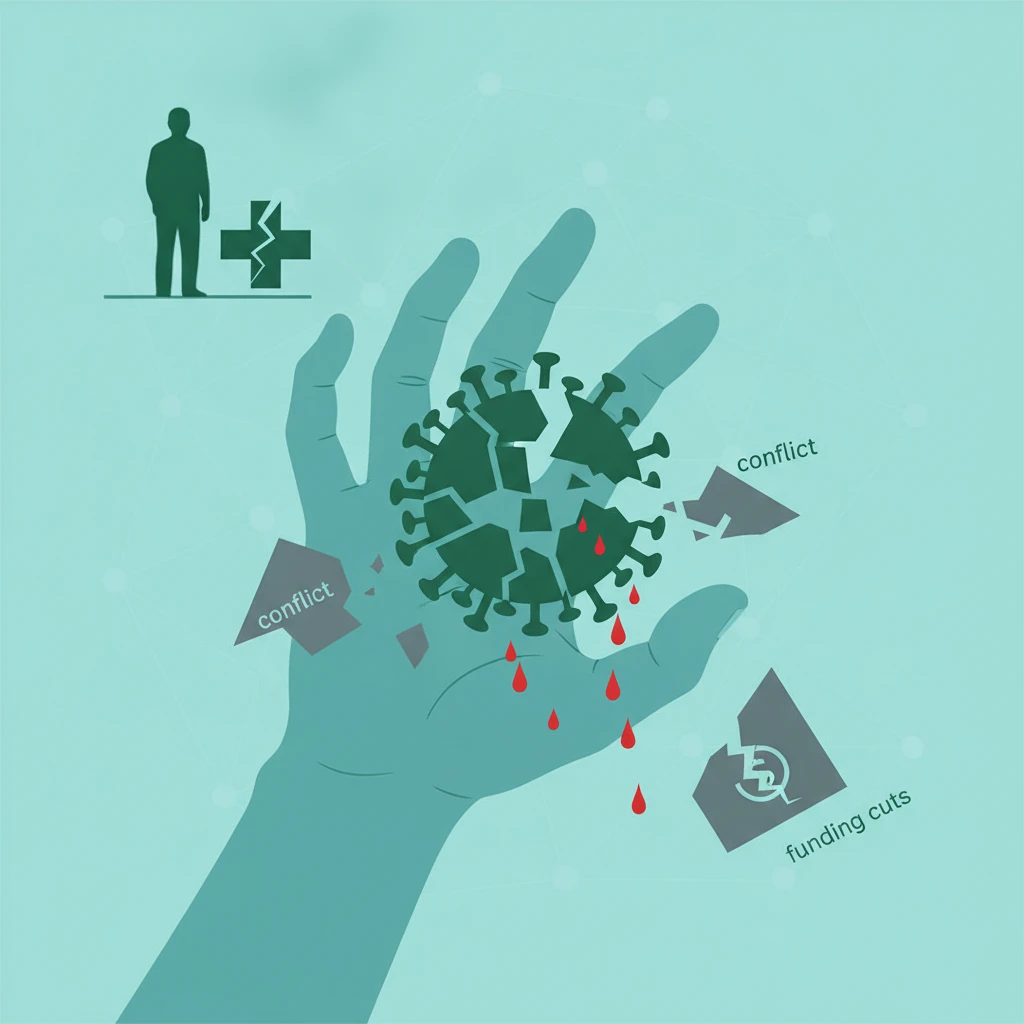

The Democratic Republic of Congo (DRC) has enhanced its capacity to respond to Ebola outbreaks. However, this improved capability is currently under strain due to persistent conflict and reductions in funding, which are testing the nation's ability to manage future outbreaks effectively.1
The Democratic Republic of Congo (DRC) has made progress in strengthening its national response mechanisms for Ebola virus disease. This includes improvements in surveillance, contact tracing, laboratory diagnostics, and rapid deployment of response teams. These advancements are critical given the recurrent nature of Ebola outbreaks in the region.1
Challenges to Response Capacity
Despite these improvements, the sustained capacity of the DRC's Ebola response is being tested by two significant external factors: ongoing conflict and reductions in financial support. Conflict in affected regions frequently disrupts public health interventions, making it difficult for response teams to access communities, conduct surveillance, and deliver essential medical supplies and care. Security concerns can delay or prevent the implementation of critical public health measures, thereby prolonging outbreaks and increasing transmission risks.1
Simultaneously, funding cuts are directly impacting the operational capabilities of the response infrastructure. Reduced financial resources can lead to shortages in personnel, equipment, and logistical support necessary for a comprehensive and timely response. This financial strain compromises the ability to maintain trained staff, procure necessary vaccines and therapeutics, and sustain community engagement efforts, which are vital for effective outbreak control. The combination of these factors creates a precarious situation, potentially undermining the gains made in strengthening the national Ebola response.1
The interplay between conflict and funding cuts creates a complex web of challenges. In conflict zones, healthcare infrastructure is often damaged or destroyed, further limiting access to care and making it harder to implement public health measures. Displaced populations, often living in overcrowded and unsanitary conditions, are particularly vulnerable to infectious disease outbreaks, including Ebola. Monitoring and managing these mobile populations presents a significant logistical hurdle for response teams, exacerbating the risk of wider transmission.
Furthermore, the erosion of trust in government and international organizations, often a byproduct of prolonged conflict, can hinder community engagement efforts. Without community buy-in and cooperation, essential public health interventions such as safe burials, contact tracing, and vaccination campaigns become significantly less effective. Misinformation and rumors, which thrive in environments of distrust, can further complicate response efforts, leading to resistance to public health measures and potentially violent encounters for healthcare workers.
Clinical Implications and Future Directions
The immediate clinical implication of these challenges is a heightened risk of delayed outbreak detection and uncontrolled transmission. When surveillance is hampered by insecurity or lack of resources, cases may go undetected for longer, allowing the virus to spread more widely before intervention. This can lead to larger, more protracted outbreaks with increased morbidity and mortality. From a clinical perspective, this translates to a greater burden on healthcare facilities, potential shortages of specialized medical staff, and increased demand for therapeutics and supportive care, all of which are exacerbated by funding constraints.
Moreover, the repeated disruption of public health services can have long-term consequences for the overall health system in the DRC. The diversion of resources and personnel to emergency Ebola responses, coupled with the destruction of infrastructure, can weaken routine immunization programs, maternal and child health services, and other essential healthcare provisions. This creates a vicious cycle where a weakened health system is less resilient to future shocks, including subsequent Ebola outbreaks or other emerging infectious diseases.
To mitigate these risks, a multi-pronged approach is essential. Firstly, international donors must recognize the critical importance of sustained, predictable funding for public health emergencies, particularly in fragile and conflict-affected states. This funding should not only cover immediate outbreak response but also invest in long-term health system strengthening, including robust surveillance systems, well-equipped laboratories, and a trained healthcare workforce capable of responding to diverse health threats. Secondly, innovative strategies are needed to deliver public health interventions safely and effectively in conflict zones. This may involve leveraging local community networks, negotiating humanitarian corridors, and employing remote monitoring technologies where direct access is limited.
Finally, there is a need for greater integration of peace-building and development efforts with public health initiatives. Addressing the root causes of conflict and fostering stability can create a more conducive environment for public health interventions. Investing in community resilience, promoting social cohesion, and ensuring equitable access to resources can help rebuild trust and empower communities to actively participate in their own health security. The DRC's experience underscores that effective Ebola response is not solely a medical challenge but a complex humanitarian and political endeavor requiring sustained international commitment and a holistic approach.
The situation in the DRC highlights a recurring dilemma in global health: the fragility of public health achievements in the face of geopolitical instability and fluctuating donor priorities. Clinicians on the ground, often working with limited resources, are acutely aware that even the most meticulously planned response strategies can falter when security is compromised or funding dries up. The investment in building local capacity is commendable, but its utility is directly proportional to the sustained support it receives. Without consistent funding, the infrastructure and expertise developed risk becoming dormant, only to be reactivated inefficiently during the next crisis.
For patients and communities, this translates into a heightened risk of prolonged outbreaks and increased morbidity and mortality. When conflict prevents access to care or funding cuts limit the availability of vaccines and treatments, the burden falls disproportionately on those already vulnerable. The global health community, including pharmaceutical companies involved in vaccine and therapeutic development, must recognize that the efficacy of their products is contingent upon an operational delivery system. An effective vaccine is of little use if it cannot reach the population in need due to insecurity or lack of cold chain infrastructure, both of which are impacted by funding and conflict.
This scenario should serve as a stark reminder to international donors and policy makers. Short-term, reactive funding cycles are insufficient for managing endemic and epidemic diseases in complex environments. A more sustainable, predictable funding model is required to fortify public health systems against the inevitable shocks of conflict and economic downturns. The cost of maintaining preparedness is invariably lower than the cost of responding to an uncontrolled outbreak, both in terms of human lives and economic impact. Prioritising long-term investment in health security, even in politically challenging regions, is not merely altruistic; it is a pragmatic necessity for global health stability.
- The Pivot The DRC has developed a more robust Ebola response infrastructure.
- The Data Conflict and funding cuts are identified as primary stressors on this enhanced capacity.
- The Action Continued international support and stable funding are essential to maintain the DRC's Ebola response capabilities.
ART-2026-580
·10/26
Drafted with AI assistance and checked by automated style rules. Not individually read by an editor. This publication is intended for healthcare professionals, researchers, and life science industry professionals. Content is provided for informational and educational purposes only and does not constitute medical advice.

I cover NHS policy, NICE guidance, and the gap between what the evidence says and what gets commissioned. I bring a health economics background to reporting on how health systems make decisions under uncertainty.
Cite This Article
Mistry D, Voss M. DRC ebola response capacity tested by conflict, funding cuts. The Life Science Feed. Published July 27, 2026. Updated October 6, 2026. Accessed October 26, 2026. https://thelifesciencefeed.com/infectious-diseases/covid19/news/drc-ebola-response-capacity-tested-by-conflict-funding-cuts.
Editorial & AI Standards
Content is drafted with AI tools from peer-reviewed, open-access sources such as published trial data, clinical guidelines, and regulatory filings. This article is checked by automated style rules but is not individually read by an editor, so check the cited source before relying on a figure.
Source citations are listed in the References section. This content does not represent the views of any pharmaceutical company, medical device manufacturer, or healthcare provider.
Licence & Rights
© 2026 The Life Science Feed. All rights reserved. Unless otherwise indicated, all content is the property of The Life Science Feed and may not be reproduced, distributed, or transmitted in any form or by any means without prior written permission.
Medical Disclaimer
The information provided on The Life Science Feed is for educational and informational purposes only. It is not intended as a substitute for professional medical advice, diagnosis, or treatment. Always seek the advice of your physician or other qualified healthcare provider regarding any medical condition or treatment decision. Never disregard professional medical advice or delay in seeking it because of something you have read on this website.
References
1. Abbara A, Adeyemi Lawal M. DRC has strengthened its response to Ebola - but conflict and funding cuts are testing its capacity. BMJ.







