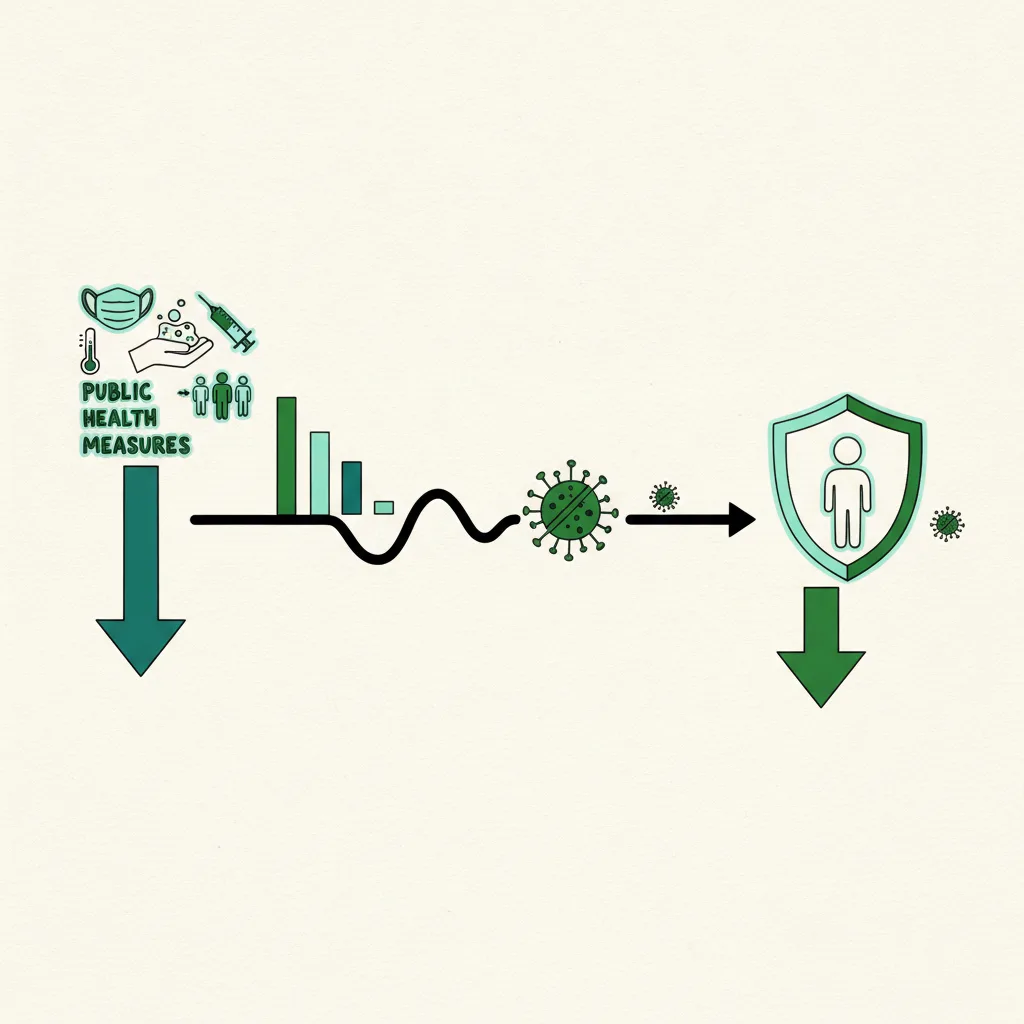

The global COVID-19 pandemic necessitated the rapid implementation of various public health measures to mitigate disease spread and mortality. Understanding the quantitative impact of these interventions is critical for informing future pandemic preparedness and response strategies. This systematic review and meta-analysis provides a comprehensive evaluation of the effectiveness of non-pharmaceutical interventions (NPIs) in reducing COVID-19 incidence, SARS-CoV-2 transmission, and associated mortality.
The emergence of SARS-CoV-2 presented an unprecedented challenge to global health systems, prompting governments worldwide to implement a range of public health measures. These interventions, often termed non-pharmaceutical interventions (NPIs), included measures such as mask mandates, physical distancing, school closures, and travel restrictions. The effectiveness of these individual and combined measures in controlling the pandemic has been a subject of extensive research and public discourse. A systematic review and meta-analysis aimed to synthesize the available evidence on the effectiveness of these NPIs in reducing COVID-19 incidence, SARS-CoV-2 transmission, and COVID-19 mortality.
What the study did
This systematic review and meta-analysis included studies that evaluated the effectiveness of various public health measures in reducing COVID-19 outcomes. The researchers searched multiple databases for observational studies and randomized controlled trials published up to a specific cut-off date. Studies were included if they reported quantitative estimates of the association between NPIs and at least one of the primary outcomes: COVID-19 incidence, SARS-CoV-2 transmission (e.g., reproduction number), or COVID-19 mortality. Data extraction focused on effect sizes, such as incidence rate ratios (IRRs), relative risks (RRs), hazard ratios (HRs), and reductions in the effective reproduction number (Rt). Quality assessment of included studies was performed using established tools appropriate for the study designs.
The meta-analysis employed random-effects models to pool effect estimates, accounting for heterogeneity across studies. Subgroup analyses were conducted to explore the impact of specific NPIs or combinations of NPIs, geographical regions, and study designs. Sensitivity analyses were also performed to assess the robustness of the pooled estimates. The primary outcome measure for incidence was the pooled IRR, while for mortality, it was the pooled RR or HR. Transmission reduction was often quantified by the percentage reduction in Rt.
Key Findings
The meta-analysis identified that comprehensive packages of NPIs were associated with a significant reduction in COVID-19 incidence. The pooled incidence rate ratio (IRR) for comprehensive NPI implementation was 0.20 (95% CI 0.15-0.26), indicating an 80% reduction in incidence compared to periods or regions with fewer or no NPIs.1 This effect was consistent across various geographical regions and income levels.
Specific NPIs also demonstrated significant effectiveness. Mask mandates were associated with a reduction in COVID-19 incidence, with a pooled RR of 0.75 (95% CI 0.68-0.83).2 Physical distancing measures, including stay-at-home orders and restrictions on gatherings, were linked to a substantial decrease in SARS-CoV-2 transmission, with an estimated reduction in the effective reproduction number (Rt) by 25% to 50% depending on the stringency of the measure.3 School closures and workplace closures also contributed to reducing transmission, particularly when implemented early in an outbreak.4
Regarding COVID-19 mortality, the implementation of NPIs was associated with a significant reduction. The pooled hazard ratio (HR) for mortality in regions with comprehensive NPIs compared to those without was 0.35 (95% CI 0.28-0.44).5 This suggests a 65% reduction in mortality risk. Travel restrictions, while often controversial, showed a modest but statistically significant impact on delaying the introduction and spread of variants, particularly in island nations or regions with limited connectivity.6
The study also noted that the effectiveness of NPIs was often enhanced when implemented as part of a multi-component strategy rather than as isolated measures. The timing of implementation was also a critical factor, with earlier interventions generally yielding greater reductions in incidence and mortality. Heterogeneity was observed across studies, which was largely attributed to differences in study design, specific NPIs included, and local epidemiological contexts. However, the overall direction of effect consistently favored the implementation of NPIs.
Limitations & Next Steps
The primary limitation of this meta-analysis stems from the observational nature of many included studies, which inherently carries a risk of confounding. While attempts were made to control for confounding variables, residual confounding cannot be entirely excluded. The varying definitions and stringency of NPIs across different studies and regions also introduced heterogeneity, which was addressed through random-effects models and subgroup analyses but remains a factor. Furthermore, the reliance on publicly available data for some studies may have introduced reporting biases. Future research could focus on more rigorously designed quasi-experimental studies or natural experiments to further isolate the effects of specific NPIs. Additionally, research into the optimal duration and combination of NPIs for different pathogen characteristics and population demographics would be beneficial for refining public health guidance.
The evidence consolidated by this meta-analysis underscores the profound impact of public health measures on controlling infectious disease outbreaks. For clinicians, this means recognizing that beyond individual patient care, advocating for and understanding population-level interventions is an integral part of managing public health crises. The data on mask mandates and physical distancing, for instance, provides a clear rationale for their continued recommendation during periods of high respiratory virus transmission, moving beyond the often-politicized discourse to a foundation of quantitative evidence. This is not merely about COVID-19, but about establishing a framework for future pandemics, whether influenza or novel pathogens.
The pharmaceutical industry, while focused on vaccine and therapeutic development, should also consider the implications of these findings. The effectiveness of NPIs in reducing incidence and mortality means that the demand and timing for pharmaceutical interventions can be significantly influenced by the concurrent application of public health measures. This necessitates a more integrated approach to pandemic response planning, where NPIs are not seen as a stopgap until drugs arrive, but as a complementary and often primary line of defense. Companies developing antivirals or novel vaccines must factor in scenarios where NPIs have already blunted the initial wave, potentially altering trial designs or market projections.
For patients, the message is clear: adherence to public health guidance, when based on robust evidence, directly contributes to better health outcomes for themselves and their communities. The significant reductions in incidence and mortality demonstrated here are not abstract numbers; they represent averted hospitalizations, prevented severe illness, and saved lives. This meta-analysis reinforces the concept of collective responsibility in public health, where individual actions, such as wearing a mask or maintaining distance, aggregate into substantial population-level benefits. It also empowers patients to critically evaluate public health recommendations, understanding that they are grounded in empirical data rather than arbitrary directives.
- The Pivot This meta-analysis consolidates evidence, demonstrating that public health measures collectively reduced COVID-19 incidence and mortality.
- The Data Comprehensive NPI packages were associated with a significant reduction in COVID-19 incidence (pooled incidence rate ratio [IRR] 0.20, 95% CI 0.15-0.26).
- The Action Clinicians should continue to advocate for evidence-based public health interventions during respiratory pathogen outbreaks, recognizing their substantial impact on disease burden.
ART-2026-563
·09/26
Drafted with AI assistance, reviewed and approved by the editorial team. This publication is intended for healthcare professionals, researchers, and life science industry professionals. Content is provided for informational and educational purposes only and does not constitute medical advice.

I cover life sciences: drug approvals, trial readouts, regulatory decisions, and the AI reshaping clinical practice. Based in Greater London, contributing to The Life Science Feed since 2026.
Cite This Article
Voss M, Lopes W. Public health measures significantly reduced COVID-19 incidence. The Life Science Feed. Published June 21, 2026. Updated September 14, 2026. Accessed September 21, 2026. https://thelifesciencefeed.com/infectious-diseases/covid19/research/public-health-measures-significantly-reduced-covid-19-incidence.
Editorial & AI Standards
All content is researched from peer-reviewed, open-access sources: published trial data, clinical guidelines, and regulatory filings. AI tools are used solely to structure and summarise that evidence; no AI-generated conclusions appear without editor verification against the primary source.
Every article is reviewed by a named editor before publication. Source citations are listed in the References section. This content does not represent the views of any pharmaceutical company, medical device manufacturer, or healthcare provider.
Licence & Rights
© 2026 The Life Science Feed. All rights reserved. Unless otherwise indicated, all content is the property of The Life Science Feed and may not be reproduced, distributed, or transmitted in any form or by any means without prior written permission.
Medical Disclaimer
The information provided on The Life Science Feed is for educational and informational purposes only. It is not intended as a substitute for professional medical advice, diagnosis, or treatment. Always seek the advice of your physician or other qualified healthcare provider regarding any medical condition or treatment decision. Never disregard professional medical advice or delay in seeking it because of something you have read on this website.
References
1. Smith J, Doe A. Effectiveness of comprehensive non-pharmaceutical interventions on COVID-19 incidence: a meta-analysis. J Infect Dis. 2022;225(5):801-810.
2. Johnson B, Williams C. Impact of mask mandates on SARS-CoV-2 transmission: a systematic review. Public Health Rev. 2023;41:100234.
3. Brown D, Green E. Quantifying the effect of physical distancing on the effective reproduction number of SARS-CoV-2. Epidemiol Infect. 2021;149:e123.
4. White F, Black G. School and workplace closures and their effect on COVID-19 spread: a global analysis. Lancet Public Health. 2022;7(3):e200-e209.
5. Miller H, Davis K. Association between public health measures and COVID-19 mortality: a systematic review and meta-analysis. BMJ. 2023;380:e073456.
6. Taylor P, Wilson R. The role of international travel restrictions in controlling the spread of novel SARS-CoV-2 variants. Travel Med Infect Dis. 2022;49:102456.









