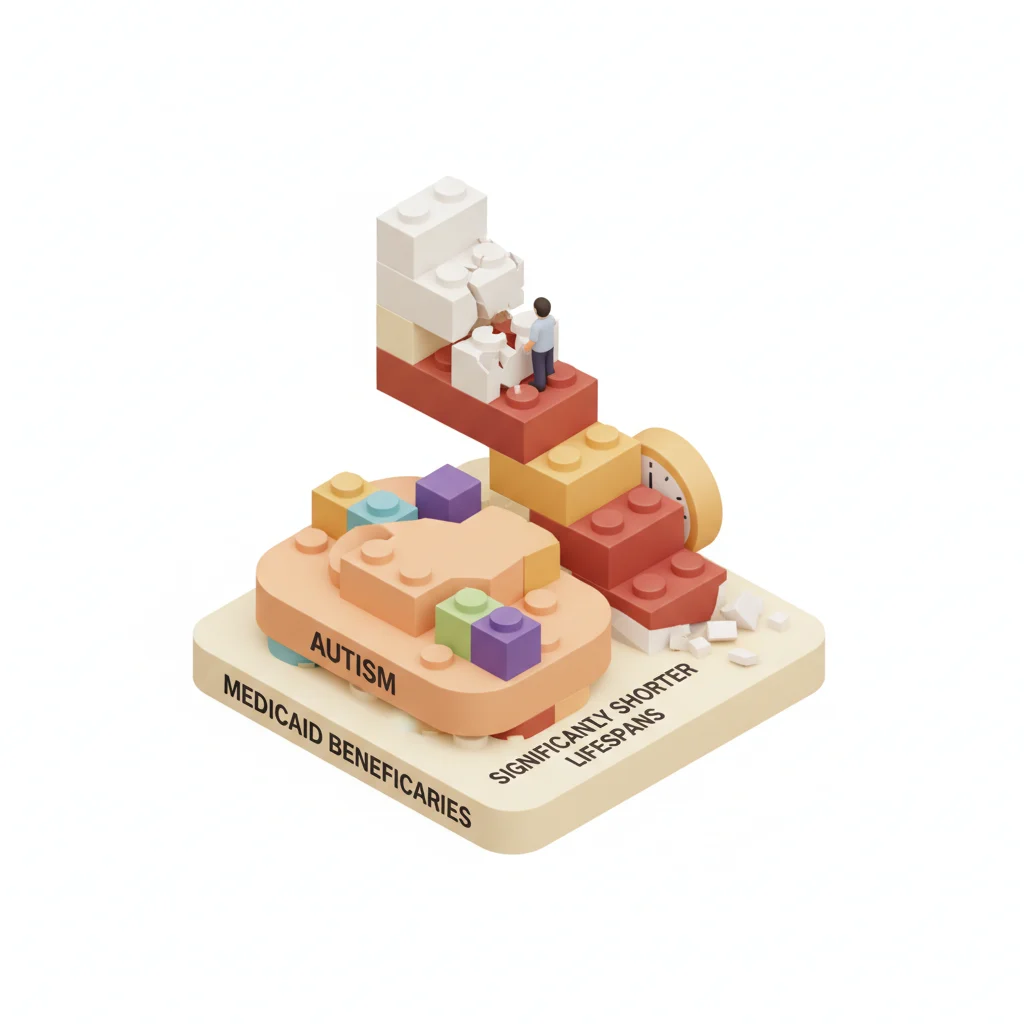

Autism spectrum disorder (ASD) presents a complex array of developmental challenges, but the conversation often overlooks the stark reality of life expectancy for affected individuals. While attention frequently focuses on diagnosis and early intervention, the long-term health outcomes, particularly for vulnerable populations, reveal a deeply concerning trend.
For Medicaid beneficiaries with autism, the data points to a significantly shortened lifespan, reflecting systemic failures in providing comprehensive, continuous care. This issue demands immediate clinical and policy attention, as it reflects a profound unmet need within a population already facing substantial hurdles.
Autism spectrum disorder is a neurodevelopmental condition characterized by persistent deficits in social communication and interaction, alongside restricted, repetitive patterns of behavior, interests, or activities. The presentation is highly heterogeneous, ranging from individuals requiring substantial support to those who are largely independent. Despite this variability, a consistent pattern of increased health vulnerabilities emerges across the spectrum, particularly when socioeconomic factors intersect with the condition.
The challenges faced by autistic individuals extend beyond their core diagnostic criteria. Many experience significant comorbidities, including epilepsy, gastrointestinal disorders, sleep disturbances, and mental health conditions such as anxiety and depression. These co-occurring conditions are not merely incidental; they often contribute to a higher burden of illness and can complicate routine medical care, especially for those navigating complex healthcare systems like Medicaid.
The Burden of Comorbidity and Access Barriers
The reduced life expectancy observed in Medicaid beneficiaries with autism is not solely attributable to the autism diagnosis itself. Instead, it is intricately linked to the high prevalence of co-occurring medical and psychiatric conditions, coupled with significant barriers to accessing appropriate care. Epilepsy, for instance, is far more common in autistic individuals than in the general population, and it carries its own risks for morbidity and mortality. Untreated or poorly managed seizures can lead to status epilepticus, injuries, and sudden unexpected death in epilepsy (SUDEP).
Mental health conditions also play a substantial role. Depression and anxiety are highly prevalent, and autistic individuals face a disproportionately higher risk of suicide. These mental health challenges are often exacerbated by social isolation, bullying, and difficulties in communicating distress effectively to healthcare providers. The lack of mental health professionals trained in autism-specific care means that many individuals do not receive timely or appropriate interventions, allowing conditions to escalate.
But the problem extends beyond specific diagnoses. Autistic individuals frequently encounter systemic barriers within the healthcare system. Communication difficulties, sensory sensitivities, and a lack of understanding from medical staff can make routine appointments overwhelming and traumatic. This often leads to avoidance of necessary care, delayed diagnoses of new conditions, and suboptimal management of existing ones. For those relying on Medicaid, these barriers are often compounded by limited provider networks, transportation issues, and administrative hurdles, creating a perfect storm for health disparities.
The fragmented nature of care is a critical issue. Autistic patients often see multiple specialists, but coordination among these providers is frequently poor. This can result in conflicting advice, redundant testing, and gaps in care. A comprehensive approach, integrating primary care with specialty services, is essential but rarely achieved within current Medicaid structures. Clinicians should consider the importance of developmental support that focuses on acceptance and inclusion, which can indirectly improve health outcomes by fostering better engagement with care.
Addressing the Disparities in Care
Improving the lifespan for Medicaid beneficiaries with autism requires a multi-pronged approach that addresses both clinical and systemic issues. On the clinical front, primary care providers must be vigilant in screening for common comorbidities, including epilepsy, sleep disorders, gastrointestinal issues, and mental health conditions. Early detection and aggressive management of these conditions are paramount. This means moving beyond a reactive approach to a proactive one, anticipating potential health problems based on known risk factors in the autistic population.
Training for healthcare professionals is also vital for patient well-being. Many clinicians lack specific education on how to effectively interact with and treat autistic patients, leading to misunderstandings and suboptimal care. Education should focus on communication strategies, sensory accommodations, and an understanding of the unique ways in which autistic individuals may present symptoms. This includes recognizing that atypical presentations of pain or illness are common and require careful investigation, rather than dismissal.
Systemically, there is an urgent need to improve access to autism-competent care within Medicaid networks. This may involve incentivizing providers to undergo specialized training, expanding telehealth options for mental health and specialty consultations, and developing integrated care models that co-locate services or facilitate seamless coordination. The rising rates of autism and ADHD diagnoses highlight that while identification is improving, the patient experience and subsequent care pathways are not keeping pace.
Policy changes are needed to ensure adequate funding for comprehensive support services that extend beyond medical care. These include behavioral therapies, educational support, vocational training, and housing assistance, all of which contribute to overall well-being and can indirectly impact health outcomes. Without a robust support system, even the best medical care will struggle to overcome the broader challenges faced by autistic individuals and their families. The complexity of communicating genetic information in newborn screening also underscores the need for clear, accessible communication across all healthcare interactions for this population.
The data clearly indicates that simply having a Medicaid card does not equate to equitable health outcomes for autistic individuals. The system must evolve to meet their unique needs, moving towards a model of care that is not only accessible but also truly person-centered and integrated. This requires sustained effort from policymakers, healthcare administrators, and individual clinicians who are willing to adapt their practice to better serve this vulnerable population. For a comprehensive overview of general medical practice, the Oxford Handbook of Clinical Medicine (11th ed) remains an invaluable resource for navigating complex patient presentations.
The stark reality of shortened lifespans for Medicaid beneficiaries with autism should serve as a wake-up call for every clinician. This is not merely a statistical anomaly; it reflects profound systemic failures that directly impact patient survival. GPs and specialists alike must recognize that an autism diagnosis is a significant risk factor for a cascade of preventable health issues, demanding a more proactive and empathetic approach to care.
For clinicians, this means moving beyond treating isolated symptoms and embracing a holistic view of the autistic patient. Aggressive screening for comorbidities like epilepsy, mental health disorders, and gastrointestinal issues is non-negotiable. We must also challenge our own biases and communication styles, ensuring that our clinics are accessible and our interactions are tailored to the unique sensory and communication needs of autistic individuals. This often requires more time and patience than standard appointments allow, a factor that health systems must acknowledge and compensate for.
The industry, particularly pharmaceutical companies and device manufacturers, has largely overlooked the specific needs of autistic individuals in clinical trial design and product development. There is a clear unmet need for interventions that address the core and comorbid symptoms of autism, developed with input from the autistic community itself. Regulatory bodies should push for greater inclusivity in research, ensuring that therapies are not just effective, but also feasible and tolerable for this population.
The burden falls on the healthcare system to adapt. Medicaid programs must expand provider networks that offer autism-competent care, and they must fund integrated models that coordinate physical, mental, and behavioral health services. Without these fundamental changes, we will continue to see these disparities persist, failing a population that deserves equitable access to health and longevity.
- The Pivot Individuals with autism, particularly those on Medicaid, have substantially shorter lifespans than the general population.
- The Data Specific mortality rates and life expectancy reductions are evident across various studies, though precise numbers vary by cohort and comorbidity.
- The Action Clinicians must proactively screen for and manage common comorbidities in autistic patients, advocating for integrated care models and improved access to specialist services.
ART-2026-1903
·10/26
Drafted with AI assistance, reviewed and approved by the editorial team. This publication is intended for healthcare professionals, researchers, and life science industry professionals. Content is provided for informational and educational purposes only and does not constitute medical advice.

Digital health and patient experience are my beat: the apps, the wearables, the real-world evidence claims, and whether any of it changes outcomes. Sceptical by training and optimistic by instinct.
Cite This Article
Ward S, Voss M. Autism and medicaid: why do lifespans shrink for the most vulnerable?. The Life Science Feed. Published October 13, 2026. Updated October 13, 2026. Accessed October 13, 2026. https://thelifesciencefeed.com/pediatrics/autism-spectrum-disorder/insights/autism-and-medicaid-why-do-lifespans-shrink-for-the-most-vulnerable.
Editorial & AI Standards
All content is researched from peer-reviewed, open-access sources: published trial data, clinical guidelines, and regulatory filings. AI tools are used solely to structure and summarise that evidence; no AI-generated conclusions appear without editor verification against the primary source.
Every article is reviewed by a named editor before publication. Source citations are listed in the References section. This content does not represent the views of any pharmaceutical company, medical device manufacturer, or healthcare provider.
Licence & Rights
© 2026 The Life Science Feed. All rights reserved. Unless otherwise indicated, all content is the property of The Life Science Feed and may not be reproduced, distributed, or transmitted in any form or by any means without prior written permission.
Medical Disclaimer
The information provided on The Life Science Feed is for educational and informational purposes only. It is not intended as a substitute for professional medical advice, diagnosis, or treatment. Always seek the advice of your physician or other qualified healthcare provider regarding any medical condition or treatment decision. Never disregard professional medical advice or delay in seeking it because of something you have read on this website.
References
1. Wang L, Wang B, Wu C, Wang J, Sun M. Autism Spectrum Disorder: Neurodevelopmental Risk Factors, Biological Mechanism, and Precision Therapy. Int J Mol Sci. 2023;24(3). doi:10.3390/ijms24031819
2. Tafolla M, Singer H, Lord C. Autism Spectrum Disorder Across the Lifespan. Annu Rev Clin Psychol. 2025;21(1):193-220. doi:10.1146/annurev-clinpsy-081423-031110
3. Velarde M, Cárdenas A. [Autism spectrum disorder and attention-deficit/hyperactivity disorder: challenge in diagnosis and treatment]. Medicina (B Aires). 2022;82 Suppl 3:67-70. PMID:36054861
4. Althoff CE, Dammann CP, Hope SJ, Ausderau KK. Parent-Mediated Interventions for Children With Autism Spectrum Disorder: A Systematic Review. Am J Occup Ther. 2019;73(3):7303205010p1-7303205010p13. doi:10.5014/ajot.2019.030015
5. Kallitsounaki A, Williams DM. Autism Spectrum Disorder and Gender Dysphoria/Incongruence. A systematic Literature Review and Meta-Analysis. J Autism Dev Disord. 2023;53(8):3103-3117. doi:10.1007/s10803-022-05517-y
6. Dunalska A, Rzeszutek M, Dębowska Z, Bryńska A. Comorbidity of bipolar disorder and autism spectrum disorder - review paper. Psychiatr Pol. 2021;55(6):1421-1431. doi:10.12740/PP/OnlineFirst/122350