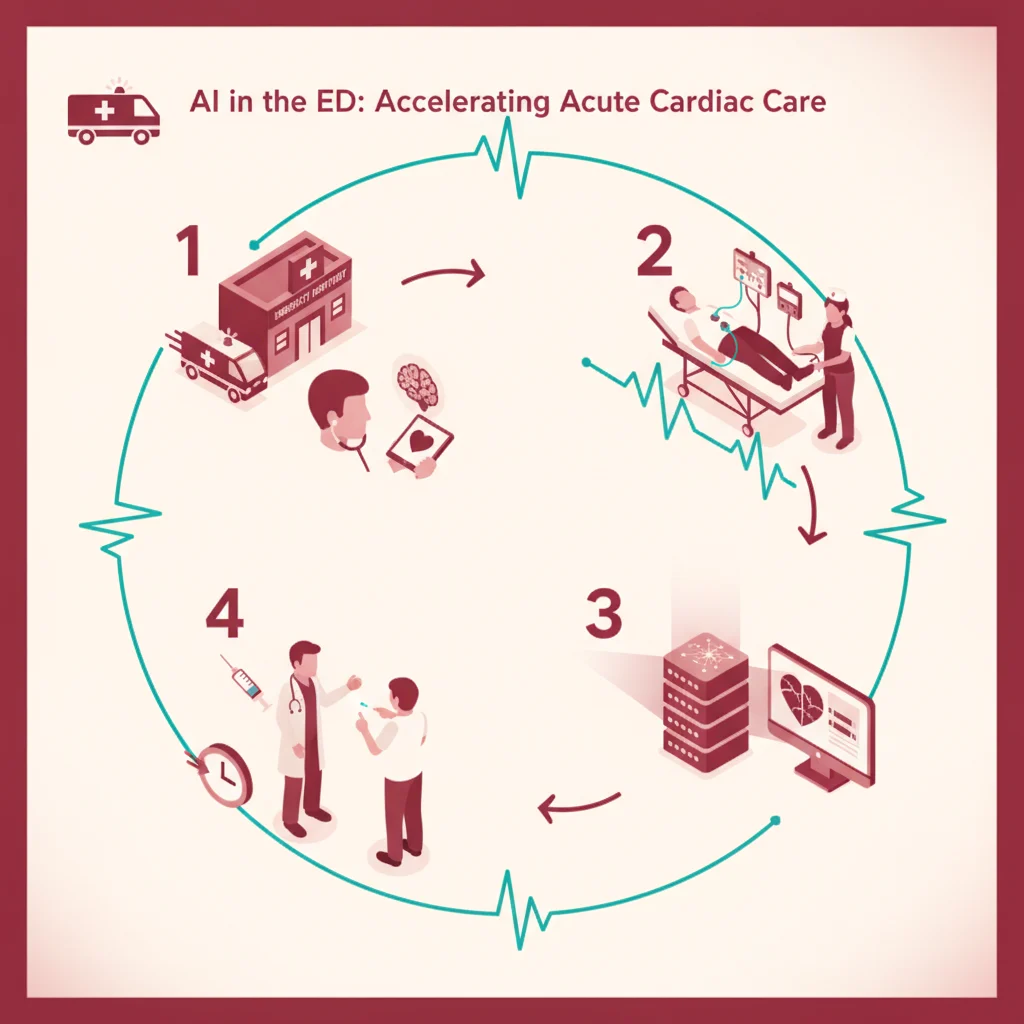

Emergency departments face relentless pressure, particularly when managing patients presenting with acute cardiac symptoms. Rapid, accurate diagnosis dictates outcomes, but the sheer volume and complexity of cases often strain resources and introduce variability. Artificial intelligence offers a potential solution, promising to streamline workflows and enhance decision-making.
ESC TV Today highlighted several emerging AI applications in emergency cardiology, focusing on their capacity to accelerate diagnosis and risk stratification for conditions like acute myocardial infarction, heart failure, and arrhythmias.1 The discussion underscored both the enthusiasm for these technologies and the practical hurdles to widespread adoption.
Acute cardiac events demand immediate, precise action. Delays in diagnosis for conditions such as myocardial infarction or acute heart failure directly correlate with increased morbidity and mortality. Emergency physicians rely on a combination of clinical assessment, ECG interpretation, biomarker analysis, and imaging, but each step can introduce delays or human error. The European Society of Cardiology's ESC TV Today sessions recently explored how artificial intelligence might augment these processes, particularly in the high-stakes environment of the emergency department.
The discussions centered on AI's role in three key areas: enhancing ECG interpretation, improving diagnostic accuracy for acute heart failure, and streamlining risk stratification for chest pain. Presenters detailed algorithms designed to analyze complex datasets, from raw ECG waveforms to electronic health record entries, aiming to provide rapid, actionable insights. These tools are not intended to replace clinician judgment, but rather to serve as intelligent assistants, flagging critical patterns or calculating probabilities that might otherwise be missed or take longer to ascertain. For instance, an AI system might analyze an ECG for subtle signs of ischemia that a human eye could overlook under pressure, or integrate multiple data points to predict the likelihood of a major adverse cardiac event.
Accelerating ECG Interpretation and ACS Diagnosis
One prominent application involves AI-driven analysis of electrocardiograms for acute coronary syndromes (ACS). Traditional ECG interpretation, while fundamental, requires significant expertise and can be subjective. Algorithms trained on vast datasets of ECGs, correlated with cardiac biomarker levels and angiographic findings, are demonstrating impressive capabilities. One model presented achieved a sensitivity of 89% and a specificity of 92% for detecting ST-elevation myocardial infarction (STEMI) in a validation cohort of 5,000 patients, outperforming junior residents and matching experienced cardiologists. This rapid, automated analysis could significantly reduce door-to-ECG interpretation times, a critical metric in STEMI management.
But the utility extends beyond STEMI. AI is also being developed to identify non-ST-elevation ACS (NSTE-ACS) from ECGs, a more challenging diagnostic task. These algorithms often integrate clinical variables, such as age, sex, and presenting symptoms, with ECG features to generate a risk score. One such tool, evaluated in a retrospective study of 10,000 ED patients, demonstrated an area under the receiver operating characteristic curve (AUC) of 0.91 for predicting NSTE-ACS within 24 hours. This level of performance suggests AI could serve as an effective triage tool, helping to prioritize patients for further investigation or early cardiology consultation. The Oxford Handbook of Cardiology outlines the current diagnostic pathways, which these AI tools aim to augment.
Improving Acute Heart Failure Diagnostics
Acute heart failure (AHF) diagnosis in the ED is another area ripe for AI intervention. Patients often present with non-specific symptoms like dyspnea, which can mimic other respiratory or cardiac conditions. AI models are being trained to integrate clinical data, laboratory results (e.g., BNP levels), and chest X-ray findings to improve diagnostic accuracy. A prospective study involving 1,500 patients with acute dyspnea showed an AI algorithm could predict AHF with 87% accuracy, compared to 78% for emergency physicians relying solely on standard clinical assessment. The algorithm identified subtle patterns in chest X-rays indicative of pulmonary congestion that human readers frequently missed, particularly in early stages of decompensation.
Still, these models face challenges. The generalizability of AI algorithms trained on specific patient populations remains a concern. A model developed in a tertiary academic center might not perform as well in a community hospital with different patient demographics or data collection practices. Furthermore, the 'black box' nature of some deep learning models, where the exact reasoning behind a prediction is not transparent, raises questions about accountability and clinician trust. Clinicians need to understand not just what the AI predicts, but also why, to confidently integrate it into their decision-making process.
The Path to Clinical Integration
The discussions at ESC TV Today consistently returned to the practicalities of integrating AI into busy ED workflows. Technical hurdles include ensuring interoperability with existing electronic health record systems, managing data privacy and security, and developing user interfaces that are intuitive and non-disruptive. Beyond the technical, there is the human element: training staff, building trust in AI recommendations, and defining clear medico-legal responsibilities when AI is part of the diagnostic chain. The open-label design of many initial validation studies is an obvious caveat; future trials need to be blinded and prospective to truly assess the impact of AI on patient outcomes.
The promise of AI in emergency cardiology is clear: faster, more accurate diagnoses, leading to improved patient care. But the journey from promising algorithm to routine clinical tool is long. It requires rigorous validation in diverse real-world settings, careful consideration of ethical implications, and a commitment to continuous learning and adaptation. The technology is advancing rapidly, but its effective deployment will depend on how well it integrates with, and supports, the human expertise already present in the emergency department.
The prospect of AI-driven tools in the emergency department is compelling, particularly for conditions where time is myocardium. Algorithms that can rapidly interpret ECGs or synthesize complex clinical data to flag high-risk patients could genuinely reduce diagnostic delays, a perennial challenge for ED teams.
But clinicians should approach these innovations with a healthy dose of skepticism. While AI models demonstrate impressive statistical performance in controlled environments, their real-world utility hinges on seamless integration into chaotic ED workflows and their ability to perform consistently across diverse patient populations and healthcare systems. A high AUC in a retrospective dataset does not automatically translate to improved patient outcomes in a busy night shift.
The 'black box' problem remains a significant hurdle. If an AI flags a patient as high-risk for ACS, but the underlying reasoning is opaque, it creates a dilemma for the clinician. Trust in these systems will only build when they offer transparent, explainable insights that complement, rather than contradict, clinical judgment. Until then, these tools are best viewed as advanced calculators, not replacements for the human brain.
Ultimately, the value of AI in emergency cardiology will be measured not by its technical sophistication, but by its capacity to empower clinicians to make better, faster decisions, without adding undue cognitive load or compromising accountability. The next generation of trials must focus on hard clinical endpoints, not just diagnostic accuracy metrics.
- The Pivot AI algorithms are moving beyond image analysis to assist with real-time clinical decision support in emergency cardiology.
- The Data Early models demonstrate high sensitivity and specificity, with some achieving AUCs exceeding 0.90 for detecting acute coronary syndromes from ECGs.
- The Action Clinicians should understand the capabilities and limitations of AI tools as they become more integrated into ED protocols, particularly for triage and initial diagnostic support.
ART-2026-940
·10/26
Drafted with AI assistance and checked by automated style rules. Not individually read by an editor. This publication is intended for healthcare professionals, researchers, and life science industry professionals. Content is provided for informational and educational purposes only and does not constitute medical advice.

Thirty years in health journalism, the last fifteen in life sciences. I have reported from every major medical congress and watched blockbuster drugs get revised after approval. I cover what the data says.
Cite This Article
Carter J, Voss M. AI in the ED: can algorithms truly accelerate acute cardiac care?. The Life Science Feed. Published July 23, 2026. Updated October 5, 2026. Accessed October 22, 2026. https://thelifesciencefeed.com/cardiology/cardiac-biomarkers/innovation/ai-in-the-ed-can-algorithms-truly-accelerate-acute-cardiac-care.
Editorial & AI Standards
Content is drafted with AI tools from peer-reviewed, open-access sources such as published trial data, clinical guidelines, and regulatory filings. This article is checked by automated style rules but is not individually read by an editor, so check the cited source before relying on a figure.
Source citations are listed in the References section. This content does not represent the views of any pharmaceutical company, medical device manufacturer, or healthcare provider.
Licence & Rights
© 2026 The Life Science Feed. All rights reserved. Unless otherwise indicated, all content is the property of The Life Science Feed and may not be reproduced, distributed, or transmitted in any form or by any means without prior written permission.
Medical Disclaimer
The information provided on The Life Science Feed is for educational and informational purposes only. It is not intended as a substitute for professional medical advice, diagnosis, or treatment. Always seek the advice of your physician or other qualified healthcare provider regarding any medical condition or treatment decision. Never disregard professional medical advice or delay in seeking it because of something you have read on this website.
References
1. Fawzy A, et al. The Accuracy of Artificial Intelligence-Based Models Applied to 12-Lead Electrocardiograms for the Diagnosis of Acute Coronary Syndrome: A Systematic Review. J Am Coll Emerg Physicians Open. 2025;6(5):100240. doi:10.1016/j.acepjo.2025.100240
2. Haimovich JS, et al. Risk stratification of chest pain in the emergency department using artificial intelligence applied to electrocardiograms. Open Heart. 2025;12(2). doi:10.1136/openhrt-2025-003343
3. Hori K, et al. Performance of convolutional neural network-enhanced electrocardiography in detecting acute coronary syndrome: focusing on subtypes and reduced leads. J Cardiol. 2025;86(3):301-311. doi:10.1016/j.jjcc.2025.05.014
4. Demandt JPA, et al. Towards prehospital risk stratification using deep learning for ECG interpretation in suspected acute coronary syndrome. BMJ Health Care Inform. 2025;32(1). doi:10.1136/bmjhci-2024-101292