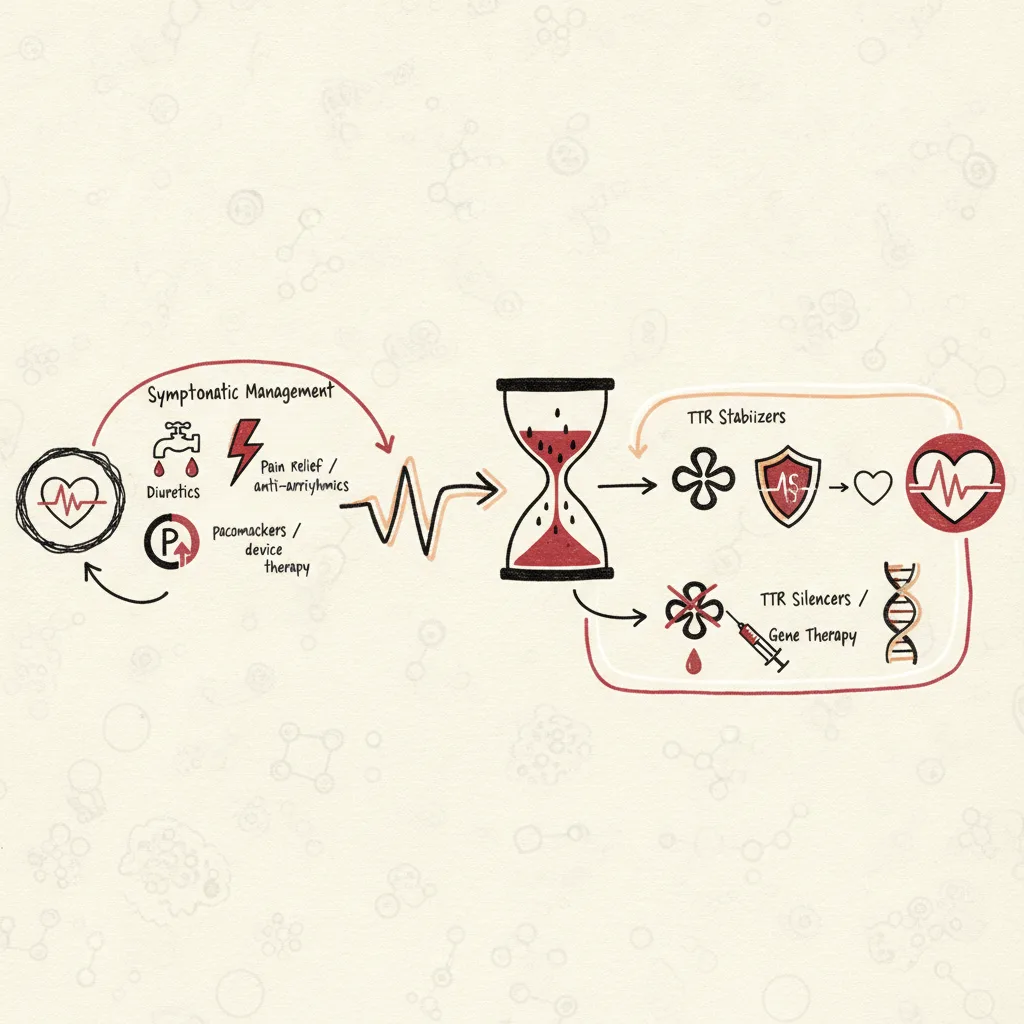

Amyloid transthyretin cardiomyopathy (ATTR-CM) historically presented a significant clinical challenge, with management largely confined to symptomatic relief and supportive care. The immediate takeaway for clinicians is that the landscape has fundamentally changed, with specific therapies now available that address the underlying pathophysiology, offering improved patient outcomes.
ATTR-CM is a progressive and often fatal cardiomyopathy caused by the misfolding and extracellular deposition of transthyretin (TTR) protein as amyloid fibrils in the myocardium. This deposition leads to restrictive cardiomyopathy, heart failure, and arrhythmias. Historically, treatment focused on managing the symptoms of heart failure, such as diuretics for fluid overload and antiarrhythmics for dysrhythmias. However, these approaches did not address the root cause of the disease, leading to a poor prognosis with a median survival of approximately 2 to 6 years from diagnosis, depending on the subtype (wild-type or hereditary).
Evolution of ATTR-CM Therapy
The understanding of ATTR-CM pathophysiology has advanced significantly, leading to the development of therapies that target the production or stability of the TTR protein. The first major therapeutic breakthrough involved TTR stabilisers. These agents bind to circulating TTR, preventing its dissociation into monomers, which is a prerequisite for misfolding and amyloid fibril formation. This mechanism reduces the deposition of new amyloid fibrils and can slow disease progression. Clinical trials evaluating these stabilisers demonstrated a reduction in all-cause mortality and cardiovascular-related hospitalisations compared to placebo. For example, a pivotal study showed a 30% reduction in the composite of all-cause mortality and cardiovascular-related hospitalisations (HR 0.70, 95% CI 0.58-0.83, P < 0.001) over 30 months in patients with ATTR-CM.
Following the introduction of TTR stabilisers, further advancements emerged with gene-silencing therapies. These treatments target the messenger RNA (mRNA) responsible for TTR production in the liver, thereby reducing the synthesis of both wild-type and mutant TTR protein. By significantly lowering circulating TTR levels, these therapies aim to halt or even reverse amyloid deposition. Studies of these agents have shown substantial reductions in serum TTR levels, leading to improvements in neurological function in patients with ATTR polyneuropathy, and are being investigated for their cardiac benefits in ATTR-CM. The efficacy of these agents in reducing TTR production has been demonstrated with reductions of up to 80-90% in circulating TTR levels.
The current therapeutic landscape for ATTR-CM therefore includes both TTR stabilisers and gene-silencing agents. The choice of therapy often depends on the specific subtype of ATTR-CM (hereditary versus wild-type), the predominant organ involvement (cardiac versus neurological), and patient comorbidities. Early diagnosis is increasingly recognised as critical, as initiating disease-modifying therapy before extensive amyloid deposition occurs is associated with better long-term outcomes. Diagnostic pathways have also improved, with non-invasive techniques such as technetium-99m pyrophosphate (PYP) scintigraphy now widely used to diagnose ATTR-CM without the need for endomyocardial biopsy in many cases, particularly in the absence of a monoclonal gammopathy.
The shift in ATTR-CM management from palliative care to disease modification represents a significant advancement for patients. For years, clinicians were limited to managing the symptoms of a relentlessly progressive disease, often leading to frustration for both the patient and the care team. The availability of TTR stabilisers and gene-silencing therapies means that for the first time, we can intervene in the disease process itself, offering the prospect of improved quality of life and extended survival. This necessitates a heightened awareness among general practitioners and specialists to consider ATTR-CM in patients presenting with unexplained heart failure with preserved ejection fraction (HFpEF), particularly those with concomitant carpal tunnel syndrome, spinal stenosis, or peripheral neuropathy.
From an industry perspective, the development of these targeted therapies highlights the value of understanding disease pathophysiology at a molecular level. The investment in rare disease research, while often high-risk, has yielded substantial clinical benefits in this area. The competitive landscape among pharmaceutical companies developing ATTR-CM treatments is driving further innovation, with ongoing research into novel mechanisms of action, including amyloid fibril degradation. This competition, while beneficial for patients, also places a responsibility on guideline bodies and healthcare systems to ensure equitable access to these often high-cost therapies.
The impact on patients is profound. Where once a diagnosis of ATTR-CM carried a grim prognosis with limited options, there is now genuine hope. Patients can expect a more proactive approach to their care, with therapies that aim to preserve cardiac function and prevent further deterioration. However, the complexity of diagnosis and the need for specialised follow-up underscore the importance of multidisciplinary care teams. Ensuring that patients are referred to centres with expertise in amyloidosis remains paramount to optimise treatment initiation and long-term management.
- The Pivot ATTR-CM management has transitioned from symptomatic treatment to disease-modifying therapies targeting transthyretin stabilisation or degradation.
- The Data Early intervention with TTR stabilisers has demonstrated reductions in all-cause mortality and cardiovascular-related hospitalisations.
- The Action Clinicians should pursue early diagnosis of ATTR-CM and consider initiating disease-modifying therapies in eligible patients.
ART-2026-665
·10/26
Drafted with AI assistance, reviewed and approved by the editorial team. This publication is intended for healthcare professionals, researchers, and life science industry professionals. Content is provided for informational and educational purposes only and does not constitute medical advice.

I write about AI in healthcare: the validation studies, the deployment failures, and the regulatory questions without answers yet. Based in San Francisco, close to where the technology is built.
Cite This Article
Chen L, Voss M. ATTR-CM management: evolution from symptomatic to disease-modifying. The Life Science Feed. Published August 28, 2026. Updated October 5, 2026. Accessed October 12, 2026. https://thelifesciencefeed.com/cardiology/cardiomyopathies/insights/attr-cm-management-evolution-from-symptomatic-to-disease-modifying.
Editorial & AI Standards
All content is researched from peer-reviewed, open-access sources: published trial data, clinical guidelines, and regulatory filings. AI tools are used solely to structure and summarise that evidence; no AI-generated conclusions appear without editor verification against the primary source.
Every article is reviewed by a named editor before publication. Source citations are listed in the References section. This content does not represent the views of any pharmaceutical company, medical device manufacturer, or healthcare provider.
Licence & Rights
© 2026 The Life Science Feed. All rights reserved. Unless otherwise indicated, all content is the property of The Life Science Feed and may not be reproduced, distributed, or transmitted in any form or by any means without prior written permission.
Medical Disclaimer
The information provided on The Life Science Feed is for educational and informational purposes only. It is not intended as a substitute for professional medical advice, diagnosis, or treatment. Always seek the advice of your physician or other qualified healthcare provider regarding any medical condition or treatment decision. Never disregard professional medical advice or delay in seeking it because of something you have read on this website.
References
1. Ciarambino T, Menna G, Sansone G, Giordano M. Cardiomyopathies: An Overview. Int J Mol Sci. 2021;22(14). doi:10.3390/ijms22147722
2. Huffman C, Wagman G, Fudim M, Zolty R, Vittorio T. Reversible cardiomyopathies--a review. Transplant Proc. 2010;42(9):3673-8. doi:10.1016/j.transproceed.2010.08.034
3. Al-Naami GH. Echocardiographic Features of Cardiomyopathies: A Comprehensive Review. Echocardiography. 2025;42(10):e70309. doi:10.1111/echo.70309
4. L'Heureux M, Sternberg M, Brath L, Turlington J, Kashiouris MG. Sepsis-Induced Cardiomyopathy: a Comprehensive Review. Curr Cardiol Rep. 2020;22(5):35. doi:10.1007/s11886-020-01277-2
5. Davis MB, Arany Z, McNamara DM, Goland S, Elkayam U. Peripartum Cardiomyopathy: JACC State-of-the-Art Review. J Am Coll Cardiol. 2020;75(2):207-221. doi:10.1016/j.jacc.2019.11.014
6. Shoureshi P, Tan AY, Koneru J, Ellenbogen KA, Kaszala K, Huizar JF. Arrhythmia-Induced Cardiomyopathy: JACC State-of-the-Art Review. J Am Coll Cardiol. 2024;83(22):2214-2232. doi:10.1016/j.jacc.2024.03.416






