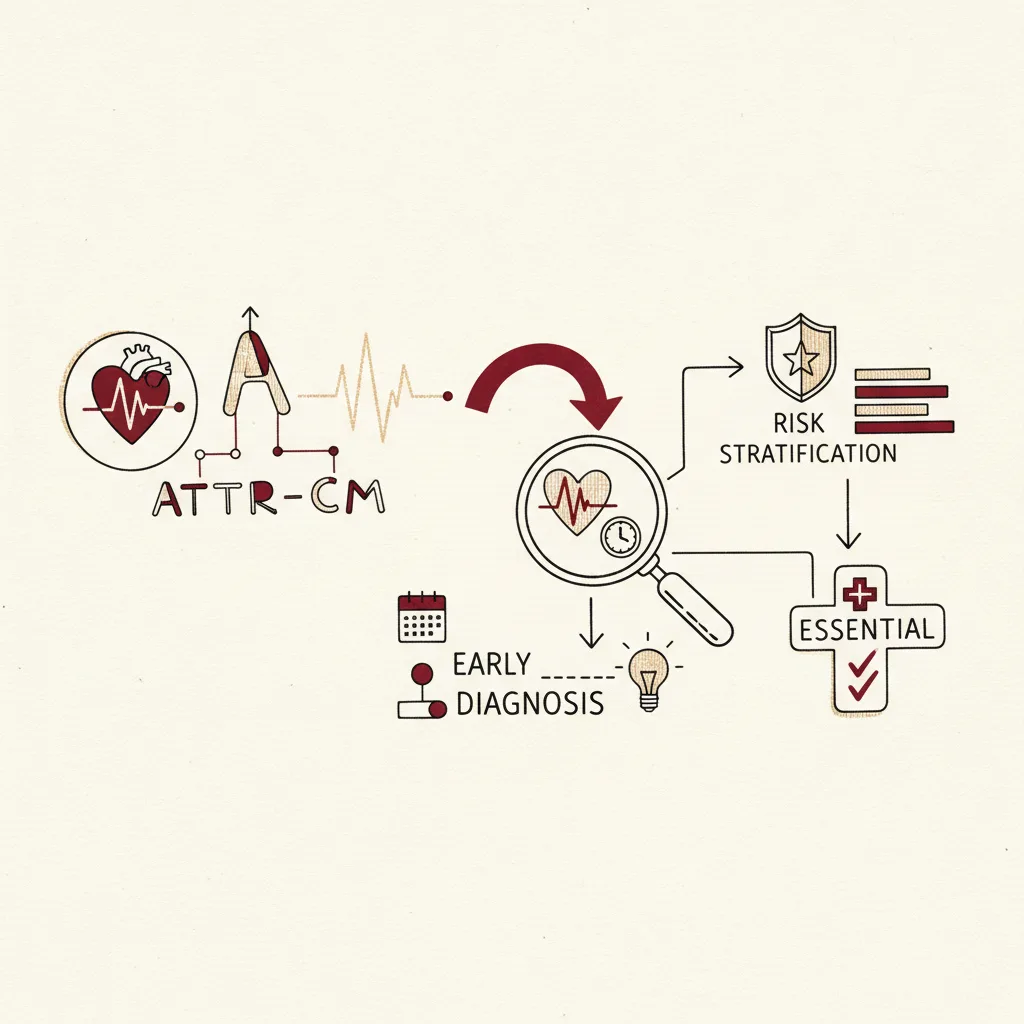

Transthyretin amyloid cardiomyopathy (ATTR-CM) presents a diagnostic and prognostic challenge, often leading to delayed intervention and suboptimal patient management. The clinical dilemma centres on identifying ATTR-CM early in its progression and accurately stratifying risk to guide therapeutic decisions. Immediate takeaway: improved diagnostic pathways and refined risk assessment tools are critical for enhancing patient outcomes in ATTR-CM.
Transthyretin amyloid cardiomyopathy (ATTR-CM) is a progressive, infiltrative cardiomyopathy caused by the deposition of misfolded transthyretin (TTR) protein in the myocardium. This deposition leads to myocardial thickening, restrictive physiology, and ultimately heart failure. The disease manifests in two primary forms: wild-type ATTR-CM (wtATTR-CM), which typically affects older males, and hereditary ATTR-CM (hATTR-CM), caused by TTR gene mutations and presenting with variable age of onset and penetrance. The non-specific nature of early symptoms, such as dyspnoea, fatigue, and peripheral oedema, often leads to misdiagnosis or delayed diagnosis, frequently as heart failure with preserved ejection fraction (HFpEF).
The diagnostic pathway for ATTR-CM has evolved significantly. Historically, endomyocardial biopsy was the gold standard, but non-invasive imaging techniques have largely superseded it. Technetium-99m pyrophosphate (Tc-99m PYP) scintigraphy, when performed in conjunction with serum and urine monoclonal protein screening to rule out light chain (AL) amyloidosis, offers high sensitivity and specificity for ATTR-CM. A Perugini score of 2 or 3 on Tc-99m PYP scintigraphy, in the absence of a monoclonal gammopathy, is diagnostic for ATTR-CM. Cardiac magnetic resonance imaging (CMR) can also provide supportive evidence, demonstrating characteristic findings such as diffuse subendocardial late gadolinium enhancement and increased extracellular volume.
Optimising Patient Outcomes Through Risk Stratification
Once diagnosed, accurate risk stratification is paramount for guiding treatment and predicting prognosis. Several factors contribute to the risk profile of ATTR-CM patients. These include New York Heart Association (NYHA) functional class, N-terminal pro-B-type natriuretic peptide (NT-proBNP) levels, and estimated glomerular filtration rate (eGFR). Elevated NT-proBNP levels reflect increased myocardial wall stress and are consistently associated with worse outcomes. Similarly, declining renal function, indicated by a low eGFR, is a marker of advanced disease and higher mortality risk. The presence of specific TTR gene mutations in hATTR-CM also influences disease progression and phenotype, necessitating genetic counselling and cascade screening for at-risk family members.
Beyond these established markers, ongoing research explores additional prognostic indicators. These include measures of cardiac strain by echocardiography, which can detect subtle myocardial dysfunction even in early stages, and advanced CMR parameters. The goal is to identify patients at higher risk of rapid progression or adverse events, allowing for more aggressive or tailored therapeutic strategies. For instance, patients with more advanced disease or rapidly progressing symptoms may benefit from earlier initiation of TTR stabilisers or silencers. The current therapeutic landscape includes TTR stabilisers, such as tafamidis, which prevent the dissociation of the TTR tetramer, and TTR silencers, like patisiran and inotersen, which reduce the production of TTR protein. The efficacy of these agents is greatest when initiated early in the disease course, underscoring the importance of timely diagnosis and precise risk assessment.
Limitations in current practice include the continued under-recognition of ATTR-CM, particularly in primary care settings, and the need for broader access to diagnostic imaging. While Tc-99m PYP scintigraphy is highly effective, its availability can be a barrier in some regions. Furthermore, the long-term comparative effectiveness of different therapeutic agents across various ATTR-CM subtypes and risk profiles continues to be an area of active investigation. Future directions include the development of novel biomarkers for earlier detection and monitoring of disease progression, as well as combination therapies to further improve patient outcomes.
Another crucial area of development involves refining risk stratification models to incorporate a wider array of clinical, imaging, and biochemical parameters. Machine learning algorithms are being explored to integrate these diverse data points, potentially offering more granular and predictive risk scores than current methods. This could lead to truly personalised treatment pathways, optimising the balance between therapeutic benefit and potential side effects for each patient.
Furthermore, the role of multidisciplinary teams in managing ATTR-CM is gaining increasing recognition. Collaboration between cardiologists, neurologists (especially for hATTR-CM with neurological manifestations), nephrologists, genetic counsellors, and palliative care specialists is essential to address the multifaceted nature of the disease and provide comprehensive patient support. This integrated approach is vital for improving quality of life and extending survival in this challenging patient population.
The persistent under-diagnosis of ATTR-CM represents a significant missed opportunity for intervention. Clinicians, particularly cardiologists and general practitioners, must maintain a higher index of suspicion for ATTR-CM in patients presenting with unexplained HFpEF, especially those with co-existing carpal tunnel syndrome, spinal stenosis, or a history of atrial fibrillation. The availability of non-invasive diagnostic tools like Tc-99m PYP scintigraphy means that invasive biopsies are rarely necessary, yet uptake remains inconsistent. Early diagnosis is not merely academic; it directly impacts the efficacy of disease-modifying therapies such as tafamidis, patisiran, and inotersen, which demonstrate greater benefit when initiated before significant myocardial damage has occurred.
The industry's role in this evolving landscape is to support broader diagnostic access and clinician education. While pharmaceutical companies have invested heavily in developing TTR stabilisers and silencers, the value of these therapies is diminished if patients are not identified in time. This necessitates continued efforts to streamline diagnostic pathways and ensure that the cost of advanced imaging does not become a barrier to care. Furthermore, as the therapeutic arsenal expands, robust real-world evidence will be crucial to inform optimal sequencing and combination strategies, moving beyond trial populations to reflect the heterogeneity of patients seen in daily practice.
For patients, the implications of improved ATTR-CM management are profound. Earlier diagnosis and precise risk stratification offer the prospect of preserving cardiac function, reducing hospitalisations for heart failure, and improving quality of life. The shift from a purely symptomatic management approach to disease modification represents a substantial advance. However, patients and their families also require comprehensive genetic counselling, particularly in hATTR-CM, to understand the hereditary nature of the disease and the implications for family planning and cascade screening. This holistic approach, encompassing early detection, targeted therapy, and genetic support, is essential to truly optimise outcomes in this complex condition.
- The Pivot The evolving understanding of ATTR-CM necessitates a shift towards earlier diagnosis and more granular risk stratification.
- The Data While no specific trial data is provided, established medical knowledge indicates that early intervention in ATTR-CM can significantly alter disease progression.
- The Action Clinicians should consider ATTR-CM in patients presenting with unexplained heart failure with preserved ejection fraction (HFpEF), particularly those with carpal tunnel syndrome or spinal stenosis.
ART-2026-597
·10/26
Drafted with AI assistance, reviewed and approved by the editorial team. This publication is intended for healthcare professionals, researchers, and life science industry professionals. Content is provided for informational and educational purposes only and does not constitute medical advice.

Science writer covering the frontier between basic research and clinical practice. I am interested in the moment a mechanism becomes a therapy, and everything that can go wrong in between.
Cite This Article
Aldrich M, Voss M. ATTR-CM: early diagnosis and risk stratification essential. The Life Science Feed. Published August 30, 2026. Updated October 5, 2026. Accessed October 14, 2026. https://thelifesciencefeed.com/cardiology/cardiomyopathies/research/attr-cm-early-diagnosis-and-risk-stratification-essential.
Editorial & AI Standards
All content is researched from peer-reviewed, open-access sources: published trial data, clinical guidelines, and regulatory filings. AI tools are used solely to structure and summarise that evidence; no AI-generated conclusions appear without editor verification against the primary source.
Every article is reviewed by a named editor before publication. Source citations are listed in the References section. This content does not represent the views of any pharmaceutical company, medical device manufacturer, or healthcare provider.
Licence & Rights
© 2026 The Life Science Feed. All rights reserved. Unless otherwise indicated, all content is the property of The Life Science Feed and may not be reproduced, distributed, or transmitted in any form or by any means without prior written permission.
Medical Disclaimer
The information provided on The Life Science Feed is for educational and informational purposes only. It is not intended as a substitute for professional medical advice, diagnosis, or treatment. Always seek the advice of your physician or other qualified healthcare provider regarding any medical condition or treatment decision. Never disregard professional medical advice or delay in seeking it because of something you have read on this website.
References
1. Porcari A, Serenelli M, Bussani R, Sinagra G, Venneri L. The evolving landscape of screening, management and treatment strategies of aortic stenosis in ATTR amyloidosis. Eur J Intern Med. 2026;148:106616. doi:10.1016/j.ejim.2025.106616







