
Gingivitis, a common inflammatory condition of the gingiva, affects a substantial portion of the adult population. While mechanical plaque control through brushing and flossing forms the bedrock of prevention and treatment, adjunctive chemical agents often enter the picture, particularly when patients struggle with optimal oral hygiene. The question for clinicians then becomes: which adjunctive rinse offers the most reliable benefit without undue risk? A systematic review and network meta-analysis published in the Journal of Clinical Periodontology provides a clear hierarchy.2
Gingivitis, characterized by inflammation of the gums, arises primarily from the accumulation of bacterial plaque. If left unaddressed, this inflammation can progress to periodontitis, leading to irreversible damage to the supporting structures of the teeth. For patients who cannot achieve adequate plaque control through brushing and flossing alone, or those undergoing specific dental procedures, adjunctive antiseptic mouth rinses offer a chemical means to reduce bacterial load and inflammation. The market offers a variety of these rinses, each with different active ingredients and proposed mechanisms, making it challenging for clinicians to discern which product provides the most evidence-based benefit.1,2
The primary goal of these rinses is to reduce the bacterial biofilm that forms on tooth surfaces, thereby mitigating the inflammatory response in the gingiva. Chlorhexidine gluconate (CHX), essential oils (EO), and cetylpyridinium chloride (CPC) represent the most common active ingredients in commercially available antiseptic mouth rinses. Each agent operates through distinct mechanisms. CHX, a cationic bisbiguanide, binds to bacterial cell walls, disrupting their integrity and causing cell lysis. It also has a substantive effect, meaning it adheres to oral tissues and slowly releases its active ingredient over several hours, prolonging its antimicrobial action. Essential oils, typically a combination of thymol, eucalyptol, menthol, and methyl salicylate, penetrate the bacterial cell wall, inhibiting enzyme activity and disrupting the cell membrane. CPC, a quaternary ammonium compound, also acts by disrupting bacterial cell membranes, leading to cell death. Understanding these mechanisms helps explain their varying efficacies.1
Comparing the Antiseptic Heavyweights
A comprehensive systematic review and network meta-analysis by Figuero, Herrera, and Tobías, published in 2019, directly compared the efficacy of various adjunctive anti-plaque chemical agents in managing gingivitis. This analysis included 102 randomized controlled trials, encompassing 10,740 participants, making it one of the most robust comparisons to date. The primary outcomes assessed were reductions in plaque and gingivitis indices over a 6-month period.2
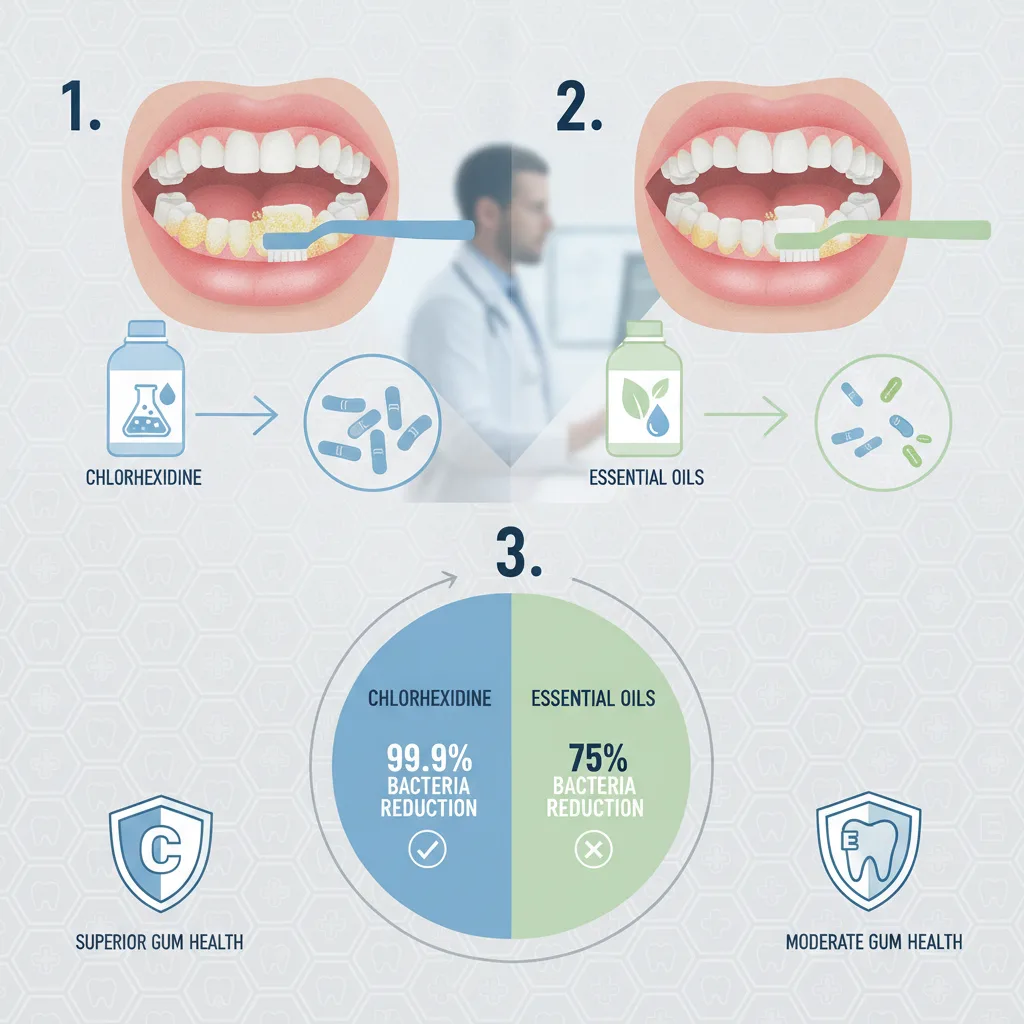
The analysis unequivocally established chlorhexidine gluconate as the most effective agent for both plaque and gingivitis reduction. Specifically, CHX 0.12% demonstrated a significant reduction in gingivitis by 33% (95% CI, 27-39%) and plaque by 33% (95% CI, 28-38%) over 6 months compared to placebo. This level of efficacy positions CHX as the gold standard against which other agents are measured.2
Essential oil-based mouth rinses also showed efficacy, but to a lesser degree than CHX. These rinses reduced gingivitis by 21% (95% CI, 16-26%) and plaque by 20% (95% CI, 16-24%) over the same 6-month period. While these reductions are statistically significant compared to placebo, they fall short of the performance observed with CHX. Cetylpyridinium chloride (CPC) formulations, depending on their concentration, offered more variable results. CPC 0.07% to 0.10% reduced gingivitis by 17% (95% CI, 11-23%) and plaque by 19% (95% CI, 14-24%). Lower concentrations of CPC (0.05%) showed even less effect, with a gingivitis reduction of 10% (95% CI, 4-16%) and plaque reduction of 12% (95% CI, 7-17%).2
The network meta-analysis allowed for direct and indirect comparisons between these active agents. When directly compared, CHX 0.12% was superior to essential oils for both gingivitis reduction (SMD -0.28; 95% CI, -0.42 to -0.14) and plaque reduction (SMD -0.30; 95% CI, -0.44 to -0.16). Similarly, CHX 0.12% outperformed CPC 0.07-0.10% for gingivitis (SMD -0.32; 95% CI, -0.47 to -0.17) and plaque (SMD -0.29; 95% CI, -0.44 to -0.14). These standardized mean differences (SMD) indicate a moderate to large effect size favoring CHX.2
Safety and Tolerability Considerations
Efficacy is only one side of the coin; safety and tolerability are equally critical for adjunctive therapies, especially those used daily. Chlorhexidine, while highly effective, carries well-documented side effects. The most common include extrinsic tooth staining, which can range from mild to severe and typically requires professional cleaning for removal. Patients also frequently report taste alteration, a temporary but often bothersome side effect that can impact compliance. Less common but still reported are oral desquamation and parotid gland swelling. These side effects are generally reversible upon discontinuation of the rinse.1
Essential oil rinses are generally better tolerated than CHX. The most common side effects associated with essential oils are a burning sensation or dryness in the mouth, which some patients find unpleasant. But these are typically less severe and less frequent than the staining and taste alteration seen with CHX. Cetylpyridinium chloride rinses also tend to have a favorable safety profile, with occasional reports of oral irritation or staining, though usually milder than that associated with CHX.1
A 1994 study by Moran, Addy, and Kohut, published in the Journal of Periodontology, investigated the efficacy of various mouthrinses in inhibiting plaque development over a 4-day period of no oral hygiene. This model, while not directly comparable to long-term gingivitis management, provides insight into the immediate anti-plaque potential. The study found that chlorhexidine 0.2% significantly inhibited plaque regrowth, reducing plaque scores by 84% compared to saline. Essential oil rinses also showed significant inhibition, reducing plaque by 56%. CPC 0.05% showed a more modest reduction of 38%. These short-term data corroborate the long-term findings from the network meta-analysis, reinforcing the superior anti-plaque action of CHX.3
The systematic review by Osso and Kanani in the Journal of Dental Hygiene also summarized current studies on the comparative effectiveness and risks. They highlighted that while antiseptic rinses are widely marketed, the evidence base for their comparative efficacy and long-term risks, such as effects on salivary flow or potential links to oral cancer, remains an area of ongoing research. For instance, concerns about potential links between alcohol-containing mouthrinses and oral cancer have been raised, though definitive causal evidence is still lacking. Many modern formulations are now alcohol-free to mitigate this theoretical risk and improve patient comfort.1
The Catch: Adherence and Long-Term Use
While CHX demonstrates superior efficacy, its side effect profile, particularly tooth staining and taste alteration, can impact patient adherence. Long-term daily use of CHX is generally not recommended due to these issues and the potential for microbial resistance, though this is less of a concern in the oral cavity compared to systemic antibiotic use. Instead, CHX is typically prescribed for short-term use, often post-surgically, during acute inflammatory phases, or for patients with compromised manual dexterity. For daily, long-term adjunctive use, essential oils or lower concentration CPC rinses, with their milder side effect profiles, might be more appropriate, despite their lower efficacy. This is a trade-off between maximal efficacy and patient comfort and compliance. Clinicians must weigh these factors carefully when recommending an adjunctive rinse, considering the individual patient's needs, oral hygiene status, and tolerance.1,2
The trial was not powered to detect differences in specific patient subgroups, such as those with diabetes or immunocompromised states, and that gap matters. These populations often have a heightened inflammatory response and may benefit disproportionately from effective plaque control, but also might be more susceptible to side effects or have specific contraindications. The generalizability of these findings to all patient demographics, therefore, requires careful consideration. For a deeper dive into managing chronic conditions, the Oxford Handbook of General Practice offers practical, evidence-based guidance.
Still, the evidence clearly shows that for maximal anti-plaque and anti-gingivitis effect, chlorhexidine remains the most potent chemical agent available. But its use requires careful patient education regarding potential side effects and the importance of its temporary nature. For patients seeking a milder, long-term adjunctive rinse, essential oils offer a reasonable, albeit less effective, alternative. The role of antimicrobial agents in various clinical settings extends beyond oral health, highlighting the broader implications of effective infection control.
The question of whether these rinses can truly replace or significantly reduce the need for mechanical plaque control remains unanswered. The current consensus holds that chemical agents are adjunctive, not substitutes. Future research should focus on identifying novel agents with CHX-level efficacy but without its drawbacks, or on optimizing delivery systems to minimize side effects. The ongoing debate around adjunctive non-opioid therapies in other fields underscores the continuous search for improved patient outcomes with fewer adverse events.
For clinicians, the message is straightforward: chlorhexidine gluconate remains the most effective adjunctive rinse for reducing plaque and gingivitis. The data is clear; no other over-the-counter option comes close to its efficacy. This means for acute phases of gingivitis, or when short-term, intensive plaque control is necessary, CHX should be the first choice.
But efficacy does not equate to universal applicability. The side effect profile of CHX, particularly tooth staining and taste alteration, limits its long-term utility. Patients will not adhere to a regimen that makes their teeth brown or alters their perception of food. Therefore, essential oil rinses, while less potent, offer a more tolerable option for daily, long-term adjunctive use, especially for patients who struggle with mechanical cleaning but do not require the maximal effect of CHX.
The industry must continue to innovate. The gap between CHX's efficacy and its tolerability is significant. Developing new formulations or entirely new chemical entities that match CHX's antimicrobial power without its aesthetic and sensory drawbacks would be a genuine advance. Until then, clinicians must manage patient expectations and tailor recommendations to individual needs, emphasizing that no rinse replaces diligent brushing and flossing.
- The Pivot Chlorhexidine gluconate (CHX) consistently delivers superior plaque and gingivitis reduction compared to essential oils (EO) and cetylpyridinium chloride (CPC).
- The Data CHX 0.12% reduced gingivitis by 33% (95% CI, 27-39%) and plaque by 33% (95% CI, 28-38%) over 6 months.
- The Action Prescribe CHX for short-term adjunctive plaque and gingivitis control, but counsel patients on potential side effects and the importance of mechanical cleaning.
ART-2026-1414
·10/26
Drafted with AI assistance, reviewed and approved by the editorial team. This publication is intended for healthcare professionals, researchers, and life science industry professionals. Content is provided for informational and educational purposes only and does not constitute medical advice.

Infectious disease, epidemiology, and global health equity. I have covered outbreaks from Ebola to COVID-19 to mpox. The stories I am most drawn to are where the science is clear and the response is slow.
Cite This Article
Reeves T, Voss M. Chlorhexidine vs. essential oils: which rinse actually cleans up gingivitis?. The Life Science Feed. Published August 27, 2026. Updated October 6, 2026. Accessed October 11, 2026. https://thelifesciencefeed.com/dentistry/periodontal-diseases/research/chlorhexidine-essential-oils-cpc-adjunctive-rinses.
Editorial & AI Standards
All content is researched from peer-reviewed, open-access sources: published trial data, clinical guidelines, and regulatory filings. AI tools are used solely to structure and summarise that evidence; no AI-generated conclusions appear without editor verification against the primary source.
Every article is reviewed by a named editor before publication. Source citations are listed in the References section. This content does not represent the views of any pharmaceutical company, medical device manufacturer, or healthcare provider.
Licence & Rights
© 2026 The Life Science Feed. All rights reserved. Unless otherwise indicated, all content is the property of The Life Science Feed and may not be reproduced, distributed, or transmitted in any form or by any means without prior written permission.
Medical Disclaimer
The information provided on The Life Science Feed is for educational and informational purposes only. It is not intended as a substitute for professional medical advice, diagnosis, or treatment. Always seek the advice of your physician or other qualified healthcare provider regarding any medical condition or treatment decision. Never disregard professional medical advice or delay in seeking it because of something you have read on this website.
References
1. Osso D, Kanani N. Antiseptic mouth rinses: an update on comparative effectiveness, risks and recommendations. J Dent Hyg. 2013;87(1):10-18. https://pubmed.ncbi.nlm.nih.gov/23433693/
2. Figuero E, Herrera D, Tobías A. Efficacy of adjunctive anti-plaque chemical agents in managing gingivitis: A systematic review and network meta-analyses. J Clin Periodontol. 2019;46 Suppl 21:106-121. https://pubmed.ncbi.nlm.nih.gov/31058336/
3. Moran J, Addy M, Kohut B. Efficacy of mouthrinses in inhibiting the development of supragingival plaque over a 4-day period of no oral hygiene. J Periodontol. 1994;65(1):63-67. https://pubmed.ncbi.nlm.nih.gov/7823270/