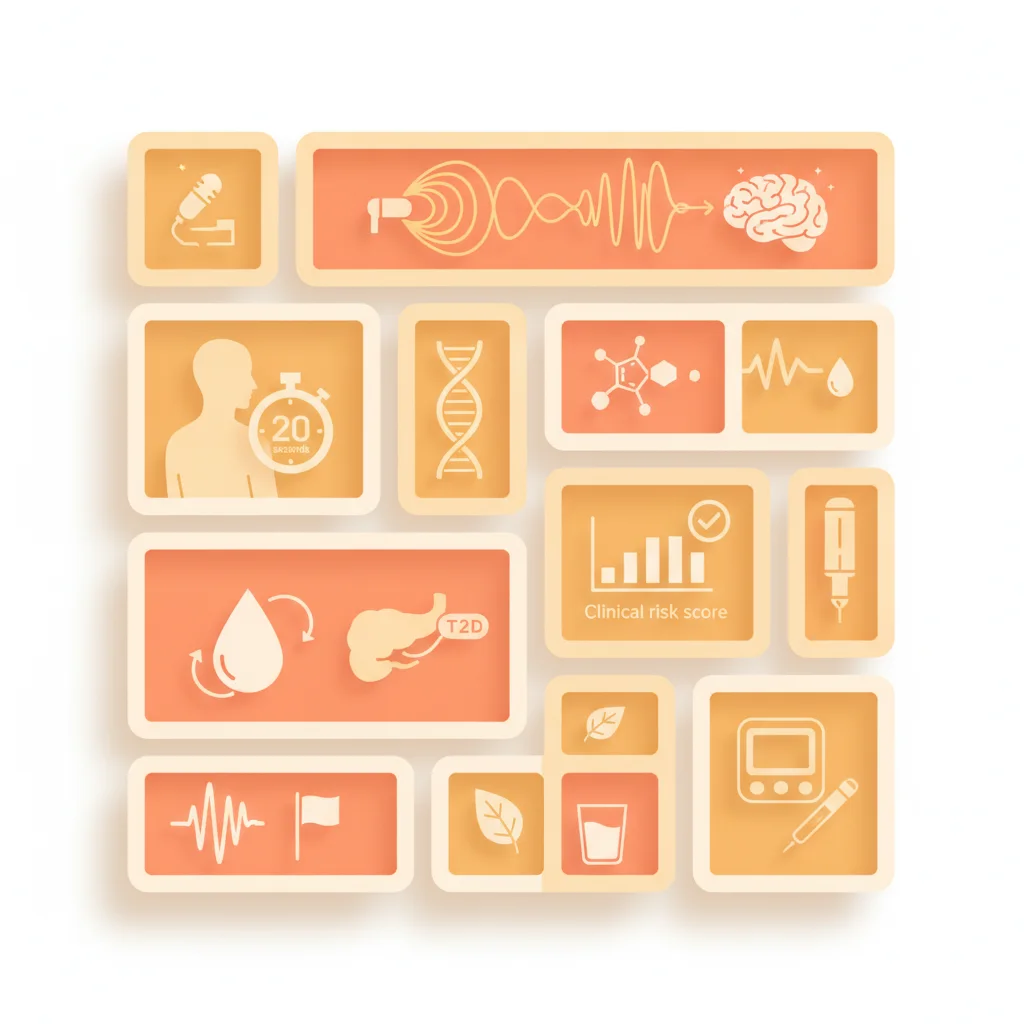

Screening for type 2 diabetes in the UK still runs on blood tests and time-intensive GP appointments, and only 40.4% of eligible adults attend the NHS Health Checks designed to catch it early. A new large-scale validation study presented at the EASD Annual Meeting in Milan tests a different route in: an AI model that estimates diabetes risk from a 20-second speech recording, validated against both self-reported diagnoses and, in a subset, actual HbA1c blood tests.
Researchers at thymia, working with colleagues at RMIT University in Melbourne, trained a speech model on 63,283 voice recordings from 21,129 UK and US participants who reported whether they had ever been diagnosed with diabetes. The model was then validated in two stages: first against self-reported type 2 diabetes status in 7,319 UK adults, then against home HbA1c blood tests in a stratified subset of 801 of those participants, selected to cover the full range of model-predicted risk.
Accuracy approaching an established clinical risk tool
Against self-reported diagnoses, the speech model achieved an AUC of 0.80 (±0.03), a level generally considered clinically useful, and well-calibrated (Expected Calibration Error 0.019). By comparison, QDiabetes, the NICE-recommended risk tool used in NHS Health Checks, scored 0.86 (±0.03) on the same population. In plain terms, the speech model gave a higher risk score to someone who had self-reported type 2 diabetes than to someone who had not, roughly 80% of the time. Sensitivity was 76% and the false positive rate was 31%, neither statistically different from QDiabetes at their respective thresholds.
Validated against actual HbA1c blood tests rather than self-report, at the clinical diabetes threshold (HbA1c ≥48 mmol/mol), the model achieved an AUC of 0.75, correctly identifying 82% of diabetes cases, with a false positive rate of 47%. The model also cleanly separated risk groups among participants with no self-reported diagnosis: those it flagged as high-risk had a mean HbA1c of 34.9 mmol/mol, against 31.7 for medium-risk and 29.6 for low-risk, and none of the participants it classed as low-risk had HbA1c results in the prediabetic or diabetic range.
Where it works well, and where it does not
Performance held up across sex (male AUC 0.79, female 0.81) and most age and ethnic groups (AUC ≥0.80 for White, South Asian, Mixed and Other participants). It dropped for Black participants (AUC 0.69) and Other Asian participants (AUC 0.65), though the authors note both subgroups had very few confirmed type 2 diabetes cases (18 and 5 respectively), limiting how much weight those numbers can bear. Performance also fell in people with cardiovascular disease (AUC 0.69), hypertension (AUC 0.65) or obesity (AUC 0.73), conditions that share physiological overlap with type 2 diabetes and may independently alter voice.
The authors, and the preprint itself, are explicit that this is not a replacement for blood testing: "Our model opens a new route to screening for diabetes. It is not a replacement for a blood test, and it should never stop anyone who thinks they need one from getting one," said Giedrė Čepukaitytė, who is presenting the findings. thymia's founders and several co-authors hold equity in the company, a conflict the preprint discloses directly; the research received no external funding.
The authors acknowledge that the model's performance in certain demographic and comorbidity subgroups warrants further investigation. The reduced AUC in Black and Other Asian participants, while potentially influenced by small sample sizes of confirmed diabetes cases, highlights the critical need for more diverse training data to ensure equitable model performance across all populations. Similarly, the diminished accuracy in individuals with cardiovascular disease, hypertension, or obesity suggests that these conditions introduce confounding vocal biomarkers that necessitate more sophisticated algorithmic adjustments or the integration of additional clinical data points for accurate risk stratification.
Despite these limitations, the study posits a compelling case for the potential of voice-based screening as a scalable and non-invasive tool. Its ability to identify individuals at high risk, even among those without a self-reported diagnosis, and to cleanly separate risk groups based on HbA1c levels, underscores its utility as a pre-screening mechanism. This could significantly streamline the identification of individuals who would benefit most from confirmatory blood testing, potentially reducing the burden on healthcare systems and improving early detection rates, particularly in underserved communities where access to traditional screening methods may be limited.
Clinical Implications and Future Directions
The development of a voice-based screening tool for type 2 diabetes, while not a diagnostic replacement, offers a promising avenue for enhancing population-level risk assessment and early intervention strategies. The model's performance, approaching that of established clinical risk tools like QDiabetes, suggests its potential utility in identifying individuals who warrant further investigation with traditional blood tests. This could be particularly impactful in primary care settings or community health programs, where a quick, non-invasive screening method could help prioritize individuals for more definitive diagnostic pathways, thereby improving the efficiency of diabetes screening programs.
However, several critical considerations must be addressed before such a tool can be widely adopted in clinical practice. The observed disparities in performance across different ethnic groups and in individuals with specific comorbidities necessitate further research to refine the model and ensure its generalizability and fairness. Future studies should focus on expanding the diversity of the training datasets to include more representative samples from underperforming subgroups, and explore whether integrating additional clinical or demographic data can improve accuracy in these populations. Furthermore, the high false positive rate observed in the HbA1c validation (47%) indicates that while the tool is effective at identifying true positives, it may also flag a substantial number of individuals who do not have diabetes, potentially leading to unnecessary follow-up tests and associated patient anxiety or healthcare costs. Balancing sensitivity and specificity will be crucial for optimizing its clinical utility.
Beyond refining the algorithm, future research should also investigate the practical implementation of this technology within existing healthcare workflows. This includes assessing user acceptance among both patients and healthcare professionals, evaluating the cost-effectiveness of integrating voice screening into routine care, and understanding the ethical implications of using AI-driven tools for health risk assessment. Pilot programs in diverse clinical settings could provide valuable insights into these operational challenges and help identify best practices for deployment. The potential for this technology to reach individuals who might otherwise not engage with traditional screening methods, such as those in remote areas or with limited access to healthcare, represents a significant opportunity that warrants careful and robust exploration.
Ultimately, while the 20-second voice recording is not a standalone diagnostic, it represents a significant step towards leveraging accessible technology for proactive health management. Its role is likely to be as a powerful pre-screening filter, guiding clinicians to focus resources on those most likely to benefit from further diagnostic workup. The ongoing development and rigorous validation of such tools, coupled with a commitment to addressing issues of equity and practical implementation, will be essential for realizing their full potential in the fight against type 2 diabetes.
For services struggling with NHS Health Check uptake below 41%, a 20-second remote speech sample is a meaningfully lower-friction first step than a 20-30 minute in-person appointment. The data suggests this could work as intended: as a triage layer that directs people toward confirmatory blood testing, not a diagnostic in its own right, which is exactly how the authors frame it.
The reduced accuracy in Black and Other Asian participants, and in people with common comorbidities like hypertension and obesity, is a real limitation given these groups often carry higher undiagnosed type 2 diabetes burden, and the authors are candid that it needs dedicated validation in larger samples before wider rollout, not just a footnote.
This is a preprint, not yet peer-reviewed, and the underlying speech dataset is not publicly available for independent replication. The financial conflict, several authors hold equity in the company that would commercialise this technology, is disclosed, but is worth weighing against the study's own design and reporting rather than dismissed or ignored.
- The Pivot A 20-second speech recording detected type 2 diabetes with accuracy approaching an established clinical risk score, and its risk scores tracked real HbA1c results.
- The Data AUC 0.80 against self-report (vs 0.86 for QDiabetes) and 0.75 against HbA1c-confirmed diabetes, with 82% sensitivity at the diabetes threshold.
- The Action The authors propose speech screening as a triage step ahead of blood testing, not a replacement for it, particularly for people who never attend a health check.
ART-2026-1832
·09/26
Drafted with AI assistance, reviewed and approved by the editorial team. This publication is intended for healthcare professionals, researchers, and life science industry professionals. Content is provided for informational and educational purposes only and does not constitute medical advice.

Infectious disease, epidemiology, and global health equity. I have covered outbreaks from Ebola to COVID-19 to mpox. The stories I am most drawn to are where the science is clear and the response is slow.
Cite This Article
Reeves T, Voss M. Can a 20-second voice recording really flag type 2 diabetes?. The Life Science Feed. Published September 29, 2026. Updated September 29, 2026. Accessed September 29, 2026. https://thelifesciencefeed.com/endocrinology/diabetes-mellitus-type-2/research/can-a-20-second-voice-recording-really-flag-type-2-diabetes.
Editorial & AI Standards
All content is researched from peer-reviewed, open-access sources: published trial data, clinical guidelines, and regulatory filings. AI tools are used solely to structure and summarise that evidence; no AI-generated conclusions appear without editor verification against the primary source.
Every article is reviewed by a named editor before publication. Source citations are listed in the References section. This content does not represent the views of any pharmaceutical company, medical device manufacturer, or healthcare provider.
Licence & Rights
© 2026 The Life Science Feed. All rights reserved. Unless otherwise indicated, all content is the property of The Life Science Feed and may not be reproduced, distributed, or transmitted in any form or by any means without prior written permission.
Medical Disclaimer
The information provided on The Life Science Feed is for educational and informational purposes only. It is not intended as a substitute for professional medical advice, diagnosis, or treatment. Always seek the advice of your physician or other qualified healthcare provider regarding any medical condition or treatment decision. Never disregard professional medical advice or delay in seeking it because of something you have read on this website.
References
Brann E, Polle R, Čepukaitytė G, Georgescu AL, Parsons O, de Courten B, Molimpakis E, Goria S. Detection of Type 2 Diabetes from 20-second Speech Recordings: A Large-Scale Validation Study. medRxiv preprint (posted 18 August 2026), doi:10.64898/2026.03.16.26348468. Presented as Abstract 321 at the European Association for the Study of Diabetes (EASD) Annual Meeting, Milan, Italy, 27 September-2 October 2026.