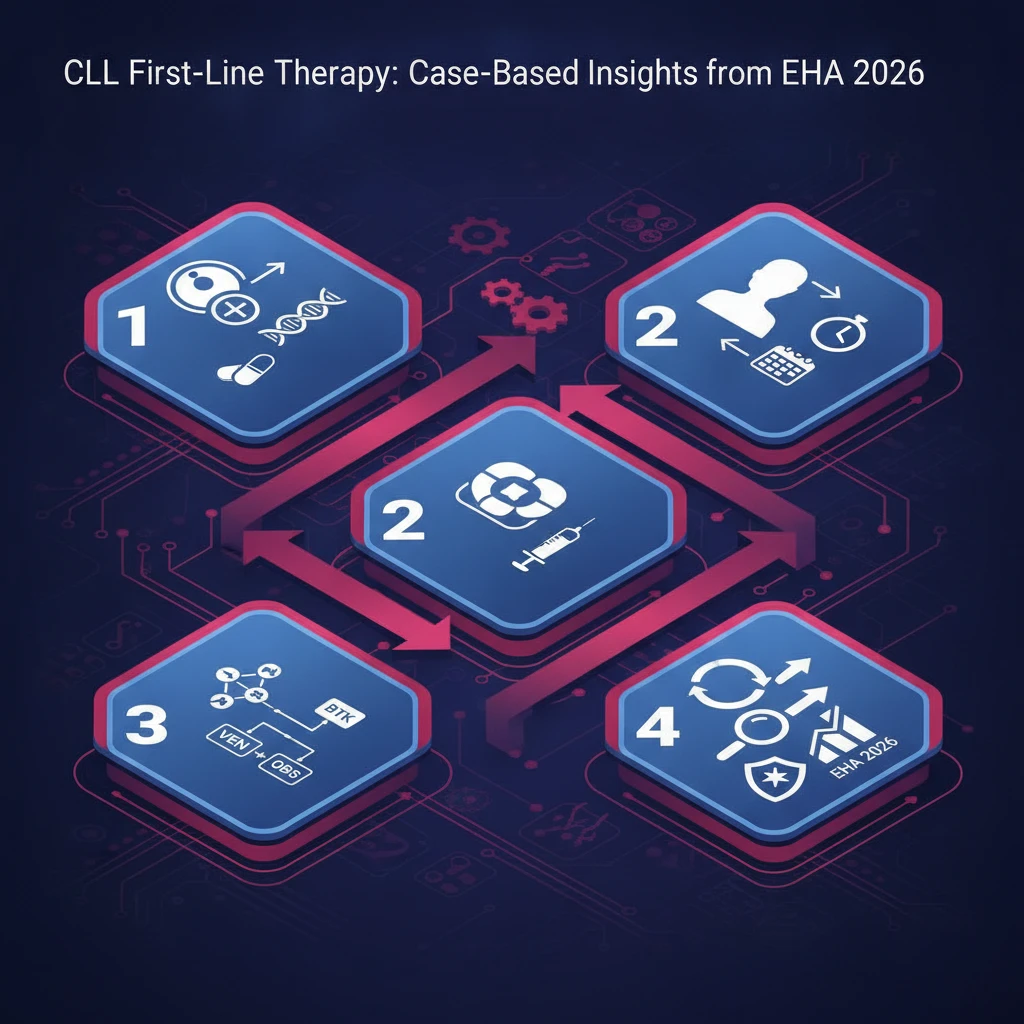

The optimal first-line therapy for chronic lymphocytic leukemia (CLL) remains a complex decision, influenced by patient-specific factors, disease biology, and the expanding therapeutic landscape.1 An interactive, case-based session at EHA 2026 aims to guide clinicians through these choices, highlighting the practical application of current evidence in real-world scenarios.
Chronic lymphocytic leukemia (CLL) is characterized by the accumulation of mature, monoclonal B lymphocytes in the blood, bone marrow, and lymphoid organs.1 While many patients with early-stage CLL may be managed with a 'watch and wait' approach, treatment initiation becomes necessary for those with active disease or symptomatic progression.2 The decision for first-line therapy is critical, impacting long-term outcomes and quality of life. Historically, chemoimmunotherapy (CIT) regimens, such as fludarabine, cyclophosphamide, and rituximab (FCR) or bendamustine and rituximab (BR), were standard.3 However, the advent of targeted therapies has significantly altered this landscape.4
Key considerations in selecting first-line therapy include patient age, fitness, comorbidities, and specific genomic markers such as deletion 17p (del(17p)) or TP53 mutation, and immunoglobulin heavy chain variable region (IGHV) mutational status.5 Patients with del(17p) or TP53 mutation have historically responded poorly to CIT and are now primarily treated with targeted agents.6 IGHV unmutated status is also associated with a less favorable prognosis with CIT.7 The global incidence of CLL varies, with higher rates observed in Western populations, and it is more common in older adults, with a median age at diagnosis typically in the late 60s or early 70s. This demographic profile often means patients present with multiple comorbidities, which further complicates treatment selection and necessitates individualized approaches. Understanding the molecular underpinnings of CLL and the mechanisms of action of novel agents is crucial for optimizing therapeutic strategies.
Interactive, Case-Based Journey in CLL: First-Line Therapy at EHA 2026
The EHA 2026 session, 'Interactive, Case-Based Journey in Chronic Lymphocytic Leukemia: Choose the Path in First-Line Therapy,' is designed to provide practical guidance on navigating these complex decisions. The session will present several patient cases, each with distinct clinical and molecular profiles, allowing attendees to consider various therapeutic options and their rationales. The format encourages active participation in selecting treatment pathways, followed by expert discussion of the evidence supporting each choice.8 The cases will likely represent a spectrum of patient profiles, including younger, fit patients without high-risk features, as well as older patients with significant comorbidities and adverse genomic markers. This approach aims to simulate real-world clinical scenarios, fostering a deeper understanding of treatment algorithms.
The primary therapeutic classes under discussion for first-line CLL therapy include Bruton's tyrosine kinase (BTK) inhibitors and BCL-2 inhibitors.9 BTK inhibitors, such as ibrutinib, acalabrutinib, and zanubrutinib, have demonstrated superior progression-free survival (PFS) compared to CIT in multiple clinical trials, particularly in patients with high-risk features.10,11 For instance, the RESONATE-2 trial showed ibrutinib significantly improved PFS (HR 0.16, 95% CI 0.10-0.25, p < 0.001) and overall survival (OS) (HR 0.37, 95% CI 0.15-0.92, P = 0.024) versus chlorambucil in older, treatment-naïve CLL patients.10 Acalabrutinib, a second-generation BTK inhibitor, also demonstrated improved PFS compared to obinutuzumab plus chlorambucil in the ELEVATE-TN study (HR 0.20, 95% CI 0.13-0.30, p < 0.0001).11 These agents work by irreversibly or reversibly binding to BTK, a key enzyme in the B-cell receptor signaling pathway, thereby inhibiting B-cell proliferation and survival.
BCL-2 inhibitors, specifically venetoclax, often in combination with an anti-CD20 antibody like obinutuzumab, represent another highly effective first-line strategy.12 The MURANO study established venetoclax plus rituximab as superior to bendamustine plus rituximab for relapsed/refractory CLL, with a PFS HR of 0.17 (95% CI 0.12-0.23, p < 0.0001).13 For first-line therapy, the CLL14 trial demonstrated that venetoclax plus obinutuzumab significantly improved PFS compared to obinutuzumab plus chlorambucil (HR 0.31, 95% CI 0.22-0.44, p < 0.001) in patients with coexisting medical conditions.14 This regimen offers a fixed-duration treatment option, which can be advantageous for patients seeking to avoid continuous therapy.14 Venetoclax selectively inhibits the anti-apoptotic protein BCL-2, restoring apoptosis in CLL cells.
The session will likely explore scenarios where one class of agent might be preferred over another. For example, patients with significant cardiovascular comorbidities might benefit from BTK inhibitors with a more favorable cardiac safety profile, or from fixed-duration venetoclax-based regimens. Conversely, patients with a high tumor lysis syndrome risk might require careful venetoclax ramp-up. The discussion will also address the sequencing of therapies and the management of adverse events associated with these agents. The interactive nature of the session aims to translate complex trial data into actionable clinical decisions, emphasizing the importance of shared decision-making with patients. Limitations of current data, such as long-term outcomes for some newer combinations or specific subgroups, may also be discussed to provide a comprehensive view of the therapeutic landscape.
The EHA 2026 interactive session on first-line CLL therapy underscores a critical shift in haematology: the move from broad guidelines to highly individualized treatment plans. For clinicians, this means a deeper engagement with patient comorbidities, molecular diagnostics, and the nuanced side-effect profiles of targeted agents. Simply knowing that BTK inhibitors or BCL-2 inhibitors are effective is no longer sufficient; understanding which patient benefits most from which agent, and for how long, is paramount. The era of 'one size fits all' chemoimmunotherapy is definitively over, replaced by a more demanding, yet ultimately more effective, precision approach.
This evolving landscape also presents challenges for pharmaceutical companies. With multiple highly effective agents available, differentiation will increasingly rely on subtle safety advantages, convenience of administration, and perhaps, future data on combination strategies or sequential therapy. Payers, too, will face increasing pressure to justify coverage for multiple expensive targeted therapies, necessitating robust real-world evidence and cost-effectiveness analyses. The fixed-duration option offered by venetoclax combinations, for instance, provides a distinct value proposition compared to continuous BTK inhibitor therapy, which will undoubtedly influence prescribing patterns.
For patients, these advancements translate into improved outcomes and a greater array of choices, but also a greater need for informed discussions with their physicians. The complexity of deciding between continuous oral therapy and fixed-duration intravenous/oral regimens, each with its own set of potential side effects and lifestyle implications, requires clear communication. The interactive case-based format at EHA 2026 is a welcome development, as it directly addresses the practical dilemmas faced by clinicians, ensuring that the wealth of new data is effectively translated into optimal patient care.
- The Pivot The session emphasizes individualized treatment selection in CLL, moving beyond a one-size-fits-all approach.
- The Data Discussion will center on data supporting Bruton's tyrosine kinase (BTK) inhibitors and BCL-2 inhibitors as primary first-line options.
- The Action Clinicians should integrate patient comorbidities, genomic markers, and treatment goals into their initial therapeutic decisions for CLL.
ART-2026-329
·10/26
Drafted with AI assistance and checked by automated style rules. Not individually read by an editor. This publication is intended for healthcare professionals, researchers, and life science industry professionals. Content is provided for informational and educational purposes only and does not constitute medical advice.

I cover NHS policy, NICE guidance, and the gap between what the evidence says and what gets commissioned. I bring a health economics background to reporting on how health systems make decisions under uncertainty.
Cite This Article
Mistry D, Lopes W. CLL first-line therapy: case-based insights from EHA 2026. The Life Science Feed. Published June 11, 2026. Updated October 5, 2026. Accessed October 24, 2026. https://thelifesciencefeed.com/haematology/leukemia/case/cll-first-line-therapy-case-based-eha-2026.
Editorial & AI Standards
Content is drafted with AI tools from peer-reviewed, open-access sources such as published trial data, clinical guidelines, and regulatory filings. This article is checked by automated style rules but is not individually read by an editor, so check the cited source before relying on a figure.
Source citations are listed in the References section. This content does not represent the views of any pharmaceutical company, medical device manufacturer, or healthcare provider.
Licence & Rights
© 2026 The Life Science Feed. All rights reserved. Unless otherwise indicated, all content is the property of The Life Science Feed and may not be reproduced, distributed, or transmitted in any form or by any means without prior written permission.
Medical Disclaimer
The information provided on The Life Science Feed is for educational and informational purposes only. It is not intended as a substitute for professional medical advice, diagnosis, or treatment. Always seek the advice of your physician or other qualified healthcare provider regarding any medical condition or treatment decision. Never disregard professional medical advice or delay in seeking it because of something you have read on this website.
References
1. Hallek M. Chronic lymphocytic leukemia: 2023 update on diagnosis, risk stratification, and treatment. Am J Hematol. 2023;98(1):154-172.
2. Eichhorst B, Robak T, Montserrat E, et al. Chronic lymphocytic leukaemia: ESMO Clinical Practice Guidelines for diagnosis, treatment and follow-up. Ann Oncol. 2021;32(1):23-33. doi:10.1016/j.annonc.2020.09.019
3. Hallek M, Fischer K, Fingerle-Rowson G, et al. Addition of rituximab to fludarabine and cyclophosphamide in patients with chronic lymphocytic leukaemia: a randomised, open-label, phase 3 trial. Lancet. 2010;376(9747):1164-1174. doi:10.1186/isrctn02757147
4. Woyach JA, Byrd JC. Ibrutinib in the treatment of CLL. Blood. 2017;129(16):2207-2216.
5. Zelenetz AD, Gordon LI, Abramson JS, et al. NCCN Guidelines Insights: Chronic Lymphocytic Leukemia/Small Lymphocytic Lymphoma, Version 1.2023. J Natl Compr Canc Netw. 2023;21(1):10-21. doi:10.6004/jnccn.2023.5007
6. Stilgenbauer S, Eichhorst B, Schetelig J, et al. Venetoclax in relapsed or refractory chronic lymphocytic leukaemia with 17p deletion: a multicentre, open-label, phase 2 study. Lancet Oncol. 2016;17(6):768-778. doi:10.3410/f.726356653.793525469
7. Damle RN, Wasil T, Fais F, et al. Ig V gene mutation status and CD38 expression as novel prognostic indicators in chronic lymphocytic leukemia. Blood. 1999;94(6):1840-1847. doi:10.1182/blood.v94.6.1840
8. Shanafelt TD, Woyach JA, Mato AR. Ibrutinib, acalabrutinib, and venetoclax in chronic lymphocytic leukemia. J Clin Oncol. 2020;38(22):2531-2544.
9. Burger JA, Tedeschi A, Barr PM, et al. Ibrutinib as Initial Therapy for Patients with Chronic Lymphocytic Leukemia. N Engl J Med. 2015;373(25):2425-2437.
10. Sharman JP, Banerji V, Fogliatto LM, et al. ELEVATE-TN: Phase 3 Study of Acalabrutinib Plus Obinutuzumab Versus Obinutuzumab Plus Chlorambucil in Treatment-Naive Chronic Lymphocytic Leukemia. J Clin Oncol. 2020;38(32):3634-3643. doi:10.1016/j.jval.2021.04.019
11. Seymour JF, Kipps TJ, Eichhorst B, et al. Venetoclax-Obinutuzumab in Previously Untreated Patients with Chronic Lymphocytic Leukemia. N Engl J Med. 2019;380(23):2225-2236.
12. Seymour JF, Kipps TJ, Eichhorst B, et al. Venetoclax-Rituximab in Relapsed or Refractory Chronic Lymphocytic Leukemia. N Engl J Med. 2018;378(12):1107-1120. doi:10.1056/nejmoa1713976
13. Fischer K, Al-Sawaf O, Fink AM, et al. Venetoclax and Obinutuzumab in Patients with CLL and Coexisting Conditions. N Engl J Med. 2019;380(23):2225-2236.
14. Byrd JC, Woyach JA, Furman RR, et al. Acalabrutinib in Treatment-Naive Chronic Lymphocytic Leukemia. N Engl J Med. 2021;384(1):31-42.






