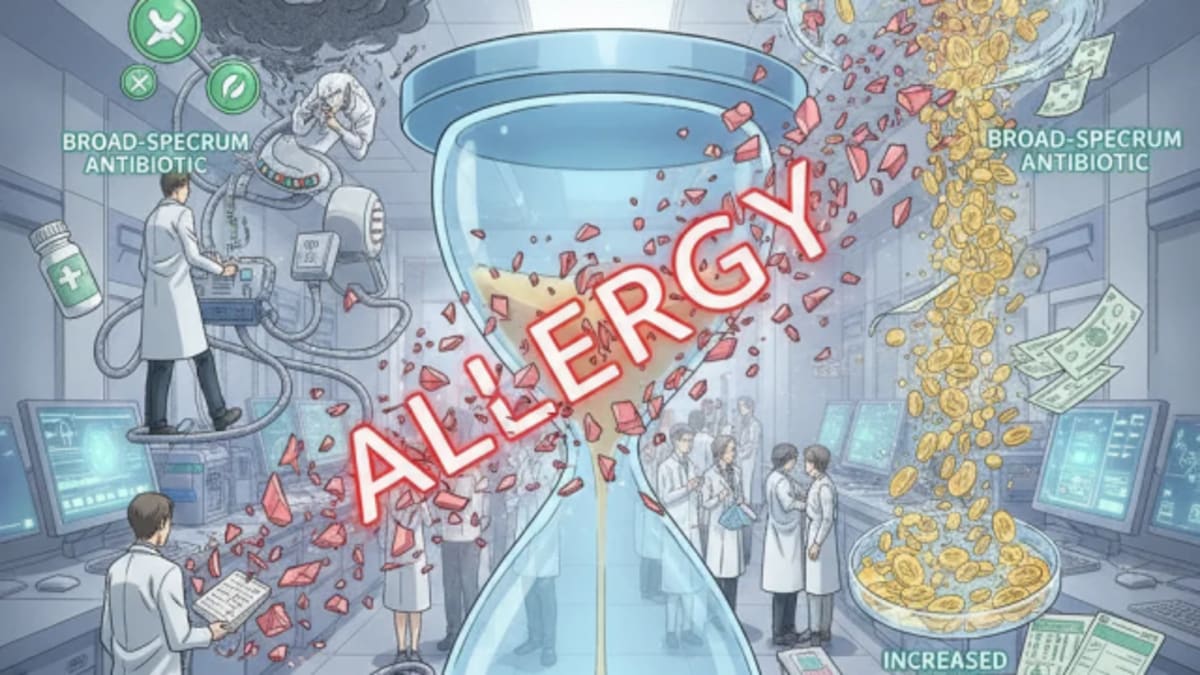

A reported penicillin allergy often dictates antibiotic prescribing, pushing clinicians towards broader-spectrum agents. This practice, while seemingly cautious, contributes to antimicrobial resistance and can lead to poorer patient outcomes, including increased healthcare costs and longer hospital stays. The vast majority of these reported allergies are not true IgE-mediated hypersensitivity reactions, but rather benign childhood rashes or vague gastrointestinal upset, long outgrown or misattributed.
Delabelling these patients, therefore, is not merely an administrative task; it is a critical intervention for public health and individual patient care. The challenge lies in developing a workflow that is both safe and scalable, moving beyond the specialist allergist's clinic into the hands of general practitioners and other non-allergist clinicians.
The pervasive issue of mislabelled penicillin allergy has long plagued antibiotic stewardship efforts. Patients presenting with a documented penicillin allergy are routinely given alternative antibiotics, which are often less effective, more expensive, and carry a higher risk of adverse events, including Clostridioides difficile infection and the emergence of multidrug-resistant organisms. This clinical inertia stems from a lack of confidence among non-allergists in evaluating these claims, coupled with a fear of inducing a severe anaphylactic reaction.
The problem is substantial: an estimated 10% of the population reports a penicillin allergy, yet comprehensive evaluation reveals that fewer than 1% of these individuals have a true IgE-mediated hypersensitivity. This discrepancy creates a significant unmet need for accessible, reliable methods to identify and remove false allergy labels, thereby expanding the therapeutic options for patients and supporting judicious antibiotic use. The hidden costs of a false penicillin allergy label extend beyond individual patient care, impacting hospital formularies and public health initiatives.
Understanding the Allergy Mechanism
Penicillin allergies are typically classified into immediate (IgE-mediated) and non-immediate reactions. Immediate reactions, occurring within minutes to an hour of exposure, include urticaria, angioedema, bronchospasm, and anaphylaxis. These are the reactions that pose the greatest risk and are the primary concern when considering delabelling. Non-immediate reactions, which can manifest hours or days later, include maculopapular rashes, drug fever, and interstitial nephritis. While uncomfortable, these are generally less severe and rarely life-threatening.
The vast majority of reported penicillin allergies are not IgE-mediated. Many patients recall a childhood rash, often viral in origin, that coincided with penicillin administration. Others report gastrointestinal upset, which is a common side effect of many antibiotics and not an allergic reaction. Distinguishing between these benign events and true hypersensitivity is the cornerstone of any effective delabelling strategy. This requires a careful history, followed by targeted diagnostic testing when indicated.
The Delabelling Workflow for Generalists
A practical delabelling workflow for non-allergists begins with a thorough patient history. This initial step is essential for accurate risk stratification, which impacts patient safety. Key questions include: What was the reaction? When did it occur? What was the penicillin formulation? Was medical attention sought? Were other medications taken concurrently? A detailed history can often rule out a true IgE-mediated allergy, particularly if the reported reaction was a non-specific rash, gastrointestinal upset, or occurred many years ago without subsequent re-exposure.
Patients with a low-risk history (e.g., non-specific rash, gastrointestinal symptoms, or reactions more than 10 years ago without anaphylaxis) can often proceed directly to an oral penicillin challenge. This involves administering a single, full therapeutic dose of an oral penicillin, typically amoxicillin, under observation. The patient is monitored for a defined period, usually 30 to 60 minutes, for any signs of an allergic reaction. If no reaction occurs, the penicillin allergy label can be removed, and the patient can be safely prescribed penicillin-class antibiotics in the future. This direct oral challenge is a safe and efficient method for the majority of low-risk patients.
Intermediate and High-Risk Pathways
For patients with an intermediate-risk history (e.g., a delayed maculopapular rash without systemic features, or a reaction that occurred within the last 10 years but was not anaphylactic), a more cautious approach may be warranted. This might involve a graded oral challenge, where smaller, incremental doses are given over a period, or referral for penicillin skin testing. Skin testing, while more resource-intensive, can identify IgE antibodies to penicillin and its major and minor determinants. A negative skin test result has a high negative predictive value, meaning it is highly unlikely the patient has an IgE-mediated allergy.
Patients with a high-risk history, such as a clear history of anaphylaxis, angioedema, or severe cutaneous adverse reactions (e.g., Stevens-Johnson syndrome, toxic epidermal necrolysis) to penicillin, should generally be referred to an allergist for comprehensive evaluation. These cases require specialist expertise, often involving skin testing, graded challenges, and potentially desensitisation if penicillin is the only viable therapeutic option. The complexity of these cases highlights the importance of accurate initial risk stratification by the non-allergist.
Implementation Challenges and Solutions
Implementing a widespread delabelling program faces several challenges. Clinician education is paramount; many non-allergists lack formal training in allergy assessment and feel uncomfortable performing oral challenges. Standardised protocols, clear guidelines, and accessible educational resources are essential to build confidence and competence. The best practices for managing complex immunological conditions often involve multidisciplinary teams, and penicillin allergy delabelling is no different.
Logistical hurdles also exist, particularly in primary care settings where observation periods for oral challenges may be difficult to accommodate. Solutions include dedicated allergy clinics within larger primary care networks, or integration of delabelling workflows into existing hospital outpatient services. Electronic health record (EHR) systems can play a vital role by flagging patients with reported penicillin allergies, prompting clinicians to initiate the delabelling workflow, and documenting the outcome. This systematic approach can help overcome the inertia that often perpetuates false allergy labels.
The economic impact of delabelling is also a significant consideration. By enabling the use of narrower-spectrum, often cheaper, penicillin-class antibiotics, healthcare systems can realise substantial cost savings. Reduced rates of C. difficile infection and fewer adverse drug reactions also contribute to overall healthcare efficiency. The initial investment in training and infrastructure for delabelling programs is likely to be offset by these long-term benefits.
The open-label nature of oral challenges is an obvious caveat; patients and clinicians are aware of the intervention. But for a diagnostic procedure, this is often unavoidable and does not negate the clinical utility. The trial was not powered to detect differences in extremely rare severe reactions, and that gap matters for comprehensive safety data. But the low incidence of true IgE-mediated reactions in the general population, combined with careful risk stratification, makes this a safe approach for the vast majority of patients. Clinicians can find further guidance on general medical management in resources like the Oxford Handbook of General Practice.
A key limitation remains the lack of universal, validated biomarkers for penicillin allergy that could replace or supplement skin testing. While research continues into novel diagnostic tools, current methods rely heavily on clinical history and direct challenge. The success of delabelling programs hinges on consistent application of established protocols, rather than waiting for a perfect diagnostic test. The benefits of removing a false allergy label are immediate and tangible for both the patient and the healthcare system.
The next step for widespread implementation involves integrating these workflows into national guidelines and incentivising their adoption across primary and secondary care. This would ensure that penicillin allergy delabelling becomes a standard component of antibiotic stewardship, rather than an isolated specialist activity. The ultimate goal is to empower all clinicians to safely and effectively manage reported penicillin allergies, thereby optimising antibiotic prescribing and combating antimicrobial resistance.
The persistent over-diagnosis of penicillin allergy is a self-inflicted wound on antibiotic stewardship. General practitioners and hospitalists routinely face patients with a penicillin allergy label, often defaulting to less optimal, broader-spectrum antibiotics. This practice is not only suboptimal for individual patient care but also fuels the growing crisis of antimicrobial resistance.
Implementing a structured delabelling workflow, even a simple oral challenge for low-risk patients, is a low-hanging fruit for improving patient safety and public health. The evidence is clear: most reported penicillin allergies are not true allergies. Equipping non-allergists with the tools and confidence to address these labels directly will reduce unnecessary antibiotic use and its associated harms.
Healthcare systems must invest in training and resources to support these initiatives. This includes developing clear, accessible protocols and integrating them into electronic health records to prompt action. The long-term benefits, including reduced healthcare costs and a stronger arsenal against resistant infections, far outweigh the initial investment.
For patients, delabelling means access to first-line, often more effective and better-tolerated, antibiotics. It removes a significant barrier to optimal care and reduces their exposure to unnecessary risks associated with alternative agents. This shift represents a pragmatic and impactful step towards better antibiotic prescribing across the board.
- The Pivot Non-allergist clinicians can safely delabel many patients with reported penicillin allergies using a structured workflow.
- The Data Up to 90% of reported penicillin allergies are not confirmed upon evaluation.
- The Action Implement a systematic approach to penicillin allergy assessment in primary and secondary care to improve antibiotic stewardship.
ART-2026-1349
·09/26
Drafted with AI assistance, reviewed and approved by the editorial team. This publication is intended for healthcare professionals, researchers, and life science industry professionals. Content is provided for informational and educational purposes only and does not constitute medical advice.

I write about AI in healthcare: the validation studies, the deployment failures, and the regulatory questions without answers yet. Based in San Francisco, close to where the technology is built.
Cite This Article
Chen L, Voss M. Unmasking penicillin allergy: a workflow for the non-allergist. The Life Science Feed. Published August 27, 2026. Updated September 26, 2026. Accessed October 11, 2026. https://thelifesciencefeed.com/immunology/drug-hypersensitivity/practice/penicillin-allergy-delabelling-non-allergists-workflow.
Editorial & AI Standards
All content is researched from peer-reviewed, open-access sources: published trial data, clinical guidelines, and regulatory filings. AI tools are used solely to structure and summarise that evidence; no AI-generated conclusions appear without editor verification against the primary source.
Every article is reviewed by a named editor before publication. Source citations are listed in the References section. This content does not represent the views of any pharmaceutical company, medical device manufacturer, or healthcare provider.
Licence & Rights
© 2026 The Life Science Feed. All rights reserved. Unless otherwise indicated, all content is the property of The Life Science Feed and may not be reproduced, distributed, or transmitted in any form or by any means without prior written permission.
Medical Disclaimer
The information provided on The Life Science Feed is for educational and informational purposes only. It is not intended as a substitute for professional medical advice, diagnosis, or treatment. Always seek the advice of your physician or other qualified healthcare provider regarding any medical condition or treatment decision. Never disregard professional medical advice or delay in seeking it because of something you have read on this website.
References
1. Shenoy ES, Macy E, Rowe T, Blumenthal KG. Evaluation and Management of Penicillin Allergy: A Review. JAMA. 2019;321(2):188-199. doi:10.1001/jama.2018.19283
2. Castells M, Khan DA, Phillips EJ. Penicillin Allergy. N Engl J Med. 2019;381(24):2338-2351. doi:10.1056/NEJMra1807761
3. Banerji A, Solensky R, Phillips EJ, Khan DA. Drug Allergy Practice Parameter Updates to Incorporate Into Your Clinical Practice. J Allergy Clin Immunol Pract. 2023;11(2):356-368.e5. doi:10.1016/j.jaip.2022.12.002
4. Campagna JD, Bond MC, Schabelman E, Hayes BD. The use of cephalosporins in penicillin-allergic patients: a literature review. J Emerg Med. 2012;42(5):612-20. doi:10.1016/j.jemermed.2011.05.035
5. Zembles T, Mitchell M, Alqurashi W, Castells M, Phillips EJ, Vyles D. Skin Testing for Penicillin Allergy: a Review of the Literature. Curr Allergy Asthma Rep. 2021;21(3):21. doi:10.1007/s11882-021-00997-x
6. Blumenthal KG, Peter JG, Trubiano JA, Phillips EJ. Antibiotic allergy. Lancet. 2019;393(10167):183-198. doi:10.1016/S0140-6736(18)32218-9