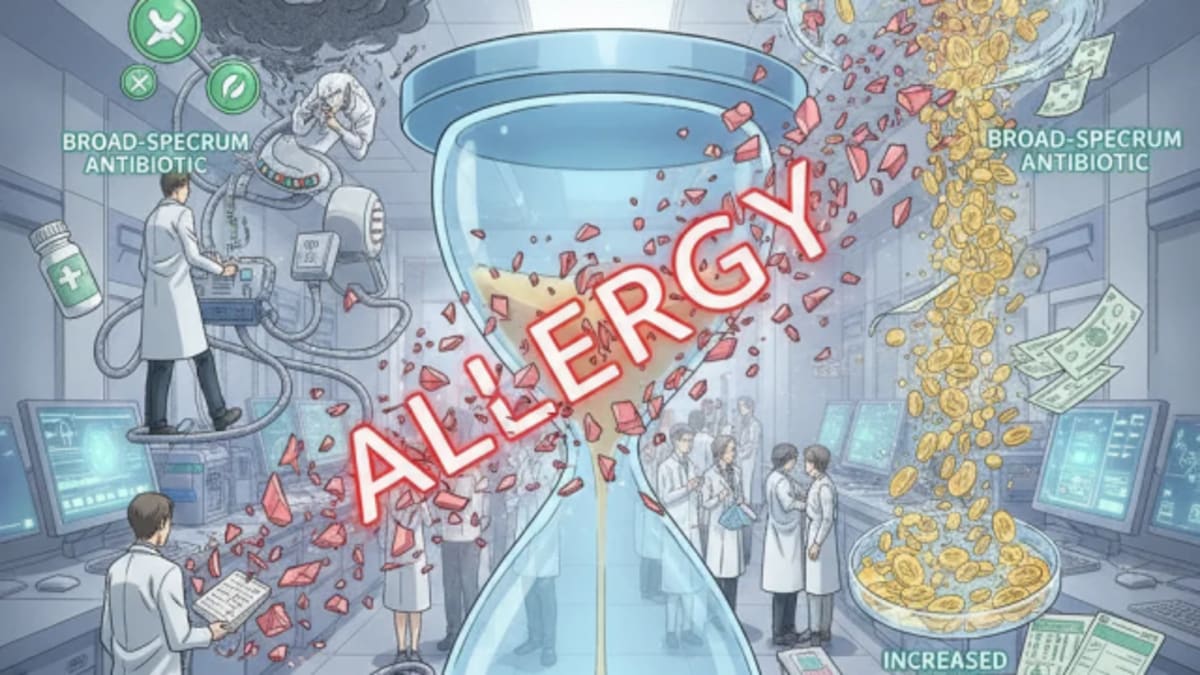

A significant proportion of patients in Europe carry a documented penicillin allergy, often based on childhood rashes or vague recollections rather than confirmed IgE-mediated reactions. This allergy label frequently leads to the use of broader-spectrum, more expensive, and potentially less effective antibiotics, contributing to antimicrobial resistance and poorer patient outcomes. The challenge lies in safely and efficiently delabelling these patients without requiring specialist allergy services for every case.
The prevailing assumption has been that only allergists can safely assess and delabel penicillin allergies. But for the vast majority of patients with low-risk histories, a structured, non-specialist-led workflow can effectively remove these labels, improving antibiotic stewardship and patient care.
The widespread issue of misdiagnosed penicillin allergy has profound implications for patient care and public health. When a patient is labelled as penicillin-allergic, clinicians often default to alternative antibiotic classes, such as fluoroquinolones, macrolides, or vancomycin. These alternatives are frequently associated with higher rates of adverse events, including Clostridioides difficile infection, nephrotoxicity, and cardiac arrhythmias. They also contribute to the escalating crisis of antimicrobial resistance, a critical concern for healthcare systems globally. The economic burden is also substantial, as alternative antibiotics are typically more expensive than penicillin-based regimens.
The problem stems from the fact that many reported penicillin allergies are not true IgE-mediated hypersensitivity reactions. Studies consistently show that between 80% and 90% of patients who report a penicillin allergy can safely receive penicillin after appropriate evaluation. These false labels often originate from childhood viral rashes misattributed to penicillin, non-specific gastrointestinal upset, or family history rather than a personal, confirmed allergic reaction. The fear of anaphylaxis, though rare, understandably makes clinicians hesitant to challenge these labels without clear guidance.
Identifying Low-Risk Patients for Delabelling
An essential first step in any delabelling workflow is accurate risk stratification. Patients with a history suggestive of a severe, IgE-mediated reaction, such as anaphylaxis, Stevens-Johnson syndrome, toxic epidermal necrolysis, or drug reaction with eosinophilia and systemic symptoms (DRESS) following penicillin exposure, are considered high-risk. These individuals require specialist allergist evaluation, including skin prick testing and potentially graded oral challenge, in a controlled environment with resuscitation capabilities. Their management falls outside the scope of a generalist-led delabelling protocol.
But the majority of patients fall into a low-risk category. These are individuals whose reported reactions were mild, remote in time, or non-specific. Examples include isolated rash without urticaria or angioedema, gastrointestinal upset, headache, or reactions that occurred more than 10 years ago without subsequent exposure. Patients who report a family history of penicillin allergy but no personal history also belong in this low-risk group. For these patients, a direct oral challenge can be safely performed by non-allergist clinicians, including general practitioners, pharmacists, or nurses trained in the protocol.
The Structured Oral Challenge Protocol
A typical low-risk delabelling workflow involves a direct oral challenge with amoxicillin, a common penicillin derivative. The protocol begins with a thorough history taking to confirm the low-risk status. This involves asking specific questions about the nature of the original reaction: What were the symptoms? How quickly did they appear after taking penicillin? What was the severity? Was medical attention required? How long ago did it occur? Any history of repeated exposure without reaction is also important to ascertain. This detailed history is paramount for accurate risk assessment and is often the most time-consuming part of the process.
Once low-risk status is confirmed, the patient receives a single, therapeutic dose of amoxicillin, typically 250mg or 500mg. The challenge should be performed in a clinical setting where the patient can be observed for at least 60 minutes after administration. This observation period allows for the detection of immediate hypersensitivity reactions, which typically manifest within this timeframe. Vital signs should be monitored before and after the challenge. If no reaction occurs, the patient is then advised to take a second dose at home 24 hours later and to report any delayed reactions. The management of eosinophilic disorders, for example, often relies on accurate allergy status.
The rationale behind using amoxicillin for the challenge is its broad cross-reactivity with other penicillins. If a patient tolerates amoxicillin, they are highly likely to tolerate other penicillins. This simplifies the delabelling process, as it avoids the need for individual challenges with every penicillin derivative. The direct oral challenge is preferred over skin testing for low-risk patients because skin testing can be resource-intensive, requires specific expertise, and has a lower negative predictive value for non-IgE mediated reactions. For a comprehensive overview of clinical practice, the Oxford Handbook of General Practice, 5th Edition, provides excellent guidance on such protocols.
Overcoming Barriers to Implementation
Implementing a non-allergist-led delabelling workflow requires addressing several practical and psychological barriers. Clinician education is paramount. Many healthcare professionals, including physicians, nurses, and pharmacists, lack confidence in assessing penicillin allergies and performing oral challenges. Training programs are essential to equip them with the necessary knowledge and skills for risk stratification, protocol execution, and management of potential reactions. These programs should cover the pathophysiology of penicillin allergy, the interpretation of allergy histories, and the practical steps of the oral challenge.
Establishing clear institutional protocols and guidelines is also critical. These protocols should outline the inclusion and exclusion criteria for the low-risk pathway, the specific steps of the oral challenge, and the management of adverse events. Support from hospital leadership and antimicrobial stewardship teams can facilitate the integration of these workflows into routine clinical practice. Electronic health record (EHR) systems can be leveraged to flag patients with penicillin allergy labels, prompt risk assessment, and document delabelling outcomes, ensuring that the updated allergy status is widely accessible across the healthcare system. This is particularly relevant given the rising rates of ocular allergy, which also benefit from clear documentation.
Patient education is another key component. Patients need to understand the benefits of delabelling, the safety of the procedure, and the importance of accurate allergy information. Addressing patient anxieties about potential reactions is essential for gaining their cooperation. Providing clear written instructions and follow-up guidance can empower patients to participate actively in the delabelling process. The success of such programs hinges on a collaborative approach involving multiple healthcare disciplines, including infectious disease specialists, pharmacists, and primary care providers.
The Impact of Delabelling on Antimicrobial Stewardship
The successful delabelling of penicillin allergies has a direct and measurable impact on antimicrobial stewardship. By removing an inaccurate allergy label, clinicians gain access to a broader range of first-line, narrow-spectrum antibiotics, many of which are penicillin-based. This reduces reliance on broad-spectrum alternatives, thereby mitigating the selective pressure that drives antimicrobial resistance. For example, a patient delabelled from penicillin allergy can receive amoxicillin for community-acquired pneumonia instead of a fluoroquinolone, which has a higher propensity for resistance development and adverse effects.
The benefits extend beyond individual patient care. At a systemic level, widespread delabelling initiatives can lead to a significant reduction in the consumption of reserve antibiotics, preserving their efficacy for truly resistant infections. This aligns with national and international efforts to combat antimicrobial resistance, a public health priority. The economic benefits are also considerable, as penicillin-class antibiotics are generally less expensive than their alternatives. This frees up resources that can be reallocated to other areas of patient care. The principles of multi-specialty collaboration are also vital here.
Still, the workflow is not without its limitations. The primary caveat is the reliance on accurate patient history. If a patient's recollection of their allergic reaction is incomplete or inaccurate, there is a risk of misclassifying a high-risk patient as low-risk. This highlights the importance of thorough history taking and clinical judgment. The protocol also requires a commitment to training and resource allocation for non-allergist staff, which can be a challenge in under-resourced settings. The long-term durability of delabelling, particularly for patients who may develop new allergies or re-sensitisation over time, also warrants ongoing monitoring and re-evaluation.
The trial was not powered to detect differences in very rare, severe reactions, and that gap matters. While the overall safety profile of direct oral challenge in low-risk patients is excellent, the possibility of an unforeseen severe reaction, however remote, always exists. This necessitates that the challenge be performed in a setting where emergency resuscitation equipment and trained personnel are immediately available. The generalizability of these workflows to all healthcare settings, particularly those with limited access to specialist support or robust electronic health records, remains an area for further development. The next step is to integrate these workflows into national guidelines, ensuring consistent application and widespread adoption across primary and secondary care.
The persistent overdiagnosis of penicillin allergy is a self-inflicted wound on our antibiotic armamentarium. General practitioners and hospitalists are perfectly capable of managing the vast majority of these cases, provided they have a clear, validated protocol. Delegating this task exclusively to allergists is inefficient and unnecessary for low-risk patients, creating bottlenecks that ultimately harm patients by forcing suboptimal antibiotic choices.
Implementing a structured delabelling workflow should be a priority for every healthcare system. This is not merely about convenience; it is a critical component of antimicrobial stewardship. By empowering non-allergist clinicians to safely remove inaccurate labels, we can reduce the reliance on broad-spectrum antibiotics, curb resistance, and improve patient safety. The cost savings from using cheaper, more effective first-line agents are an added bonus.
The onus is on institutions to provide the necessary training and support. This means clear guidelines, accessible educational modules, and perhaps even dedicated nursing or pharmacy staff to coordinate these efforts. The fear of anaphylaxis, while understandable, must be balanced against the very real and pervasive harms of antibiotic resistance and suboptimal treatment. We have the tools; it is time to use them systematically.
- The Pivot Non-allergist clinicians can safely delabel low-risk penicillin allergies using a structured workflow.
- The Data Up to 90% of reported penicillin allergies are not true IgE-mediated reactions.
- The Action Implement a validated penicillin allergy delabelling protocol in primary and secondary care settings to improve antibiotic prescribing.
ART-2026-1256
·10/26
Drafted with AI assistance, reviewed and approved by the editorial team. This publication is intended for healthcare professionals, researchers, and life science industry professionals. Content is provided for informational and educational purposes only and does not constitute medical advice.

I cover women's health, reproductive medicine, and the persistent gaps in how conditions that primarily affect women get studied and funded. The evidence base is thinner than it should be. I write about why.
Cite This Article
Mitchell S, Lopes W. Unmasking penicillin allergy: a workflow for the non-allergist. The Life Science Feed. Published August 27, 2026. Updated October 5, 2026. Accessed October 11, 2026. https://thelifesciencefeed.com/immunology/drug-hypersensitivity/practice/penicillin-allergy-delabelling-non-allergist-workflow.
Editorial & AI Standards
All content is researched from peer-reviewed, open-access sources: published trial data, clinical guidelines, and regulatory filings. AI tools are used solely to structure and summarise that evidence; no AI-generated conclusions appear without editor verification against the primary source.
Every article is reviewed by a named editor before publication. Source citations are listed in the References section. This content does not represent the views of any pharmaceutical company, medical device manufacturer, or healthcare provider.
Licence & Rights
© 2026 The Life Science Feed. All rights reserved. Unless otherwise indicated, all content is the property of The Life Science Feed and may not be reproduced, distributed, or transmitted in any form or by any means without prior written permission.
Medical Disclaimer
The information provided on The Life Science Feed is for educational and informational purposes only. It is not intended as a substitute for professional medical advice, diagnosis, or treatment. Always seek the advice of your physician or other qualified healthcare provider regarding any medical condition or treatment decision. Never disregard professional medical advice or delay in seeking it because of something you have read on this website.
References
1. Shenoy ES, Macy E, Rowe T, Blumenthal KG. Evaluation and Management of Penicillin Allergy: A Review. JAMA. 2019;321(2):188-199. doi:10.1001/jama.2018.19283
2. Castells M, Khan DA, Phillips EJ. Penicillin Allergy. N Engl J Med. 2019;381(24):2338-2351. doi:10.1056/NEJMra1807761
3. Banerji A, Solensky R, Phillips EJ, Khan DA. Drug Allergy Practice Parameter Updates to Incorporate Into Your Clinical Practice. J Allergy Clin Immunol Pract. 2023;11(2):356-368.e5. doi:10.1016/j.jaip.2022.12.002
4. Campagna JD, Bond MC, Schabelman E, Hayes BD. The use of cephalosporins in penicillin-allergic patients: a literature review. J Emerg Med. 2012;42(5):612-20. doi:10.1016/j.jemermed.2011.05.035
5. Zembles T, Mitchell M, Alqurashi W, Castells M, Phillips EJ, Vyles D. Skin Testing for Penicillin Allergy: a Review of the Literature. Curr Allergy Asthma Rep. 2021;21(3):21. doi:10.1007/s11882-021-00997-x
6. Blumenthal KG, Peter JG, Trubiano JA, Phillips EJ. Antibiotic allergy. Lancet. 2019;393(10167):183-198. doi:10.1016/S0140-6736(18)32218-9