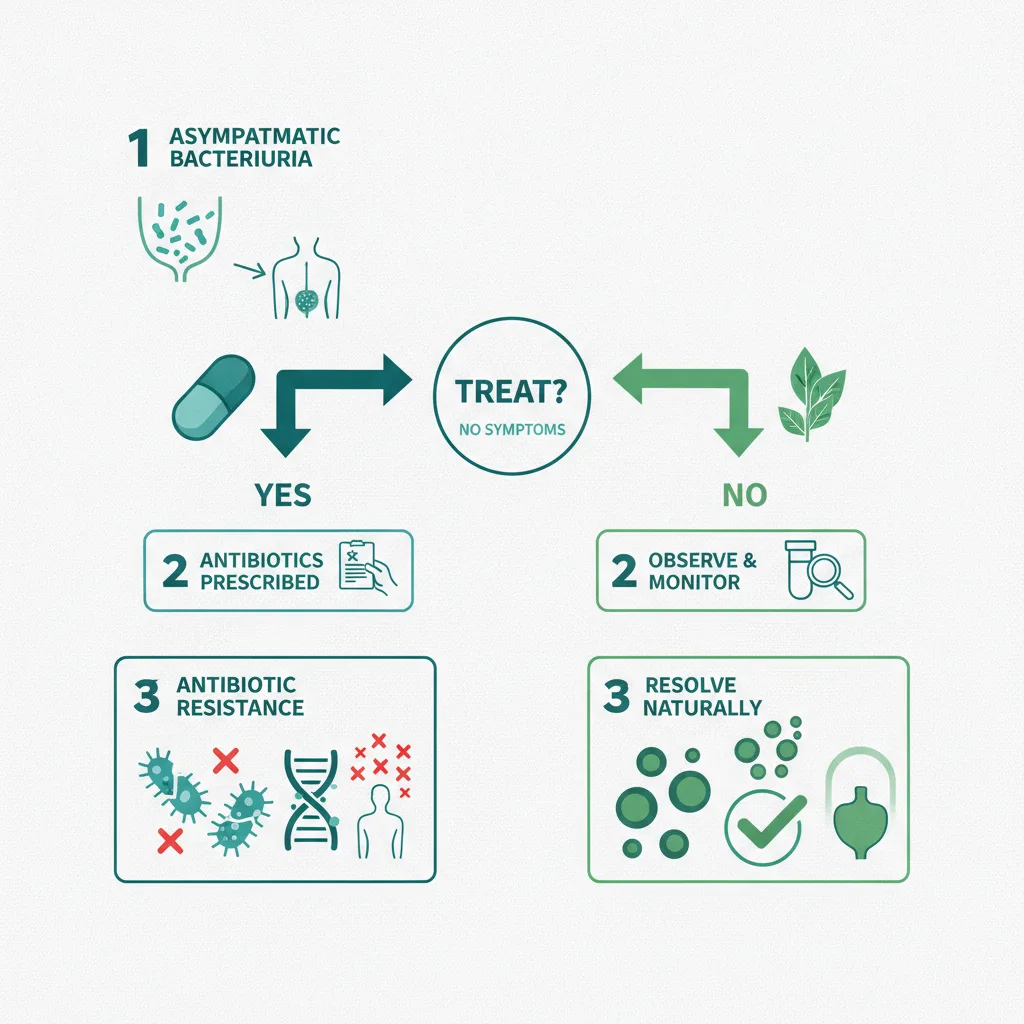

The presence of bacteria in urine without symptoms of a urinary tract infection (UTI) is a common finding, particularly in certain patient populations. This condition, known as asymptomatic bacteriuria (ASB), presents a frequent clinical dilemma: to treat or not to treat. The decision often carries significant implications for both individual patient health and broader public health efforts to combat antimicrobial resistance.
Despite clear guidance, the impulse to eradicate bacteria from the urinary tract persists, leading to widespread and often inappropriate antibiotic use. This practice contributes directly to the escalating crisis of antibiotic resistance, creating a cycle where more drugs are used, but fewer remain effective.
Asymptomatic bacteriuria is defined by the isolation of a specified quantitative count of bacteria in a urine culture from an individual without symptoms or signs referable to a urinary tract infection. This condition is prevalent, affecting 1-5% of healthy premenopausal women, 10% of postmenopausal women, and up to 20% of elderly women in long-term care facilities. Men are less commonly affected, but prevalence increases with age and prostate issues. The mere presence of bacteria, even in significant numbers, does not automatically equate to infection requiring intervention.
The historical rationale for treating ASB stemmed from a concern that untreated bacteriuria could progress to symptomatic UTIs, pyelonephritis, or even sepsis. This concern, while valid for symptomatic infections, has largely been disproven for asymptomatic cases in most patient groups. Early studies, often lacking rigorous control groups, sometimes conflated bacteriuria with true infection, leading to a default practice of treatment.
Understanding the Pathophysiology of Asymptomatic Bacteriuria
The urinary tract is not sterile, a concept that has gained increasing recognition. While traditionally considered sterile above the urethra, modern molecular techniques reveal a diverse urinary microbiome. The presence of bacteria in the bladder, therefore, can represent colonization rather than an active pathogenic process. These colonizing bacteria may even offer a protective effect by competing with more virulent strains.
The host immune response plays a critical role in distinguishing colonization from infection. In ASB, the host immune system effectively contains the bacterial presence without eliciting an inflammatory response or clinical symptoms. This delicate balance is disrupted in symptomatic UTIs, where bacterial virulence factors overcome host defenses, leading to inflammation and tissue damage.
The Evidence Against Routine Treatment
Multiple guidelines from major infectious disease and urology societies consistently recommend against screening for or treating ASB in most populations. This includes healthy non-pregnant women, diabetic patients, elderly individuals residing in the community or long-term care facilities, and patients with indwelling urinary catheters. The evidence base for these recommendations is substantial and consistent.
Treating ASB in these groups does not reduce the incidence of subsequent symptomatic UTIs, prevent renal damage, or improve survival. Instead, it exposes patients to unnecessary antibiotic side effects, including gastrointestinal disturbances, rash, and Clostridioides difficile infection. The most significant consequence, however, is the acceleration of antimicrobial resistance.
The Resistance Conundrum
Every course of antibiotics exerts selective pressure, favoring the survival and proliferation of resistant bacteria. When antibiotics are used to treat ASB, they eliminate susceptible bacteria, leaving behind resistant strains that can then colonize the patient or spread to others. This contributes directly to the global crisis of antimicrobial resistance, making future infections harder to treat. The Oxford Handbook of Infectious Diseases and Microbiology provides comprehensive guidance on this complex relationship between antibiotic use and resistance development.
The repeated exposure to antibiotics for ASB can lead to multidrug-resistant organisms (MDROs) in the urinary tract, which become problematic if a true symptomatic infection develops later. This is particularly concerning in vulnerable populations, where treatment options for MDROs are often limited and associated with higher toxicity and cost. The long-term implications for public health are severe, as the pool of effective antibiotics diminishes.
When Treatment is Indicated
There are specific, well-defined circumstances where treating ASB is recommended. The most prominent is during pregnancy. Untreated ASB in pregnant women is associated with an increased risk of pyelonephritis, preterm labor, and low birth weight. Therefore, screening for ASB is recommended early in pregnancy, and positive cases should be treated with appropriate antibiotics.
Other situations where ASB treatment may be considered include prior to invasive urological procedures where mucosal bleeding is anticipated, such as transurethral resection of the prostate or cystoscopy with biopsy. In these cases, a short course of prophylactic antibiotics can reduce the risk of post-procedure sepsis. But, even in these scenarios, the decision should be carefully weighed, and the duration of treatment kept to a minimum.
Navigating the Clinical Decision
The challenge for clinicians lies in distinguishing ASB from a true symptomatic UTI, especially in patients with non-specific symptoms or those unable to communicate clearly, such as the elderly or individuals with cognitive impairment. A positive urine culture alone is insufficient for diagnosis; clinical symptoms must be present. Symptoms like dysuria, frequency, urgency, suprapubic pain, or fever are key indicators of a symptomatic infection.
In the absence of these classic symptoms, a positive urine culture should prompt careful consideration of the patient's overall clinical picture. For instance, an elderly patient with mild confusion but no other signs of UTI and a positive urine culture likely has ASB, and antibiotics are not warranted. Attributing non-specific symptoms to a UTI based solely on bacteriuria is a common pitfall that drives inappropriate prescribing.
The Role of Diagnostic Stewardship
Improving diagnostic stewardship is as important as antibiotic stewardship in managing ASB, as both are essential for preserving antibiotic effectiveness. This involves educating clinicians on the appropriate indications for urine culture testing and the interpretation of results. Routine urine cultures in asymptomatic individuals should be avoided, except in the specific populations where screening is recommended, such as pregnant women.
When a urine culture is performed, the result must be interpreted in the context of the patient's symptoms. A positive culture in an asymptomatic patient should not automatically trigger an antibiotic prescription. Instead, it should prompt a re-evaluation of the patient's clinical status and a reaffirmation of the ASB diagnosis. This approach helps to prevent unnecessary antibiotic exposure and preserve the efficacy of existing agents.
The widespread availability of rapid urine dipstick tests can sometimes exacerbate the problem. A positive nitrite or leukocyte esterase result in an asymptomatic patient can lead to an unnecessary culture and subsequent treatment. Clinicians must remember that these tests have limited utility in asymptomatic individuals and should not be used for screening in most settings. The focus must remain on clinical presentation, not laboratory findings in isolation.
The ongoing battle against antimicrobial resistance requires a concerted effort from all healthcare providers. Adhering to guidelines for ASB management is a straightforward yet impactful step in this fight. It demands a shift from a reflex to treat any bacterial presence to a thoughtful, evidence-based approach that prioritizes patient safety and public health. This includes understanding the nuances of antibiotic prescribing for various infections, ensuring appropriate drug selection and duration.
The persistent over-treatment of asymptomatic bacteriuria is a glaring example of how well-intentioned clinical practice can inadvertently fuel a global health crisis. Clinicians must internalize the fact that a positive urine culture in an asymptomatic patient is, in most cases, a normal finding, not a disease requiring intervention. The reflex to prescribe antibiotics for this condition is a habit that needs to be broken.
This issue extends beyond individual patient care; it is a significant driver of antimicrobial resistance, eroding the effectiveness of our most critical drugs. Every unnecessary prescription for ASB contributes to the selection pressure that favors resistant strains, making future infections harder to treat for everyone. The long-term consequences of this widespread practice are dire, impacting public health systems and patient outcomes globally.
Guideline adherence is not optional here; it is a professional imperative. The evidence is clear: treating ASB in non-pregnant adults, the elderly, or catheterized patients offers no benefit and carries substantial risks. We must educate ourselves and our colleagues, challenging the ingrained assumptions that lead to inappropriate antibiotic use. The preservation of effective antibiotics depends on this collective discipline.
- The Pivot Routine screening and treatment of asymptomatic bacteriuria in most populations does not improve clinical outcomes and actively contributes to antimicrobial resistance.
- The Data Treating ASB in non-pregnant adults, catheterized patients, or the elderly does not prevent symptomatic UTIs or other adverse events.
- The Action Clinicians should adhere strictly to guidelines recommending against ASB treatment, reserving antibiotics for symptomatic infections or specific high-risk groups.
ART-2026-1375
·10/26
Drafted with AI assistance, reviewed and approved by the editorial team. This publication is intended for healthcare professionals, researchers, and life science industry professionals. Content is provided for informational and educational purposes only and does not constitute medical advice.

Thirty years in health journalism, the last fifteen in life sciences. I have reported from every major medical congress and watched blockbuster drugs get revised after approval. I cover what the data says.
Cite This Article
Carter J, Voss M. Asymptomatic bacteriuria: the treatment decision that fuels antibiotic resistance. The Life Science Feed. Published August 27, 2026. Updated October 6, 2026. Accessed October 11, 2026. https://thelifesciencefeed.com/infectious-diseases/drug-resistance-microbial/insights/asymptomatic-bacteriuria-antibiotic-resistance.
Editorial & AI Standards
All content is researched from peer-reviewed, open-access sources: published trial data, clinical guidelines, and regulatory filings. AI tools are used solely to structure and summarise that evidence; no AI-generated conclusions appear without editor verification against the primary source.
Every article is reviewed by a named editor before publication. Source citations are listed in the References section. This content does not represent the views of any pharmaceutical company, medical device manufacturer, or healthcare provider.
Licence & Rights
© 2026 The Life Science Feed. All rights reserved. Unless otherwise indicated, all content is the property of The Life Science Feed and may not be reproduced, distributed, or transmitted in any form or by any means without prior written permission.
Medical Disclaimer
The information provided on The Life Science Feed is for educational and informational purposes only. It is not intended as a substitute for professional medical advice, diagnosis, or treatment. Always seek the advice of your physician or other qualified healthcare provider regarding any medical condition or treatment decision. Never disregard professional medical advice or delay in seeking it because of something you have read on this website.
References
1. Luu T, Albarillo FS. Asymptomatic Bacteriuria: Prevalence, Diagnosis, Management, and Current Antimicrobial Stewardship Implementations. Am J Med. 2022;135(8):e236-e244. doi:10.1016/j.amjmed.2022.03.015
2. Krinitski D, Kasina R, Klöppel S, Lenouvel E. Associations of delirium with urinary tract infections and asymptomatic bacteriuria in adults aged 65 and older: A systematic review and meta-analysis. J Am Geriatr Soc. 2021;69(11):3312-3323. doi:10.1111/jgs.17418
3. Gołębiewska JE, Krawczyk B, Wysocka M, Dudziak A, Dębska-Ślizień A. Asymptomatic Bacteriuria in Kidney Transplant Recipients-A Narrative Review. Medicina (Kaunas). 2023;59(2). doi:10.3390/medicina59020198
4. Smaill FM, Vazquez JC. Antibiotics for asymptomatic bacteriuria in pregnancy. Cochrane Database Syst Rev. 2019;2019(11). doi:10.1002/14651858.CD000490.pub4
5. Nicolle LE, Gupta K, Bradley SF, et al. Clinical Practice Guideline for the Management of Asymptomatic Bacteriuria: 2019 Update by the Infectious Diseases Society of America. Clin Infect Dis. 2019;68(10):e83-e110. doi:10.1093/cid/ciy1121
6. Ansaldi Y, Martinez de Tejada Weber B. Urinary tract infections in pregnancy. Clin Microbiol Infect. 2023;29(10):1249-1253. doi:10.1016/j.cmi.2022.08.015