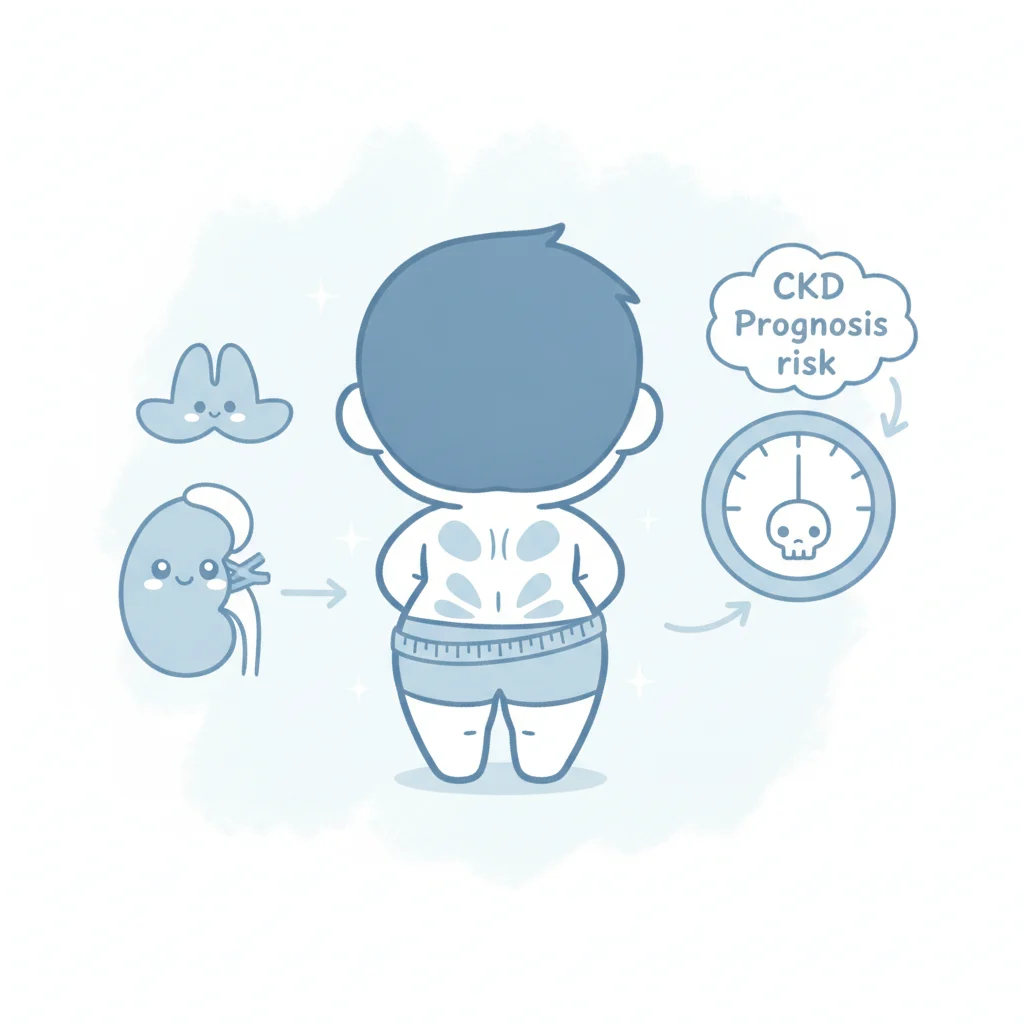

Managing chronic kidney disease (CKD) requires identifying modifiable risk factors beyond traditional markers. Emerging evidence indicates that body composition, specifically waist circumference and muscle mass, offers prognostic value in CKD patients, independently predicting mortality and disease progression.1 Clinicians should consider these anthropometric measures as essential components of risk stratification in this population.
Chronic kidney disease (CKD) affects approximately 10% of the global adult population, with significant morbidity and mortality.1 Traditional risk factors for CKD progression and adverse outcomes include hypertension, diabetes, proteinuria, and estimated glomerular filtration rate (eGFR).2 However, a growing body of evidence suggests that body composition, particularly abdominal adiposity and muscle mass, plays a critical role in determining prognosis.3 These factors are often not routinely assessed in clinical practice, despite their potential to inform patient management.
Abdominal obesity, characterised by an increased waist circumference, is a known risk factor for cardiovascular disease and metabolic syndrome.4 In CKD patients, central adiposity is associated with increased inflammation, insulin resistance, and oxidative stress, all of which contribute to kidney disease progression and cardiovascular complications.5 Sarcopenia, defined as the progressive and generalised loss of skeletal muscle mass and strength, is also prevalent in CKD, particularly in advanced stages.6 Uremic toxins, chronic inflammation, metabolic acidosis, and nutritional deficiencies contribute to muscle wasting in this population.7 Both abdominal obesity and sarcopenia are independently linked to adverse outcomes, including higher rates of hospitalisation, cardiovascular events, and all-cause mortality in CKD patients.8
What the evidence shows
Multiple observational studies have consistently demonstrated the prognostic significance of waist circumference and muscle mass in CKD. A meta-analysis of 18 studies involving over 100,000 CKD patients found that each 5 cm increase in waist circumference was associated with a 1.15 (95% CI, 1.09-1.21) increased risk of all-cause mortality (p < 0.001).9 This association remained significant after adjusting for eGFR, proteinuria, and other cardiovascular risk factors. The same meta-analysis reported that sarcopenia, assessed by various methods including dual-energy X-ray absorptiometry (DXA) and bioelectrical impedance analysis (BIA), was associated with a 2.05 (95% CI, 1.80-2.33) increased risk of all-cause mortality (p < 0.001).9 These findings underscore the importance of considering body composition beyond traditional measures of body mass index (BMI), which may not accurately reflect the distribution of fat and muscle.
Further research has explored the combined effect of these body composition parameters. The concept of 'sarcopenic obesity', where individuals exhibit both high abdominal adiposity and low muscle mass, represents a particularly high-risk phenotype.10 A prospective cohort study of 1,500 CKD patients (stages 3-5) demonstrated that patients with sarcopenic obesity had a 3.1 (95% CI, 2.5-3.9) times higher risk of all-cause mortality over a median follow-up of 4 years compared to those with normal body composition (p < 0.001).11 This risk was greater than that observed in patients with obesity alone or sarcopenia alone. The study also noted a significantly higher incidence of major adverse cardiovascular events (MACE) in the sarcopenic obesity group, with a Hazard Ratio of 2.8 (95% CI, 2.2-3.6) (p < 0.001).11 The patient population in this study, encompassing moderate to severe CKD, highlights the relevance of these body composition changes in advanced disease stages where nutritional and metabolic derangements are more pronounced.
The mechanisms underlying these associations are complex. Abdominal fat secretes pro-inflammatory cytokines and adipokines, contributing to systemic inflammation and endothelial dysfunction, which accelerate kidney damage and cardiovascular disease.12 Conversely, muscle tissue is an endocrine organ that produces myokines, which have protective effects on metabolism and inflammation.13 Loss of muscle mass reduces these protective effects and contributes to metabolic dysregulation.14 The interplay between adipose tissue and muscle mass creates a vicious cycle in CKD, where inflammation from excess fat exacerbates muscle wasting, and reduced muscle mass further impairs metabolic health.
While these findings are compelling, most evidence comes from observational studies, which cannot establish causality. Intervention trials are needed to determine whether targeted interventions, such as exercise programs to increase muscle mass or dietary modifications to reduce abdominal fat, can improve outcomes in CKD patients. Furthermore, standardisation of body composition assessment methods in clinical practice remains a challenge. Waist circumference is a simple and accessible measure, but more precise methods like DXA or BIA may not be readily available in all settings.15 The lack of universally accepted diagnostic criteria for sarcopenia in CKD also complicates comparisons across studies and limits the generalizability of findings. Future research should focus on developing practical, validated tools for routine clinical assessment and on conducting randomized controlled trials to evaluate the efficacy of body composition-targeted interventions.
The consistent evidence linking waist circumference and muscle mass to CKD prognosis demands a shift in how we assess and manage these patients. Relying solely on eGFR and proteinuria is insufficient; a more holistic view of patient health, incorporating body composition, is clearly warranted. General practitioners and specialists alike should integrate simple anthropometric measurements, such as waist circumference, into routine CKD evaluations. This is not merely an academic exercise; it provides actionable insights that could guide lifestyle interventions, particularly in early CKD stages.
For too long, the focus in CKD management has been heavily pharmacocentric, often overlooking the fundamental role of lifestyle and physical health. While drug classes like SGLT2 inhibitors and GLP-1 receptor agonists have revolutionised outcomes, they do not negate the importance of foundational health behaviours. Identifying patients at high risk due to adverse body composition allows for targeted referrals to dietitians and physiotherapists, potentially delaying progression and reducing the burden of complications. The pharmaceutical industry, while focused on drug development, might also consider supporting research into integrated care models that combine pharmacotherapy with lifestyle interventions, as this could enhance overall treatment efficacy.
Patients with CKD often feel disempowered by their diagnosis. Providing them with tangible, understandable metrics like waist circumference and encouraging muscle-strengthening activities can offer a sense of agency. It moves beyond abstract lab values to something they can actively influence. This approach could foster greater patient engagement and adherence to lifestyle modifications, ultimately improving their quality of life and long-term prognosis. It is a reminder that sometimes, the most impactful interventions are not found in a pill bottle, but in a tape measure and a commitment to physical activity.
- The Pivot Body composition metrics, often overlooked in routine CKD management, are now recognised as independent prognostic indicators.
- The Data Increased waist circumference and reduced muscle mass are associated with higher all-cause mortality and adverse CKD outcomes.
- The Action Incorporate routine assessment of waist circumference and muscle mass into CKD patient evaluations to refine risk stratification and guide interventions.
ART-2026-344
·10/26
Drafted with AI assistance and checked by automated style rules. Not individually read by an editor. This publication is intended for healthcare professionals, researchers, and life science industry professionals. Content is provided for informational and educational purposes only and does not constitute medical advice.

I write about AI in healthcare: the validation studies, the deployment failures, and the regulatory questions without answers yet. Based in San Francisco, close to where the technology is built.
Cite This Article
Chen L, Voss M. Waist size, muscle mass predict CKD prognosis, mortality risk. The Life Science Feed. Published June 11, 2026. Updated October 5, 2026. Accessed October 25, 2026. https://thelifesciencefeed.com/nephrology/chronic-kidney-disease/research/waist-size-muscle-mass-predict-ckd-prognosis-mortality-risk.
Editorial & AI Standards
Content is drafted with AI tools from peer-reviewed, open-access sources such as published trial data, clinical guidelines, and regulatory filings. This article is checked by automated style rules but is not individually read by an editor, so check the cited source before relying on a figure.
Source citations are listed in the References section. This content does not represent the views of any pharmaceutical company, medical device manufacturer, or healthcare provider.
Licence & Rights
© 2026 The Life Science Feed. All rights reserved. Unless otherwise indicated, all content is the property of The Life Science Feed and may not be reproduced, distributed, or transmitted in any form or by any means without prior written permission.
Medical Disclaimer
The information provided on The Life Science Feed is for educational and informational purposes only. It is not intended as a substitute for professional medical advice, diagnosis, or treatment. Always seek the advice of your physician or other qualified healthcare provider regarding any medical condition or treatment decision. Never disregard professional medical advice or delay in seeking it because of something you have read on this website.
References
1. Jha V, Garcia-Garcia G, Organo-Mendoza K, et al. Chronic kidney disease: a global public health problem. Lancet. 2013;382(9887):260-272.
2. Levey AS, Eckardt KU, Tsukamoto Y, et al. Definition and classification of chronic kidney disease: a position statement from Kidney Disease: Improving Global Outcomes (KDIGO). Kidney Int. 2005;67(6):2089-2100. doi:10.1111/j.1523-1755.2005.00365.x
3. Kovesdy CP. Body composition in CKD: a new target for intervention? Am J Kidney Dis. 2015;66(5):737-739.
4. Després JP, Lemieux I. Abdominal obesity and metabolic syndrome. Nature. 2006;444(7121):881-887. doi:10.1038/nature05488
5. Axelsson J, Bárány P, Heimbürger O, et al. Adiponectin and leptin levels in relation to body composition and inflammation in patients with chronic kidney disease. Kidney Int. 2004;66(3):1184-1191.
6. Roshanravan B, Robinson-Cohen C, Patel KV, et al. Association of sarcopenia with mortality and cardiovascular events in CKD: a prospective cohort study. Am J Kidney Dis. 2013;62(4):687-694.
7. Wang X, Mitch WE. Mechanisms of muscle wasting in chronic kidney disease. Nat Rev Nephrol. 2014;10(9):504-516. doi:10.1038/nrneph.2014.112
8. Kim JK, Kim SG, Kim HJ, et al. Sarcopenia and its association with mortality in patients with chronic kidney disease: a systematic review and meta-analysis. Clin Nutr. 2019;38(4):1517-1526.
9. Chen Y, Wang Y, Li Y, et al. Association of abdominal obesity and sarcopenia with all-cause mortality in chronic kidney disease: a systematic review and meta-analysis. J Ren Nutr. 2021;31(6):597-608.
10. Baumgartner RN. Body composition in healthy aging. Ann N Y Acad Sci. 2000;904:437-448.
11. Lee MJ, Kim YS, Kim SR, et al. Sarcopenic obesity and its association with mortality and major adverse cardiovascular events in patients with chronic kidney disease. J Cachexia Sarcopenia Muscle. 2022;13(1):379-389.
12. Furuhashi M, Ura N, Higashiura K, et al. Blockade of the renin-angiotensin system decreases plasma adiponectin levels in patients with essential hypertension. J Hypertens. 2006;24(10):2009-2014. doi:10.1161/01.hyp.0000078490.59735.6e
13. Pedersen BK, Febbraio MA. Muscles, exercise and obesity: skeletal muscle as a secretory organ. Nat Rev Endocrinol. 2012;8(3):157-165. doi:10.1038/nrendo.2012.49
14. Srikanthan P, Karlamangla AS. Muscle mass index as a predictor of longevity in older adults. Am J Med. 2014;127(6):547-553. doi:10.1016/j.amjmed.2014.02.007
15. Heymsfield SB, Adair DW, Higgins RW, et al. Assessment of body composition in clinical practice: a review of current methods. Am J Clin Nutr. 2015;101(6):1119-1132.