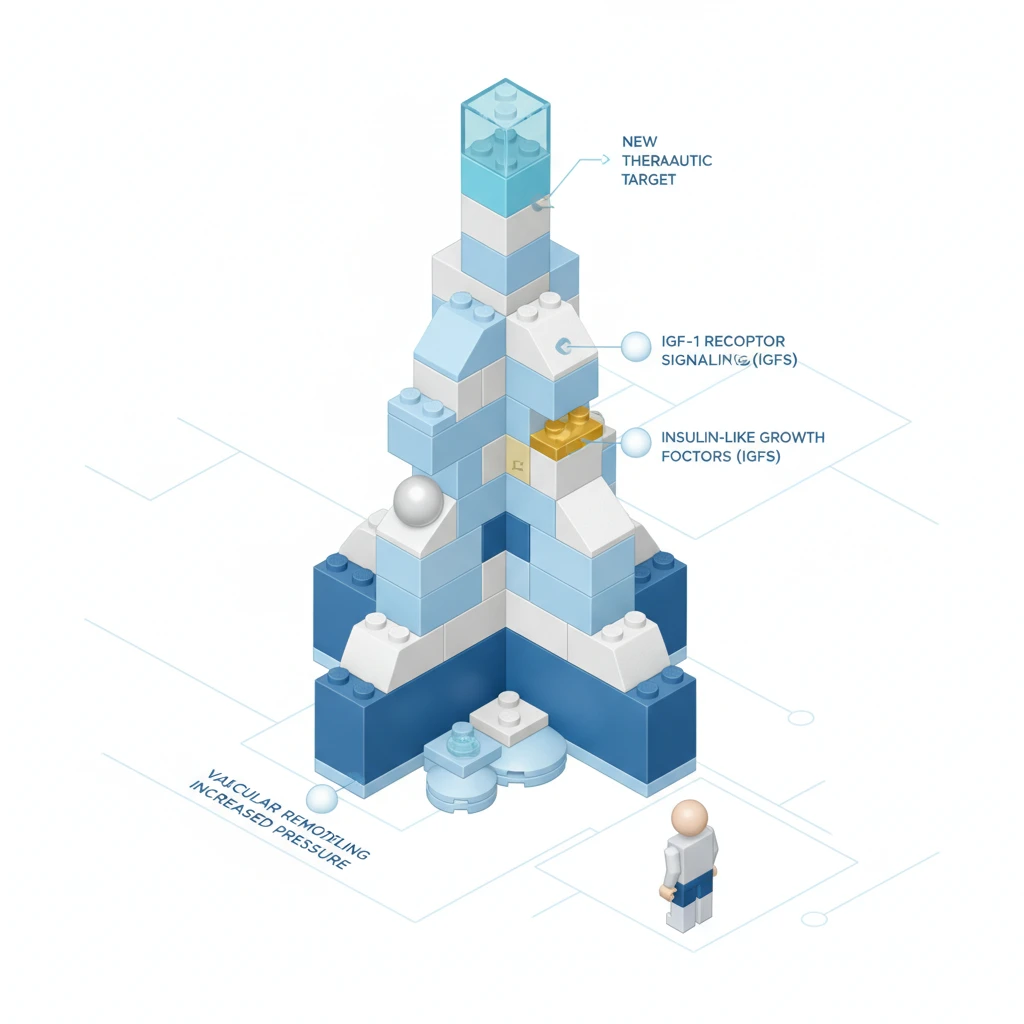

Pulmonary arterial hypertension (PAH) remains a progressive and life-threatening cardiopulmonary disorder, despite advances in symptomatic management. Current therapies improve clinical outcomes but do not offer curative options, leaving a significant unmet need for disease-modifying strategies. Understanding the complex pathogenesis of PAH, particularly the early events driving vascular remodeling, is critical for developing novel interventions.1
Pulmonary arterial hypertension (PAH) is a devastating condition characterized by increased pulmonary vascular resistance and right ventricular failure. The disease's progression is driven by a cascade of events, beginning with endothelial dysfunction and culminating in profound vascular remodeling. This remodeling involves the proliferation of pulmonary artery smooth muscle cells, activation of fibroblasts, and excessive deposition of extracellular matrix, all contributing to the narrowing of pulmonary arteries.1
Endothelial dysfunction, an early and central event in PAH, disrupts the delicate balance between vasodilators and vasoconstrictors. It also increases vascular permeability and promotes a pro-thrombotic state within the pulmonary vasculature. These initial changes set the stage for the subsequent and more severe vascular alterations that define PAH. Identifying and targeting these early pathogenic mechanisms is paramount for developing truly disease-modifying therapies.1
The IGF Family's Role in PAH Pathogenesis
Recent evidence highlights the significant contribution of the insulin-like growth factor (IGF) family to both vascular remodeling and endothelial dysfunction in PAH. The IGF family encompasses insulin-like growth factors (IGFs), IGF binding proteins (IGFBPs), and IGFBP-related proteins (IGFBPLs). These molecules operate through intricate signaling networks involving IGF receptors and various regulatory proteins, directly influencing cellular processes critical to PAH.1
Specifically, IGFs promote the proliferation of pulmonary artery smooth muscle cells, a hallmark of vascular remodeling in PAH. They also drive the accumulation of extracellular matrix, further stiffening and narrowing the pulmonary arteries. These actions directly aggravate the vascular alterations characteristic of the disease, suggesting that the IGF pathway is not merely an incidental bystander but an active participant in disease progression.1
The review by Li, Mo, and Dai, published in Frontiers in Physiology, consolidates current evidence on the IGF family's roles in PAH pathogenesis.1 The authors emphasize its contributions to vascular remodeling, endothelial dysfunction, and right ventricular adaptation. This comprehensive review aims to delineate the distinct yet interconnected actions of IGF-related molecules, with the ultimate goal of identifying potential diagnostic biomarkers and therapeutic targets for PAH management.1
Mechanistic Insights into IGF Signaling
The IGF system is complex, involving IGF-1 and IGF-2, their respective receptors (IGF-1R and IGF-2R), and a series of six high-affinity IGFBPs (IGFBP-1 to -6) that modulate IGF bioavailability and activity. IGF-1R, a tyrosine kinase receptor, mediates most of the anabolic and anti-apoptotic effects of IGFs. Activation of IGF-1R triggers downstream signaling pathways, including the PI3K/Akt and MAPK/ERK pathways, which are known to regulate cell proliferation, survival, and migration. In the context of PAH, aberrant activation of these pathways in pulmonary vascular cells contributes to the uncontrolled growth and survival of smooth muscle cells.1
IGF-1, in particular, has been shown to be elevated in the serum and lung tissue of patients with PAH. This elevation correlates with disease severity and progression. IGF-1 promotes the proliferation of human pulmonary artery smooth muscle cells (HPASMCs) and inhibits their apoptosis, leading to an accumulation of these cells in the pulmonary arterial wall. This effect is mediated through the IGF-1R and its downstream signaling cascades, which are often dysregulated in PAH.1
But the role of IGFBPs is equally critical. These proteins bind IGFs with high affinity, regulating their access to receptors and thus modulating their biological activity. Some IGFBPs inhibit IGF action by sequestering them, while others can enhance IGF effects or exert IGF-independent actions. For instance, IGFBP-3, the most abundant IGFBP, can either inhibit or potentiate IGF-1 actions depending on the cellular context and its proteolytic state. Dysregulation of specific IGFBPs in PAH could therefore contribute to the pathological effects of IGFs.1
The review also touches upon IGFBP-related proteins (IGFBPLs), a less characterized subgroup within the IGF family. While their specific involvement in PAH is still being elucidated, these proteins are known to participate in various cellular processes, including cell adhesion, migration, and angiogenesis. Their potential contribution to the complex vascular remodeling seen in PAH warrants further investigation. Understanding the precise roles of individual IGFBPs and IGFBPLs could uncover more specific therapeutic targets.1
Impact on Endothelial Dysfunction and Vascular Remodeling
Endothelial dysfunction is not merely an initiating event; it actively contributes to the perpetuation of vascular remodeling. Impaired endothelial cell function leads to reduced production of vasodilators like nitric oxide and prostacyclin, while increasing vasoconstrictors such as endothelin-1. This imbalance drives sustained vasoconstriction and promotes further smooth muscle cell proliferation. IGFs exacerbate this dysfunction by promoting endothelial cell apoptosis and impairing their regenerative capacity, creating a vicious cycle that accelerates disease progression.1
The vascular remodeling in PAH is characterized by a significant increase in the medial thickness of pulmonary arteries, due to the proliferation and migration of smooth muscle cells. Fibroblast activation and excessive extracellular matrix deposition also contribute to this structural reorganization, leading to increased stiffness and reduced compliance of the pulmonary vasculature. IGFs directly stimulate these processes, acting as potent mitogens for smooth muscle cells and enhancing fibroblast activity. This makes the IGF pathway a central player in the structural changes that ultimately lead to right ventricular failure.1
The right ventricle (RV) in PAH initially adapts to the increased afterload by undergoing hypertrophy. But sustained pressure overload eventually leads to RV dysfunction and failure, which is the primary cause of death in PAH patients. The IGF family also influences RV adaptation. While IGF-1 can initially support physiological hypertrophy, chronic activation and dysregulation of the IGF pathway can contribute to pathological remodeling and fibrosis in the RV, ultimately leading to decompensation. This dual role suggests that targeting IGFs must be carefully considered to avoid unintended consequences on cardiac function.1
Potential for Diagnostic Biomarkers and Therapeutic Targets
The intricate involvement of the IGF family in PAH pathogenesis positions its components as promising candidates for diagnostic biomarkers, as measuring circulating levels of IGFs or specific IGFBPs could provide insights into disease activity, severity, and prognosis. For example, persistently elevated IGF-1 levels might indicate ongoing vascular remodeling and a higher risk of progression. Such biomarkers could aid in early diagnosis and help monitor treatment response, guiding precision strategies for PAH management.1
From a therapeutic perspective, modulating the IGF pathway offers several avenues. Inhibiting IGF-1R signaling, for instance, could reduce pulmonary artery smooth muscle cell proliferation and extracellular matrix deposition. Small molecule inhibitors targeting IGF-1R have been developed for various cancers, and their potential application in PAH warrants investigation. But the widespread physiological roles of IGFs mean that systemic inhibition could lead to significant off-target effects, necessitating highly specific approaches.1
Alternatively, targeting specific IGFBPs that promote pathological IGF actions could offer a more tailored approach. For example, if a particular IGFBP is found to enhance IGF-mediated smooth muscle cell proliferation, developing an antagonist for that specific binding protein could selectively mitigate the detrimental effects without broadly disrupting IGF signaling. This precision approach aligns with the growing understanding of PAH as a heterogeneous disease requiring tailored interventions. Clinicians seeking to deepen their understanding of complex cardiovascular conditions might find the Braunwald's Heart Disease textbook a valuable resource for such intricate pathways.1
The review also highlights the need for further research to fully characterize the specific involvement of each IGF family member in PAH. While the IGF family has been implicated in a range of cardiovascular disorders, its precise role in PAH remains insufficiently detailed. Future studies should focus on delineating the distinct yet interconnected actions of IGF-related molecules, potentially through genetic studies, animal models, and human translational research. This will be essential for translating these mechanistic insights into effective clinical strategies, as the stakes are the development of effective clinical strategies.1
But the complexity of the IGF system presents a challenge. The redundancy and compensatory mechanisms within the IGF pathway mean that simply blocking one component might not yield the desired therapeutic effect. Combination therapies, targeting multiple aspects of the IGF system or combining IGF modulation with existing PAH therapies, could be more effective. This approach has shown promise in other complex diseases and might be necessary to overcome the robust pathological mechanisms in PAH.1
The open-label design of much of the mechanistic research on IGFs is an obvious caveat. While in vitro and animal studies provide strong evidence for the involvement of IGFs, clinical validation in well-designed human trials is still largely absent. The direct translation of these findings into human therapeutics requires rigorous testing to confirm efficacy and safety. This gap matters, as many preclinical targets fail in human trials due to unforeseen complexities in human physiology. For those interested in the broader context of pulmonary conditions, our previous coverage on novel adaptive study programmes for PAH offers additional perspectives on therapeutic development.1
The review by Li, Mo, and Dai provides a comprehensive overview, but it is a review, not a primary research paper presenting new data. It synthesizes existing knowledge, which is valuable, but it does not offer novel experimental evidence or clinical trial results. The conclusions drawn are based on the aggregation of prior studies, some of which may have their own limitations in terms of methodology or generalizability. Therefore, while the IGF family is a compelling target, the field still requires definitive clinical trials to establish its therapeutic utility.1
The identification of the insulin-like growth factor family as a central player in PAH pathogenesis shifts the focus from purely symptomatic relief to targeting underlying disease mechanisms. Clinicians should recognize that current therapies, while effective in managing symptoms, do not address the fundamental vascular remodeling. This review provides a strong rationale for exploring IGF-targeted therapies, potentially offering a new class of disease-modifying agents.
But the complexity of the IGF system means that any therapeutic intervention will require careful consideration. Systemic inhibition could lead to widespread metabolic and growth-related side effects, given the ubiquitous role of IGFs. Precision targeting, perhaps through specific IGFBP modulation or localized delivery, will be essential to maximize efficacy while minimizing harm. This is not a simple pathway to disrupt.
For patients, this research offers a glimmer of hope for treatments that go beyond managing symptoms. A therapy that could halt or even reverse vascular remodeling would fundamentally change the prognosis for PAH. But these are early mechanistic insights, and the journey from target identification to approved therapy is long and fraught with challenges. Expectations must be tempered by the reality of drug development.
The industry, particularly those focused on rare diseases, now has a clearer mechanistic target. Developing novel compounds that selectively modulate IGF signaling in the pulmonary vasculature, or identifying existing drugs with off-target IGF effects, could be a lucrative avenue. The need for better PAH treatments is undeniable, and the IGF pathway presents a scientifically sound, albeit complex, opportunity.
- The Pivot The insulin-like growth factor (IGF) family, including IGFs, IGFBPs, and IGFBPLs, plays a direct role in the vascular remodeling and endothelial dysfunction central to PAH pathogenesis.
- The Data IGFs promote pulmonary artery smooth muscle cell proliferation and extracellular matrix accumulation, key features of disease progression.
- The Action Clinicians should consider the IGF pathway as a potential area for future diagnostic and therapeutic advancements in PAH, moving beyond current symptomatic relief.
ART-2026-1734
·10/26
Drafted with AI assistance and checked by automated style rules. Not individually read by an editor. This publication is intended for healthcare professionals, researchers, and life science industry professionals. Content is provided for informational and educational purposes only and does not constitute medical advice.

I cover NHS policy, NICE guidance, and the gap between what the evidence says and what gets commissioned. I bring a health economics background to reporting on how health systems make decisions under uncertainty.
Cite This Article
Mistry D, Voss M. Pulmonary hypertension: are we missing a key driver of vascular remodeling?. The Life Science Feed. Published September 6, 2026. Updated October 5, 2026. Accessed October 21, 2026. https://thelifesciencefeed.com/pulmonology/pulmonary-hypertension/research/pulmonary-hypertension-are-we-missing-a-key-driver-of-vascular-remodeling.
Editorial & AI Standards
Content is drafted with AI tools from peer-reviewed, open-access sources such as published trial data, clinical guidelines, and regulatory filings. This article is checked by automated style rules but is not individually read by an editor, so check the cited source before relying on a figure.
Source citations are listed in the References section. This content does not represent the views of any pharmaceutical company, medical device manufacturer, or healthcare provider.
Licence & Rights
© 2026 The Life Science Feed. All rights reserved. Unless otherwise indicated, all content is the property of The Life Science Feed and may not be reproduced, distributed, or transmitted in any form or by any means without prior written permission.
Medical Disclaimer
The information provided on The Life Science Feed is for educational and informational purposes only. It is not intended as a substitute for professional medical advice, diagnosis, or treatment. Always seek the advice of your physician or other qualified healthcare provider regarding any medical condition or treatment decision. Never disregard professional medical advice or delay in seeking it because of something you have read on this website.
References
1. Li N, Mo D, Dai H. Insulin-like growth factor family and its impact on pulmonary arterial hypertension: a review. Front Physiol. 2025;16:41169887. doi:10.3389/fphys.2025.41169887