
Heart failure clinicians have long prescribed SGLT2 inhibitors on the strength of outcome data while the mechanism of cardiac benefit remained loosely defined. A 2026 review in Cardiovascular Research proposes a specific answer: suppression of ferroptosis, an iron-driven form of regulated cell death, may be central to how these drugs protect the failing myocardium.
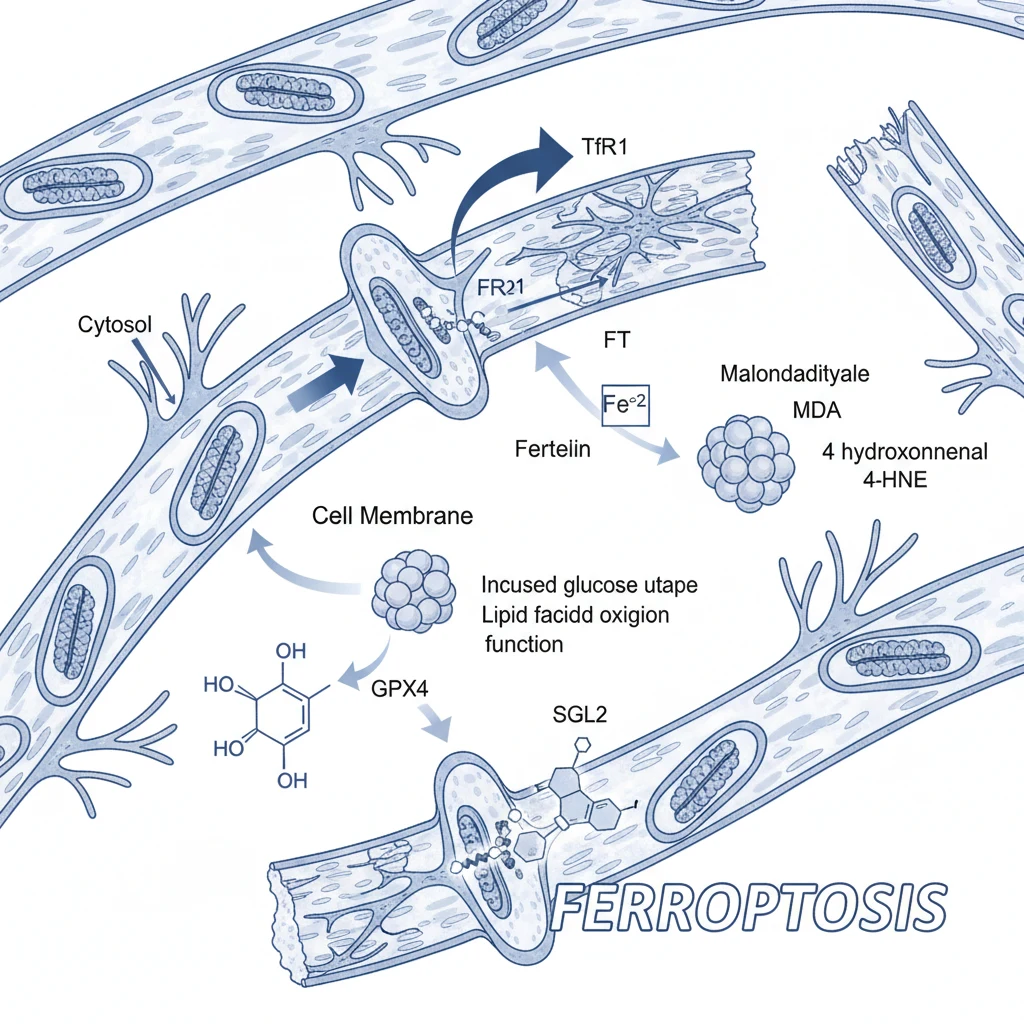
Ferroptosis is a form of regulated cell death driven by iron-induced lipid peroxidation, distinct from apoptosis and necrosis in both its triggers and its effectors.1 In the context of heart failure, it has been identified across a wide range of animal models: chronic ischaemic, pressure overload, diabetic, septic, obesity-related, and doxorubicin-induced cardiomyopathy.1 Across these models, four converging processes characterise the pathway: disordered iron handling, antioxidant failure, enzymatic phospholipid peroxidation, and mitochondrial stress.1 The result, in preclinical data, is contractile dysfunction and adverse cardiac remodelling.1
The authors of the Cardiovascular Research review propose a conceptual framework they term the "ferroptosis nexus," wherein iron mobilisation, antioxidant collapse, lipid priming, and mitochondrial and calcium amplifiers form a self-reinforcing loop that culminates in pump failure.1 This framing is intellectually coherent, but the authors are explicit that definitive causality between ferroptosis and heart failure has not yet been established in humans.1
What the evidence shows
The mechanistic case rests on two converging lines of evidence. First, classic ferroptosis inhibitors, including ferrostatin-1, liproxstatin-1, and iron chelators, rescue contractile function and reverse remodelling in animal models.1 Second, and more clinically relevant, several drugs with established efficacy in human heart failure appear to reduce ferroptosis activity. These include SGLT2 inhibitors, sacubitril/valsartan, finerenone, levosimendan, nicorandil, and certain polyphenols.1 The overlap between ferroptosis-suppressing agents and guideline-recommended heart failure therapies is striking, even if it remains correlative.
Human tissue data add a further layer. Failing myocardial and epicardial adipose tissue from human patients show ferroptosis-specific transcriptional and lipidomic signatures.1 Circulating biomarkers and tissue profiles from patients receiving SGLT2 inhibitors specifically indicate reduced ferroptosis activity compared with untreated controls.1 These are observational associations, not interventional findings, and the review does not report specific biomarker values, hazard ratios, or p-values from clinical cohorts. The signal is directionally consistent but not yet quantified at a trial level.
The authors identify the translational barriers plainly: there are no standardised ferroptosis signatures validated for clinical use, no single-cell or spatial transcriptomic datasets adequate to map ferroptosis distribution across heart failure phenotypes, and no mechanism-driven clinical trials testing ferroptosis modulation as a primary endpoint.1 They call for all three before precision cardioprotection targeting ferroptosis becomes a realistic therapeutic strategy.1
Clinical Context and Epidemiology
Heart failure represents a major global health burden, affecting over 64 million people worldwide. Its prevalence continues to rise due to an aging population and increasing rates of cardiovascular risk factors. The syndrome is characterized by the heart's inability to pump sufficient blood to meet the body's metabolic demands, leading to symptoms such as dyspnea, fatigue, and fluid retention. Despite significant advancements in pharmacotherapy and device-based treatments, morbidity and mortality remain high, underscoring the need for novel therapeutic targets and mechanistic understanding. The diverse etiologies of heart failure, including ischemic heart disease, hypertension, diabetes, and valvular disease, suggest that multiple cellular pathways contribute to myocardial dysfunction and remodeling. Understanding these pathways, such as ferroptosis, could lead to more targeted and effective interventions across different patient populations.
Mechanism of Action: SGLT2 Inhibitors
SGLT2 inhibitors, initially developed for type 2 diabetes, have demonstrated remarkable cardiovascular and renal benefits in patients with and without diabetes, leading to their widespread adoption in heart failure management. While their primary action involves inhibiting glucose reabsorption in the renal tubules, leading to glucosuria and osmotic diuresis, their cardioprotective mechanisms extend beyond glycemic control. Proposed mechanisms include improvements in cardiac energetics, reduction in preload and afterload, anti-inflammatory effects, and modulation of various cellular stress pathways. The observation that SGLT2 inhibitors reduce ferroptosis activity in human tissue samples provides a compelling, albeit correlative, link to a novel mechanism of cardioprotection. This suggests that part of their beneficial effect in heart failure may stem from their ability to mitigate iron-induced lipid peroxidation and its downstream consequences on myocardial health. Further research is needed to elucidate the precise molecular steps through which SGLT2 inhibition translates into reduced ferroptosis in cardiac cells.
Limitations and Future Directions
The current understanding of ferroptosis in heart failure, while promising, faces several limitations. The reliance on animal models, while informative for mechanistic exploration, does not always translate directly to human pathophysiology. The observational nature of human tissue and biomarker data, particularly regarding SGLT2 inhibitors, precludes definitive causal conclusions. Furthermore, the lack of standardized and validated clinical assays for ferroptosis activity poses a significant challenge for translational research. Developing robust biomarkers that can accurately reflect ferroptosis in vivo and correlate with clinical outcomes is crucial. Future research should prioritize prospective interventional studies designed to modulate ferroptosis directly and assess its impact on hard clinical endpoints in heart failure patients. Such trials would require careful selection of patient populations and the development of novel therapeutic agents specifically targeting components of the ferroptosis pathway. Integrating single-cell and spatial transcriptomics will also be vital to map the precise cellular and regional distribution of ferroptosis in the heterogeneous landscape of the failing human heart, allowing for more precise therapeutic targeting.
Readers seeking an authoritative overview of cardiology, encompassing current heart failure guidelines and management, will find further reading in the esteemed Oxford Handbook of Cardiology.
The most immediate consequence of this review is not a prescribing change but a reframing of why current drugs work. If SGLT2 inhibitors suppress ferroptosis in the failing myocardium, that would offer a plausible unifying mechanism for benefits seen across HFrEF and HFpEF populations regardless of diabetes status. That is a useful hypothesis. It is not yet a confirmed mechanism, and clinicians should resist the temptation to treat a mechanistic narrative in a review article as equivalent to trial evidence. The distinction matters when patients or colleagues ask why empagliflozin or dapagliflozin are being prescribed.
The pharmaceutical consequence is considerable, even in the absence of trial data. AstraZeneca and Boehringer Ingelheim have substantial commercial interest in deepening the mechanistic story behind dapagliflozin and empagliflozin respectively, particularly as patent timelines shorten and generic SGLT2 inhibitors enter the market. A validated ferroptosis suppression claim, backed by a mechanism-driven trial, would be a meaningful differentiator. The same applies to Novartis and sacubitril/valsartan, and to Bayer with finerenone. The irony is that all four appear to converge on the same pathway, which makes competitive differentiation harder, not easier.
Patients stand to benefit in the longer term if ferroptosis biomarkers can identify which heart failure phenotypes are most likely to respond to existing therapies or to novel ferroptosis-targeted agents. The review's proposal for single-cell and spatial transcriptomic mapping of ferroptosis in the failing heart is scientifically sound. Whether trial sponsors or funders will invest in mechanism-driven studies that do not obviously favour a single proprietary compound is a separate, less optimistic question. For now, SGLT2 inhibitors remain among the most evidence-supported drugs in heart failure medicine. The ferroptosis story is a hypothesis worth watching, not yet a reason to act differently.
- The Pivot SGLT2 inhibitors, sacubitril/valsartan, and finerenone all show ferroptosis-suppressing activity in preclinical and early human data, suggesting their shared cardiac benefit may converge on a common cell-death pathway.
- The Data Circulating biomarkers and tissue profiles from patients receiving SGLT2 inhibitors indicate reduced ferroptosis activity in human failing myocardium and epicardial adipose tissue, though no controlled clinical trial has yet tested ferroptosis modulation as a primary endpoint.
- The Action No prescribing change is warranted today; SGLT2 inhibitors remain indicated per existing guidelines. Clinicians should, however, treat mechanistic claims in reviews cautiously until mechanism-driven trials are completed.
ART-2026-61
·09/26
Drafted with AI assistance, reviewed and approved by the editorial team. This publication is intended for healthcare professionals, researchers, and life science industry professionals. Content is provided for informational and educational purposes only and does not constitute medical advice.

I cover life sciences: drug approvals, trial readouts, regulatory decisions, and the AI reshaping clinical practice. Based in Greater London, contributing to The Life Science Feed since 2026.
Cite This Article
Voss M, Lopes W. SGLT2 inhibitors and ferroptosis: a new mechanistic picture in HF. The Life Science Feed. Published May 14, 2026. Updated September 17, 2026. Accessed September 27, 2026. https://thelifesciencefeed.com/cardiology/heart-failure/research/sglt2-inhibitors-and-ferroptosis-a-new-mechanistic-picture-in-hf.
Editorial & AI Standards
All content is researched from peer-reviewed, open-access sources: published trial data, clinical guidelines, and regulatory filings. AI tools are used solely to structure and summarise that evidence; no AI-generated conclusions appear without editor verification against the primary source.
Every article is reviewed by a named editor before publication. Source citations are listed in the References section. This content does not represent the views of any pharmaceutical company, medical device manufacturer, or healthcare provider.
Licence & Rights
© 2026 The Life Science Feed. All rights reserved. Unless otherwise indicated, all content is the property of The Life Science Feed and may not be reproduced, distributed, or transmitted in any form or by any means without prior written permission.
Medical Disclaimer
The information provided on The Life Science Feed is for educational and informational purposes only. It is not intended as a substitute for professional medical advice, diagnosis, or treatment. Always seek the advice of your physician or other qualified healthcare provider regarding any medical condition or treatment decision. Never disregard professional medical advice or delay in seeking it because of something you have read on this website.
References
1. Karampinos KI, Farmakis D, Gurung R. Ferroptosis in heart failure: from molecular insights to therapeutic implications. Cardiovasc Res.
2026. PMID:41616804.






