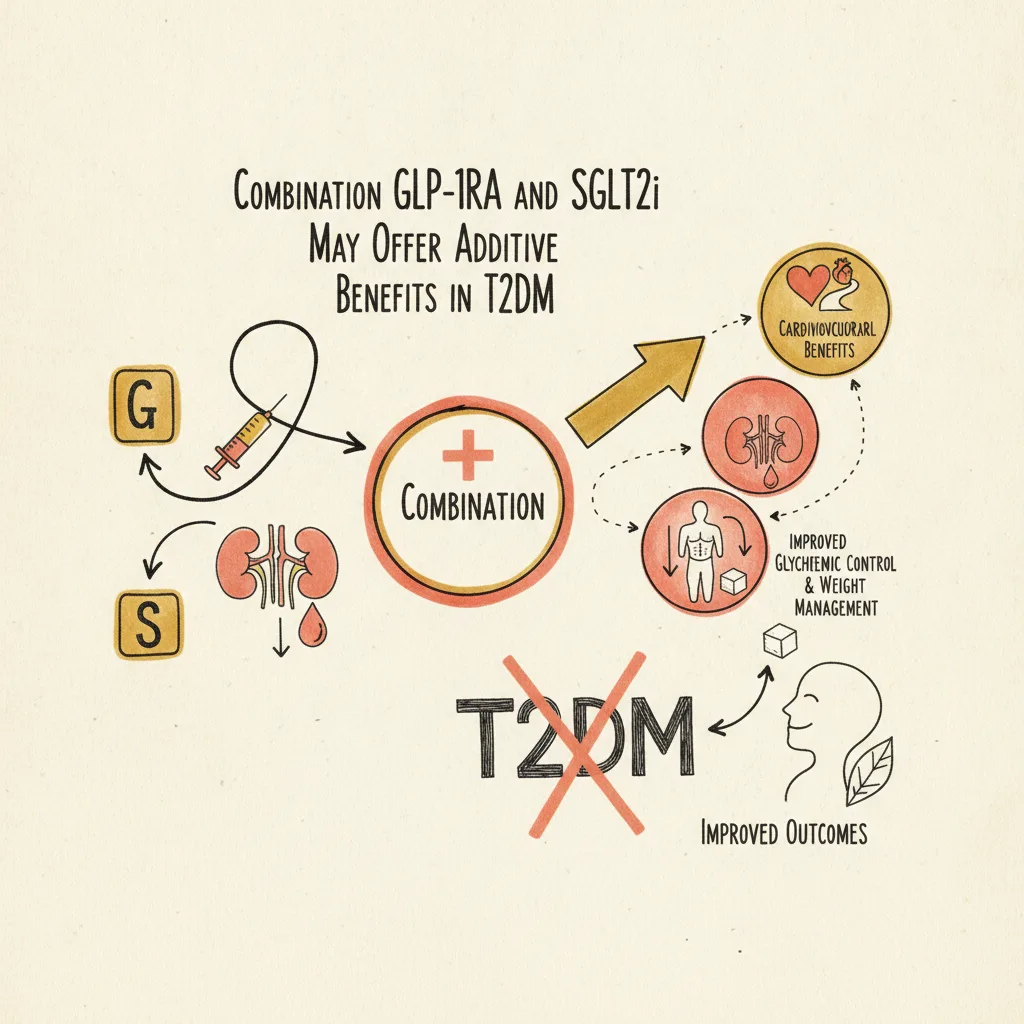

Managing type 2 diabetes mellitus (T2DM) requires multifaceted therapeutic strategies to address glycemic control and mitigate long-term cardiovascular and renal complications. While glucagon-like peptide-1 receptor agonists (GLP-1RAs) and sodium-glucose cotransporter-2 inhibitors (SGLT2i) have independently demonstrated significant benefits,12 the question of whether their combined use offers additive or synergistic protection remains a critical area of clinical inquiry. Recent reviews of existing meta-analyses indicate that while individual agents are effective, real-world evidence increasingly supports the incremental benefits of combination therapy across major adverse cardiovascular events (MACE), heart failure, and renal outcomes.
The therapeutic landscape for type 2 diabetes mellitus (T2DM) has undergone substantial evolution with the introduction of glucagon-like peptide-1 receptor agonists (GLP-1RAs) and sodium-glucose cotransporter-2 inhibitors (SGLT2i). These two classes of agents have demonstrated efficacy not only in glycemic control but also in reducing the risk of cardiovascular and renal complications, which are prevalent comorbidities in T2DM patients.1-3 Understanding the mechanisms of action for each class is crucial for appreciating their potential complementary roles. GLP-1RAs enhance glucose-dependent insulin secretion, suppress glucagon secretion, slow gastric emptying, and promote satiety, leading to reductions in HbA1c and body weight.1,2 Their cardiovascular benefits are thought to involve improvements in endothelial function, reductions in inflammation, and direct myocardial effects.1,2 SGLT2i, conversely, reduce renal glucose reabsorption, leading to increased urinary glucose excretion and subsequent reductions in blood glucose, blood pressure, and body weight.1,3 Their cardiorenal protective effects are attributed to mechanisms such as osmotic diuresis, natriuresis, reduction in intraglomerular pressure, and improvements in myocardial energetics.1,3
Given these distinct yet beneficial mechanisms, the potential for additive or synergistic effects when GLP-1RAs and SGLT2i are used in combination has been a subject of considerable interest. Both classes have independently demonstrated reductions in major adverse cardiovascular events (MACE). SGLT2i have shown superior benefits in mitigating hospitalization for heart failure and slowing chronic kidney disease progression compared to GLP-1RAs.1-3 The question for clinicians is whether combining these agents offers a greater degree of protection than either agent alone, particularly in patient populations at high risk for cardiovascular and renal complications, including those with diabetic kidney disease (DKD).3
Review of Combination Therapy Efficacy
Recent narrative reviews have critically appraised the published literature on the combined effects of GLP-1RAs and SGLT2i on cardiovascular outcomes, heart failure, and kidney disease. These reviews synthesized findings from existing meta-analyses, encompassing both randomized controlled trials (RCTs) and real-world evidence (RWE).1-3
Regarding glycemic control, randomized controlled trials consistently indicate that combination therapy achieves greater reductions in HbA1c compared with either agent alone.1-3 This is a direct consequence of their complementary glucose-lowering mechanisms. The impact on body weight is also generally enhanced with combination therapy, reflecting the weight-reducing effects of both drug classes.1,2
For cardiovascular outcomes, meta-analyses demonstrate that both GLP-1RAs and SGLT2i reduce the risk of MACE to a comparable extent when used as monotherapy.1-3 However, cardiovascular outcome trials (CVOTs) have not consistently demonstrated a synergistic or additive protective effect of combined therapy on MACE or renal endpoints.1-3 This observation from RCTs has led to ongoing discussion regarding the optimal sequencing and combination of these therapies. The design of many CVOTs, often powered to detect non-inferiority or superiority of a single agent against placebo or standard care, may not have been adequately powered or designed to definitively assess synergistic effects of combination therapy on hard cardiovascular endpoints.1
In contrast to the CVOT findings, real-world evidence (RWE) suggests incremental benefits across MACE, heart failure, and renal outcomes when GLP-1RAs and SGLT2i are used in combination.1-3 This discrepancy between RCTs and RWE is a critical point. RWE studies often include a broader and more heterogeneous patient population, reflecting routine clinical practice more closely than the highly selected cohorts in RCTs. This broader applicability may reveal benefits that are less apparent in controlled trial settings. The hypothesis is that the complementary mechanisms of action of GLP-1RAs and SGLT2i may translate into broader protection in clinical practice, particularly in patients with established cardiovascular disease or chronic kidney disease.1-3
One specific real-world analysis focused on the metabolic and renal effects of combined SGLT2i and GLP-1RA therapy in patients with and without diabetic kidney disease (DKD). This analysis aimed to understand the practical implications of combination therapy in a population often excluded or underrepresented in pivotal trials.3 The findings from such real-world studies support the notion that the combined use of these agents can optimize cardiovascular and renal protection in patients with T2DM.1-3
Limitations and Considerations
While the evidence for combination therapy is compelling, particularly from real-world data, several limitations warrant consideration. The narrative reviews themselves are syntheses of existing meta-analyses, which inherently carry the limitations of the primary studies included. Heterogeneity in study design, patient populations, duration of follow-up, and specific agents used within each class (e.g., different GLP-1RAs or SGLT2i) can influence the generalizability of findings.1-3
The discrepancy between the lack of demonstrated synergy in some CVOTs and the incremental benefits observed in RWE highlights a methodological challenge. RCTs are designed for internal validity and to establish causality, but their strict inclusion/exclusion criteria can limit external validity. RWE, while offering greater generalizability, is susceptible to confounding by indication and other biases inherent in observational studies. For instance, patients prescribed combination therapy in real-world settings may already have a higher baseline risk profile or more advanced disease, which could influence observed outcomes.1,3
Furthermore, the specific mechanisms underlying the potential additive benefits in RWE are still being elucidated. While the individual mechanisms of GLP-1RAs and SGLT2i are well-understood, their combined physiological effects, particularly on complex pathways related to cardiovascular and renal protection, require further dedicated investigation. For example, the combined impact on inflammatory markers, oxidative stress, or specific cardiac and renal hemodynamic parameters could contribute to the observed incremental benefits.1,2
Another practical consideration is the potential for increased adverse events with combination therapy. While both drug classes are generally well-tolerated, combining them may lead to a higher incidence of gastrointestinal side effects (common with GLP-1RAs) or genitourinary infections (associated with SGLT2i). Patient adherence and tolerability are crucial factors in long-term treatment success.1,3
Globally, GLP-1RAs and SGLT2i should be regarded as complementary rather than alternative therapeutic strategies. Randomized evidence supports the individual efficacy of each class, and real-world data increasingly endorse their combined use to optimize cardiovascular and renal protection in patients with T2DM. Future research, including head-to-head trials specifically designed to assess additive or synergistic effects on hard clinical endpoints, would provide further clarity. Such trials would ideally focus on specific high-risk populations, such as those with established atherosclerotic cardiovascular disease, heart failure, or advanced chronic kidney disease, to precisely define the incremental benefits and optimal patient selection for combination therapy.1-3
Further refine your understanding of diabetes management and endocrine conditions with the authoritative insights provided in the Oxford Handbook of Endocrinology and Diabetes.
The accumulating evidence, particularly from real-world data, solidifies the position of GLP-1RAs and SGLT2i as foundational therapies in type 2 diabetes management. While individual cardiovascular outcome trials for each class have been transformative, the nuanced picture emerging from combination therapy suggests that simply adding these agents together is not a mere sum of their parts. The observed incremental benefits in real-world settings, despite a lack of clear synergy in some randomized trials, should prompt clinicians to consider these agents as complementary rather than mutually exclusive. This implies a proactive approach to prescribing, especially for patients with established cardiovascular or renal complications, rather than waiting for failure on monotherapy.
For the pharmaceutical industry, this trend underscores the value of fixed-dose combination products or co-prescribing strategies. The market will likely see continued development in this area, potentially leading to more convenient dosing regimens that improve patient adherence. However, the industry must also address the cost implications, as both drug classes are expensive. Ensuring equitable access to these beneficial combinations will be critical for public health, particularly as guidelines evolve to recommend earlier and broader use of these agents.
Patients stand to gain significantly from these developments. The prospect of enhanced protection against heart failure, kidney disease progression, and major cardiovascular events offers a tangible improvement in long-term prognosis and quality of life beyond just glycemic control. However, patient education regarding potential side effects, adherence to complex regimens, and the importance of lifestyle modifications alongside pharmacotherapy remains paramount. The data supports a shift towards a more holistic, organ-protective approach to diabetes care, moving beyond HbA1c targets alone.
- The Pivot Real-world evidence suggests additive cardiovascular and renal benefits from combined GLP-1RA and SGLT2i therapy, despite a lack of demonstrated synergy in some randomized controlled trials.
- The Data Combination therapy achieves greater reductions in HbA1c compared with either agent alone, with real-world data indicating incremental benefits across MACE, heart failure, and renal outcomes.1,2,3
- The Action Clinicians should consider GLP-1RAs and SGLT2i as complementary therapeutic strategies for optimizing cardiovascular and renal protection in patients with T2DM.
ART-2026-38
·09/26
Drafted with AI assistance, reviewed and approved by the editorial team. This publication is intended for healthcare professionals, researchers, and life science industry professionals. Content is provided for informational and educational purposes only and does not constitute medical advice.

I cover life sciences: drug approvals, trial readouts, regulatory decisions, and the AI reshaping clinical practice. Based in Greater London, contributing to The Life Science Feed since 2026.
Cite This Article
Voss M, Lopes W. Combination GLP-1RA and sglt2i may offer additive benefits in t2dm. The Life Science Feed. Published June 28, 2026. Updated September 15, 2026. Accessed September 27, 2026. https://thelifesciencefeed.com/endocrinology/diabetes-mellitus-type-2/research/combination-glp-1ra-and-sglt2i-may-offer-additive-benefits-in-t2dm.
Editorial & AI Standards
All content is researched from peer-reviewed, open-access sources: published trial data, clinical guidelines, and regulatory filings. AI tools are used solely to structure and summarise that evidence; no AI-generated conclusions appear without editor verification against the primary source.
Every article is reviewed by a named editor before publication. Source citations are listed in the References section. This content does not represent the views of any pharmaceutical company, medical device manufacturer, or healthcare provider.
Licence & Rights
© 2026 The Life Science Feed. All rights reserved. Unless otherwise indicated, all content is the property of The Life Science Feed and may not be reproduced, distributed, or transmitted in any form or by any means without prior written permission.
Medical Disclaimer
The information provided on The Life Science Feed is for educational and informational purposes only. It is not intended as a substitute for professional medical advice, diagnosis, or treatment. Always seek the advice of your physician or other qualified healthcare provider regarding any medical condition or treatment decision. Never disregard professional medical advice or delay in seeking it because of something you have read on this website.
References
1. Avogaro A, Neccia M, Delfini M. The combination of glucagon-like peptide-1 receptor agonists and sodium-glucose cotransporter-2 inhibitors: a narrative review of existing meta-analysis. Acta Diabetol 2026. doi:10.1007/s00592-026-02666-9
2. Kalogeris A, Ikonomidis I, Kyriakoulis KG. The Beneficial Effects of Combination Therapy With SGLT-2 Inhibitors and GLP-1 Receptor Agonists in Type 2 Diabetes Mellitus. Curr Diabetes Rev 2026. doi:10.2174/0115733998419380251126073540
3. Mazzeo L, Wolde Sellasie S, Pecchioli C. Metabolic and renal effects of combined SGLT-2 inhibitors and GLP1-R agonists therapy in type 2 diabetes: a real-world analysis across DKD and non-DKD patients. J Endocrinol Invest 2026. doi:10.1007/s40618-025-02756-5