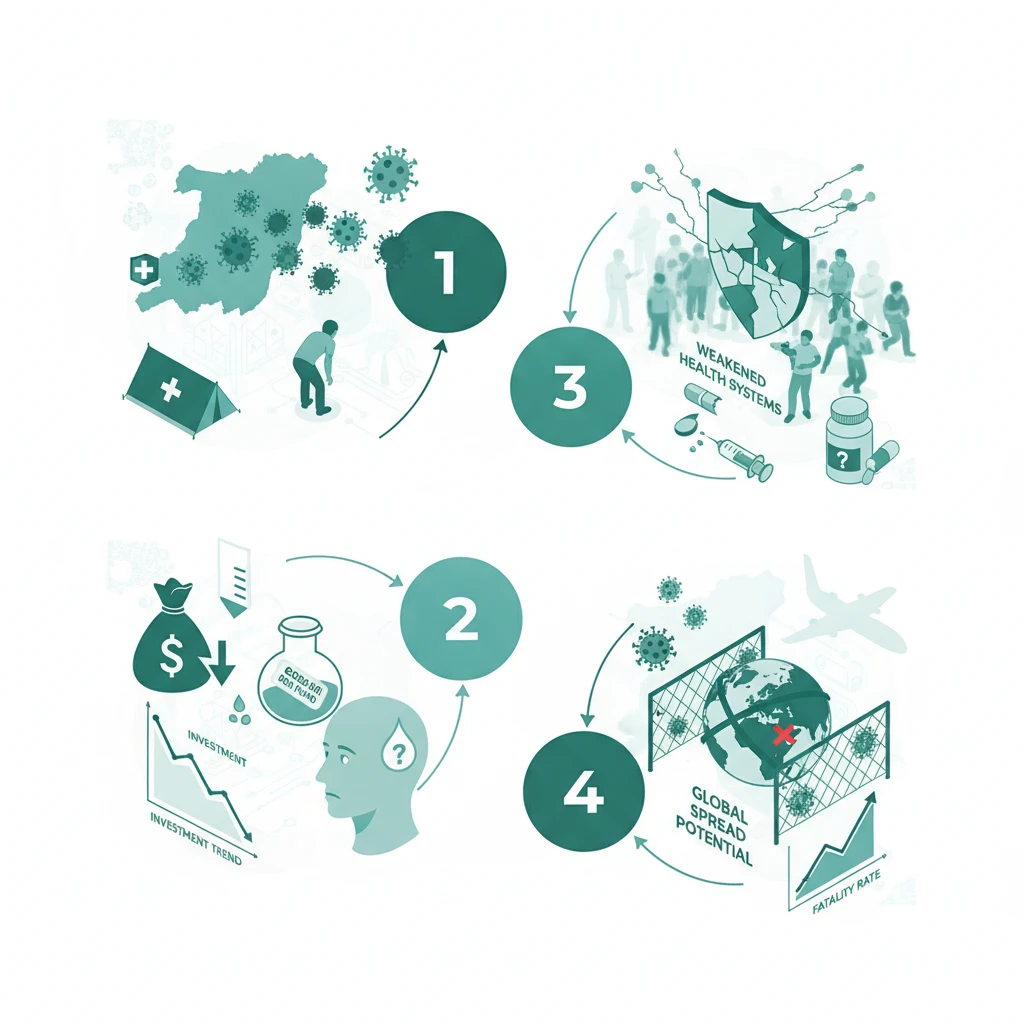

The management of infectious disease outbreaks in resource-limited settings presents a persistent challenge for global health. A recent analysis of the Democratic Republic of Congo (DRC) Ebola outbreak indicates that inadequate global health funding directly contributed to the operational difficulties encountered during the response.1
The Democratic Republic of Congo has faced multiple Ebola virus disease outbreaks, each presenting unique logistical and public health challenges. The effectiveness of outbreak control measures is contingent upon timely resource allocation, robust surveillance systems, and trained personnel. The 2026 BMJ study by Manno and Freddy examined the DRC Ebola outbreak, specifically identifying the consequences of global health underfunding.1
What the study did
Manno and Freddy's analysis focused on the operational aspects of the DRC Ebola outbreak response. The authors investigated how the level of global health funding influenced the capacity to implement public health interventions, including surveillance, contact tracing, isolation, and treatment. While specific methodologies were not detailed in the abstract, the study aimed to establish a direct correlation between financial investment and response efficacy.1
Key Findings
The study concluded that the DRC Ebola outbreak exposed significant consequences stemming from global health underfunding. The authors stated that these financial shortfalls directly impacted the ability to mount an effective and sustained response. While quantitative metrics such as specific budget deficits, delays in intervention, or changes in mortality rates were not provided in the abstract, the overarching conclusion was that underfunding hindered outbreak control efforts.1
Limitations & Next Steps
The abstract for PMID 42203253 does not detail the specific limitations of the study, nor does it outline next steps or recommendations. A full review of the paper would be necessary to understand the methodology, the specific data points supporting the conclusion, and the authors' suggestions for addressing the identified funding gaps.1
While the abstract for PMID 42203253 provides a high-level overview, a deeper dive into the full text would undoubtedly reveal critical insights into the specific mechanisms through which underfunding manifests during an Ebola response. For instance, delays in procuring essential personal protective equipment (PPE), insufficient laboratory capacity for rapid diagnostics, or a lack of resources for community engagement and risk communication can all be direct consequences of financial shortfalls. These operational deficiencies not only impede immediate containment efforts but also erode public trust, making future health interventions more challenging.
The abstract's emphasis on "operational aspects" suggests that Manno and Freddy likely explored the practical implementation challenges faced by frontline responders. This could include the availability of trained healthcare workers, the logistical complexities of vaccine distribution in remote areas, or the capacity to establish and maintain isolation units. Each of these components requires substantial and sustained financial investment. When funding is sporadic or insufficient, these critical elements become compromised, leading to a prolonged outbreak duration, increased morbidity and mortality, and a greater risk of regional or even international spread.
Clinical Implications and Future Directions
The findings, even in abstract form, carry significant clinical implications for healthcare professionals involved in outbreak preparedness and response. Understanding the systemic impact of underfunding allows clinicians and public health practitioners to advocate more effectively for robust financial commitments to global health security. It underscores the necessity of pre-positioned resources, surge capacity planning, and sustainable funding mechanisms that are not solely reliant on emergency appeals during an active crisis.
From a clinical perspective, underfunding directly translates to a reduced ability to provide optimal patient care. This can manifest as:
- Delayed diagnosis: Insufficient funding for laboratory infrastructure and reagents leads to slower turnaround times for diagnostic tests, delaying isolation and treatment initiation.
- Suboptimal treatment: Lack of resources for supportive care, rehydration therapies, and investigational treatments can worsen patient outcomes.
- Increased healthcare worker risk: Inadequate PPE, training, and infection control measures put frontline staff at higher risk of infection, leading to staff shortages and further strain on the healthcare system.
- Weakened surveillance: Limited funding for active case finding, contact tracing, and data management hinders the ability to track the epidemic's trajectory and implement targeted interventions.
Future research building upon Manno and Freddy's work should aim to quantify these impacts with greater precision. This would involve detailed cost-benefit analyses of various funding levels, modeling the epidemiological consequences of specific budget deficits, and evaluating the long-term economic and social costs of prolonged outbreaks due to underinvestment. Furthermore, studies should explore innovative financing mechanisms for global health, including pandemic bonds, international solidarity funds, and increased domestic investment in health systems within vulnerable nations. The DRC Ebola experience serves as a stark reminder that global health security is a shared responsibility, and chronic underfunding ultimately undermines the collective ability to protect populations worldwide from emerging infectious threats.
The recurring narrative of underfunded global health initiatives, as highlighted by the DRC Ebola outbreak, should prompt a re-evaluation of international health security frameworks. For clinicians on the ground, particularly those in infectious disease and public health, this translates to working with insufficient resources, delayed supply chains, and often, an inability to scale up interventions rapidly enough to contain an emerging threat. This directly impacts patient outcomes, as the window for effective containment of highly transmissible diseases is narrow.
The industry, including pharmaceutical companies and medical device manufacturers, also bears a responsibility. While emergency funding often materialises during acute crises, a more sustainable model of investment in preparedness and infrastructure is needed. This includes supporting local manufacturing capabilities for essential medicines and diagnostics, rather than relying solely on emergency imports. The current reactive approach is inefficient and costly, both in human lives and economic terms.
Patients in vulnerable regions are the ultimate bearers of these systemic failures. When global health is underfunded, it is not merely an abstract budgetary issue; it means fewer vaccines, fewer trained healthcare workers, and less robust surveillance systems. This directly translates to increased morbidity and mortality during outbreaks. The evidence from the DRC Ebola outbreak serves as a stark reminder that consistent, proactive investment in global health is not merely altruistic, but a fundamental component of global security and public health protection.
- The Pivot The DRC Ebola outbreak demonstrated a direct link between global health underfunding and operational response deficiencies.
- The Data The specific quantitative impact of underfunding on outbreak metrics (e.g., case fatality rates, response times) was not detailed in the provided abstract.
- The Action Clinicians and public health practitioners should advocate for sustained, adequate funding for global health initiatives to strengthen future outbreak preparedness and response.
ART-2026-547
·09/26
Drafted with AI assistance, reviewed and approved by the editorial team. This publication is intended for healthcare professionals, researchers, and life science industry professionals. Content is provided for informational and educational purposes only and does not constitute medical advice.

I cover life sciences: drug approvals, trial readouts, regulatory decisions, and the AI reshaping clinical practice. Based in Greater London, contributing to The Life Science Feed since 2026.
Cite This Article
Voss M, Lopes W. DRC ebola outbreak exposes global health underfunding consequences. The Life Science Feed. Published June 21, 2026. Updated September 17, 2026. Accessed September 22, 2026. https://thelifesciencefeed.com/infectious-diseases/covid19/news/drc-ebola-outbreak-exposes-global-health-underfunding-consequences.
Editorial & AI Standards
All content is researched from peer-reviewed, open-access sources: published trial data, clinical guidelines, and regulatory filings. AI tools are used solely to structure and summarise that evidence; no AI-generated conclusions appear without editor verification against the primary source.
Every article is reviewed by a named editor before publication. Source citations are listed in the References section. This content does not represent the views of any pharmaceutical company, medical device manufacturer, or healthcare provider.
Licence & Rights
© 2026 The Life Science Feed. All rights reserved. Unless otherwise indicated, all content is the property of The Life Science Feed and may not be reproduced, distributed, or transmitted in any form or by any means without prior written permission.
Medical Disclaimer
The information provided on The Life Science Feed is for educational and informational purposes only. It is not intended as a substitute for professional medical advice, diagnosis, or treatment. Always seek the advice of your physician or other qualified healthcare provider regarding any medical condition or treatment decision. Never disregard professional medical advice or delay in seeking it because of something you have read on this website.
References
1. Manno D, Freddy BB. The DRC Ebola outbreak has exposed the consequences of global health underfunding. BMJ.






