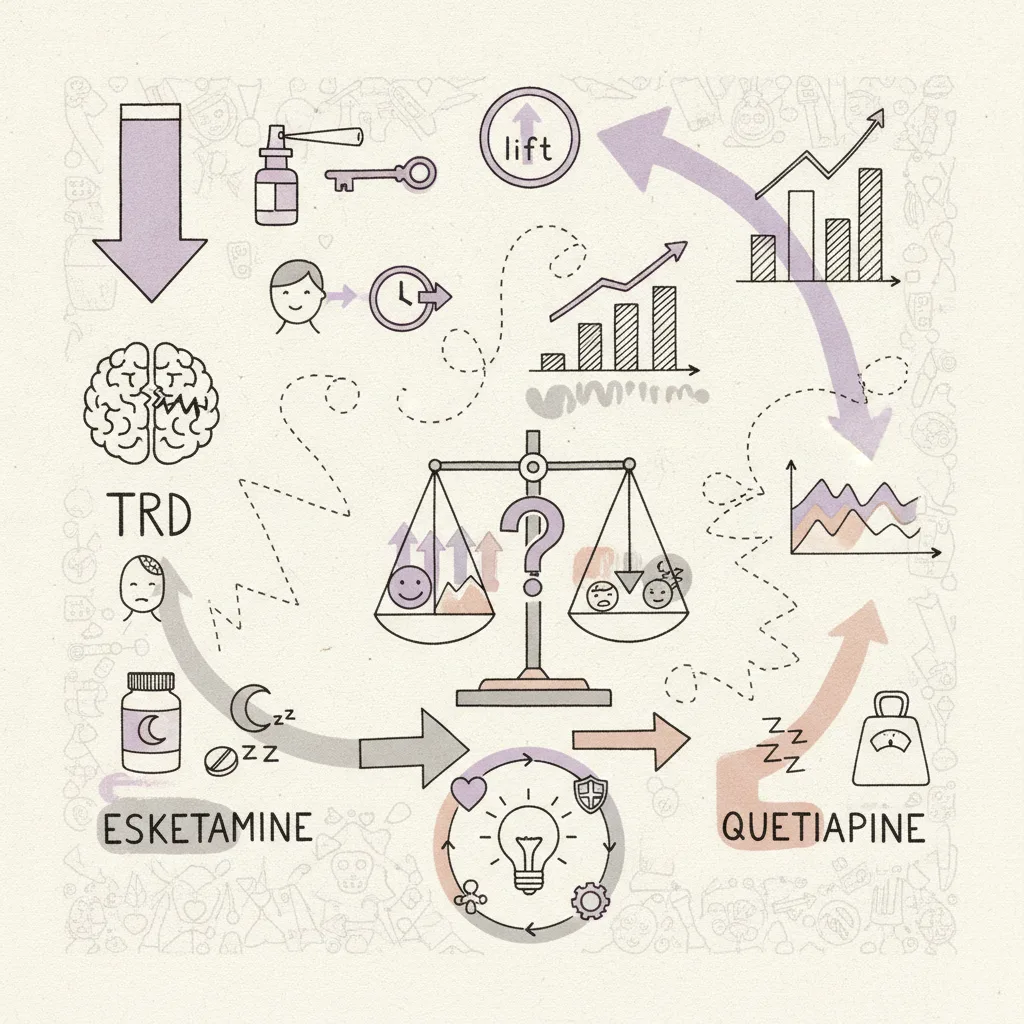

Treatment-resistant depression (TRD) remains a significant challenge, with many patients failing to achieve remission despite multiple antidepressant trials. Augmentation strategies are a cornerstone of management, but choosing between options like esketamine and quetiapine requires a clear understanding of their comparative benefits and risks.
Clinicians often grapple with balancing rapid symptom improvement against long-term tolerability and safety, a decision made more complex by the differing mechanisms of action and administration routes of these agents. The Oxford Handbook of Psychiatry offers a comprehensive overview of these complex treatment decisions.
Treatment-resistant depression is defined by an inadequate response to at least two different antidepressant treatments of adequate dose and duration. This condition affects a substantial proportion of patients with major depressive disorder, leading to chronic disability, impaired quality of life, and increased healthcare burden. The unmet need for effective and tolerable augmentation strategies is considerable, driving ongoing research into comparative effectiveness.
Esketamine, an N-methyl-D-aspartate (NMDA) receptor antagonist, is administered intranasally and offers a relatively rapid onset of action. Quetiapine, an atypical antipsychotic, is used off-label or as an approved augmentation agent in some regions, typically administered orally. Both agents aim to enhance the antidepressant effect of existing therapy, but through distinct pharmacological pathways. Understanding these differences is crucial for clinicians navigating the complex market of TRD management.
Understanding the mechanisms of action
Esketamine's antidepressant effects are thought to stem from its modulation of glutamatergic neurotransmission. By blocking the NMDA receptor, esketamine can rapidly increase synaptic plasticity and restore neuronal function in brain regions implicated in depression. This mechanism contrasts sharply with traditional antidepressants, which primarily target monoamine systems. The rapid onset observed with esketamine is a key differentiator, particularly for patients in acute distress or with severe symptoms.
Quetiapine, on the other hand, exerts its antidepressant effects through a broader pharmacological profile. It acts as an antagonist at dopamine D2 and serotonin 5-HT2A receptors, and also has affinity for histamine H1 and adrenergic alpha1 receptors. Its augmentation role in TRD is often attributed to its serotonergic and noradrenergic modulation, alongside its anxiolytic and sedative properties. The slower onset of action compared to esketamine means quetiapine is typically not the first choice for immediate symptom relief.
Efficacy and symptom reduction
When considering efficacy, both esketamine and quetiapine have demonstrated their ability to reduce depressive symptoms in patients with TRD. Esketamine's benefit often manifests within hours to days, a significant advantage for patients experiencing severe or suicidal ideation. This rapid response is a critical factor for clinicians managing acute depressive episodes. But the transient nature of esketamine's effects necessitates repeated dosing and often requires ongoing maintenance therapy.
Quetiapine augmentation typically shows symptom improvement over several weeks, aligning with the onset of action seen with many oral antidepressants. Its sustained effect can be beneficial for long-term management, but the delay in response means it is less suitable for situations demanding immediate intervention. The choice between these agents often comes down to the urgency of the clinical situation and the patient's capacity to tolerate a slower therapeutic onset. For a deeper dive into managing complex psychiatric cases, our previous coverage on novel treatments for TRD offers additional context.
Safety and tolerability profiles
The safety and tolerability profiles of esketamine and quetiapine are distinct and often dictate treatment selection. Esketamine is associated with transient dissociative symptoms, sedation, and elevated blood pressure, typically occurring during or shortly after administration. These effects necessitate in-clinic monitoring for at least two hours post-dose, which can be a logistical challenge for both patients and healthcare systems. The potential for abuse and the need for a controlled environment are also significant considerations.
Quetiapine's side effect profile includes sedation, weight gain, metabolic disturbances (e.g., dyslipidemia, hyperglycemia), and extrapyramidal symptoms, particularly at higher doses. These metabolic risks require regular monitoring of weight, blood glucose, and lipid panels, adding to the long-term management burden. The sedative effects can be beneficial for patients with insomnia, but can also impair daily functioning. Clinicians must weigh these chronic risks against the benefits of sustained symptom control. The impact of chronic conditions on mental health is also explored in our article on financial stress and brain health.
Practical considerations for clinicians
The practical implications of choosing between esketamine and quetiapine are substantial. Esketamine requires a structured treatment setting, including certified clinics and trained personnel, due to its administration route and acute side effects. This limits its accessibility and increases the administrative burden. Patients must also commit to regular, often weekly, in-clinic visits during the induction phase.
Quetiapine, as an oral medication, offers greater flexibility in administration and does not require immediate post-dose monitoring. This makes it a more accessible option for many patients and clinicians, particularly in outpatient settings. But the need for ongoing metabolic monitoring and the potential for long-term side effects mean that while the acute burden is lower, the chronic management is more involved. The choice often depends on the patient's lifestyle, comorbidities, and access to specialized care. For general practitioners, a quick reference like the Oxford Handbook of General Practice can be invaluable for managing these complex decisions.
Patient selection and shared decision-making
Patient selection is paramount for both therapies. Esketamine is often reserved for patients with severe TRD, particularly those with acute suicidal ideation, where rapid symptom reduction is critical. Patients must be willing and able to comply with the in-clinic monitoring requirements and tolerate the dissociative effects. The patient's history of substance use disorders also warrants careful consideration.
Quetiapine may be a more appropriate choice for patients who require sustained augmentation, can tolerate its metabolic and sedative side effects, and prefer an oral medication. It is also often considered for patients with comorbid anxiety or insomnia, where its sedative properties can be beneficial. Shared decision-making, involving a thorough discussion of the benefits, risks, and practicalities of each option, is essential to ensure treatment adherence and optimize outcomes. The broader impact of lifestyle factors, such as sleep quality on well-being, also plays a role in patient counseling.
The open-label nature of many real-world studies on these agents is an obvious caveat, as is the inherent difficulty in blinding for treatments with such distinct acute effects. The trials were not powered to detect subtle differences in specific patient subgroups, and that gap matters for personalized medicine. Whether benefits extend to broader populations with less severe TRD or different comorbidity profiles remains unclear.
The next trials need to focus on head-to-head comparisons in specific TRD phenotypes, with longer follow-up periods to fully characterize long-term safety and sustained remission rates. This will provide the granular data clinicians need to make truly informed decisions.
The direct comparison of esketamine and quetiapine augmentation for TRD highlights a fundamental truth in psychiatry: there is no one-size-fits-all solution. Clinicians must move beyond a simple efficacy comparison and examine the nuances of onset, tolerability, and practical administration. For patients requiring rapid stabilization, esketamine's quick action is compelling, but the logistical burden and acute side effects are not trivial.
Quetiapine offers a more accessible, oral option with sustained effects, but at the cost of metabolic risks and sedation that demand vigilant long-term monitoring. The choice between these agents is a complex equation involving patient preference, comorbidity, and the available support infrastructure. It is not merely about which drug works, but which drug works best for a specific patient in their specific context.
The industry needs to focus on developing more targeted therapies that minimize systemic side effects while maintaining efficacy. Healthcare systems must adapt to support the diverse needs of TRD patients, whether that means expanding access to specialized esketamine clinics or improving metabolic monitoring in primary care for those on atypical antipsychotics. The current trial pipeline forces clinicians to make difficult trade-offs, and better data will only partially alleviate that burden.
- The Pivot Direct comparison of esketamine and quetiapine augmentation provides a clearer picture for TRD treatment selection.
- The Data Both agents demonstrate efficacy in reducing depressive symptoms, but with differing onset and side effect profiles.
- The Action Consider patient-specific factors, including urgency of response and tolerability to sedation or dissociative effects, when choosing an augmentation strategy.
ART-2026-1330
·10/26
Drafted with AI assistance, reviewed and approved by the editorial team. This publication is intended for healthcare professionals, researchers, and life science industry professionals. Content is provided for informational and educational purposes only and does not constitute medical advice.

Infectious disease, epidemiology, and global health equity. I have covered outbreaks from Ebola to COVID-19 to mpox. The stories I am most drawn to are where the science is clear and the response is slow.
Cite This Article
Reeves T, Voss M. Esketamine vs. quetiapine: which augmentation strategy works for TRD?. The Life Science Feed. Published August 27, 2026. Updated October 6, 2026. Accessed October 11, 2026. https://thelifesciencefeed.com/psychiatry/depressive-disorder/research/esketamine-quetiapine-treatment-resistant-depression.
Editorial & AI Standards
All content is researched from peer-reviewed, open-access sources: published trial data, clinical guidelines, and regulatory filings. AI tools are used solely to structure and summarise that evidence; no AI-generated conclusions appear without editor verification against the primary source.
Every article is reviewed by a named editor before publication. Source citations are listed in the References section. This content does not represent the views of any pharmaceutical company, medical device manufacturer, or healthcare provider.
Licence & Rights
© 2026 The Life Science Feed. All rights reserved. Unless otherwise indicated, all content is the property of The Life Science Feed and may not be reproduced, distributed, or transmitted in any form or by any means without prior written permission.
Medical Disclaimer
The information provided on The Life Science Feed is for educational and informational purposes only. It is not intended as a substitute for professional medical advice, diagnosis, or treatment. Always seek the advice of your physician or other qualified healthcare provider regarding any medical condition or treatment decision. Never disregard professional medical advice or delay in seeking it because of something you have read on this website.
References
1. Schramm E, Klein DN, Elsaesser M, Furukawa TA, Domschke K. Review of dysthymia and persistent depressive disorder: history, correlates, and clinical implications. Lancet Psychiatry. 2020;7(9):801-812. doi:10.1016/S2215-0366(20)30099-7
2. Lam RW, Kennedy SH, Adams C, et al. Canadian Network for Mood and Anxiety Treatments (CANMAT) 2023 Update on Clinical Guidelines for Management of Major Depressive Disorder in Adults: Réseau canadien pour les traitements de l'humeur et de l'anxiété (CANMAT) 2023 : Mise à jour des lignes directrices cliniques pour la prise en charge du trouble dépressif majeur chez les adultes. Can J Psychiatry. 2024;69(9):641-687. doi:10.1177/07067437241245384
3. De Fruyt J, Sabbe B, Demyttenaere K. Anhedonia in Depressive Disorder: A Narrative Review. Psychopathology. 2020;53(5-6):274-281. doi:10.1159/000508773
4. Hirschfeld RM. Differential diagnosis of bipolar disorder and major depressive disorder. J Affect Disord. 2014;169 Suppl 1:S12-6. doi:10.1016/S0165-0327(14)70004-7
5. Al-Abri K, Edge D, Armitage CJ. Prevalence and correlates of perinatal depression. Soc Psychiatry Psychiatr Epidemiol. 2023;58(11):1581-1590. doi:10.1007/s00127-022-02386-9
6. Fernandez-Chinguel JE, Goicochea-Lugo S, Villarreal-Zegarra D, Taype-Rondan A, Zafra-Tanaka JH. Acupuncture for major depressive disorder: A review of the recommendations stated at clinical practice guidelines. Complement Ther Med. 2020;49:102321. doi:10.1016/j.ctim.2020.102321