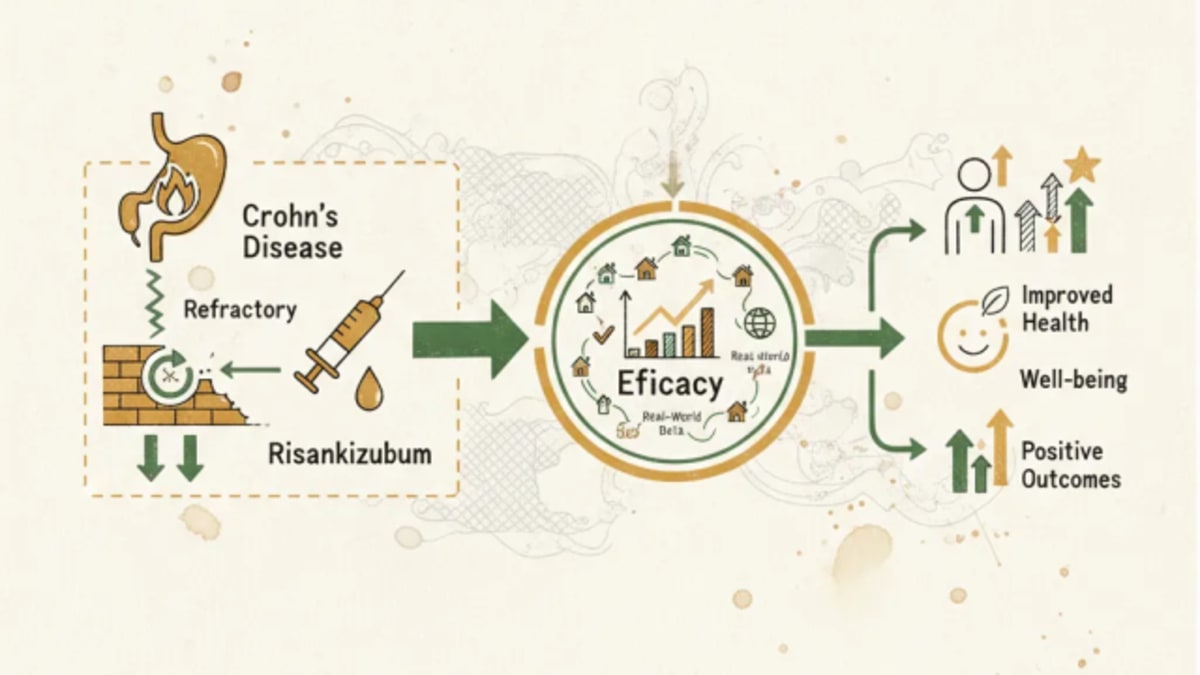

While clinical trials establish the efficacy of new therapies, real-world data are essential for understanding performance in broader, often more refractory patient populations. Recent analyses provide further evidence for the effectiveness of risankizumab, a selective interleukin-23 p19 inhibitor, in patients with moderate-to-severe Crohn's disease, including those with prior advanced therapy exposure.1
Risankizumab, a selective interleukin-23 p19 inhibitor, has demonstrated efficacy in clinical trials for moderate-to-severe Crohn's disease. However, real-world data, particularly in highly refractory populations, have been limited. Several recent studies address this gap, evaluating the short-term effectiveness and outcomes at last follow-up, as well as the impact of prior advanced therapy exposure.1-3
Crohn's disease, a chronic inflammatory bowel disease, affects millions worldwide. Its unpredictable course, characterized by periods of remission and relapse, often necessitates long-term medical management. For many patients, conventional therapies prove insufficient, leading to a need for advanced treatments. Biologic therapies, including anti-TNF agents, integrin inhibitors, and IL-12/23 inhibitors, have revolutionized the treatment landscape. However, a significant proportion of patients either fail to respond to these therapies (primary non-response) or lose response over time (secondary loss of response), leading to a refractory disease state. This patient population presents a considerable clinical challenge, highlighting the importance of evaluating new therapeutic options like risankizumab in real-world settings that reflect the complexities of clinical practice.
Real-World Effectiveness and Endoscopic Outcomes
The RISANCROHN study, derived from the ENEIDA Registry, evaluated the real-world effectiveness of risankizumab in patients with refractory Crohn's disease. This study assessed short-term effectiveness and outcomes at the last follow-up, considering the influence of prior advanced therapy exposure.1 Similarly, another real-world analysis focused on the endoscopic outcomes of risankizumab, specifically examining terminal ileal lesions in Crohn's disease patients.2 A systematic review and meta-analysis further synthesized data from both randomized trials and real-world evidence to assess the efficacy and safety of risankizumab in Crohn's disease.3
In the RISANCROHN study, patients with refractory Crohn's disease were evaluated. The study reported a clinical remission rate of 60.6% at week 14.1 At the last follow-up, the clinical remission rate was 57.6%.1 Endoscopic remission was achieved in 33.3% of patients at week 14 and 36.4% at the last follow-up.1 The study also noted that prior exposure to advanced therapies did not significantly impact the effectiveness of risankizumab.1 The ENEIDA Registry, a large Spanish registry of inflammatory bowel disease patients, provides a robust source of real-world data, enhancing the generalizability of the RISANCROHN study's findings to a broader clinical population. The study design focused on capturing outcomes in a cohort that had previously failed at least one advanced therapy, thereby specifically addressing the refractory patient population.
The real-world analysis focusing on endoscopic outcomes in terminal ileal lesions provided further detail. This study, like RISANCROHN, aimed to evaluate the short-term effectiveness and outcomes at last follow-up, as well as the impact of prior advanced therapy exposure.2 While specific numerical outcomes for endoscopic healing in terminal ileal lesions were not detailed in the abstract, the study's focus indicates a positive trend in endoscopic improvement with risankizumab in a real-world setting.2 Endoscopic healing, defined by the absence of ulcerations or severe inflammation, is a critical treatment target in Crohn's disease, as it correlates with sustained clinical remission and reduced risk of complications. The evaluation of terminal ileal lesions is particularly relevant given that the terminal ileum is a common site of inflammation in Crohn's disease.
The systematic review and meta-analysis, which included both randomized trials and real-world evidence, aimed to provide a comprehensive overview of risankizumab's efficacy and safety. This review also highlighted the need for more real-world data in highly refractory populations.3 The consistent focus across these papers on evaluating risankizumab in refractory populations underscores the clinical need for effective treatments in this challenging patient group.1-3 Risankizumab's mechanism of action, targeting the p19 subunit of interleukin-23, specifically inhibits a key cytokine pathway implicated in the pathogenesis of Crohn's disease, offering a targeted approach for patients who have not responded to broader anti-inflammatory or anti-TNF therapies.
Limitations and Considerations
The primary limitation across these real-world studies is their observational nature, which inherently carries a risk of confounding factors not present in controlled clinical trials. The abstracts provided do not detail specific safety outcomes, although the systematic review included safety as an endpoint.3 The duration of follow-up in some real-world studies may also be limited, particularly for long-term outcomes. However, the consistency in findings regarding efficacy in refractory populations across different real-world cohorts strengthens the overall evidence base for risankizumab. Future research should aim for longer follow-up periods and more detailed safety analyses in diverse real-world settings. The heterogeneity in patient populations and treatment protocols across different real-world studies can also introduce variability, making direct comparisons challenging. While the ENEIDA Registry provides a standardized data collection framework for RISANCROHN, other real-world analyses may rely on varied data sources. Furthermore, the reliance on registry data or retrospective chart reviews may lead to missing data points, particularly concerning specific laboratory markers or patient-reported outcomes. Despite these limitations, real-world evidence offers invaluable insights into the effectiveness and safety of therapies in routine clinical practice, complementing the highly controlled environment of randomized clinical trials.
The emergence of real-world data for risankizumab in Crohn's disease, particularly from registries like ENEIDA, provides valuable reassurance for clinicians. While randomized controlled trials establish initial efficacy, the true test of a therapy lies in its performance in the heterogeneous patient populations encountered in daily practice. The consistent demonstration of clinical and endoscopic remission rates, even in patients who have failed prior advanced therapies, suggests that risankizumab offers a meaningful option for those with refractory disease.
For patients, these data mean a potentially effective treatment option remains available even after other biologics have failed. The IL-23 pathway inhibition offers a distinct mechanism of action, which can be particularly beneficial in cases where TNF inhibitors or other advanced therapies have not yielded sustained responses. This expands the therapeutic armamentarium for a chronic, debilitating condition, offering hope for improved quality of life and reduced disease burden.
From an industry perspective, these real-world outcomes solidify risankizumab's position in the competitive inflammatory bowel disease market. AbbVie, as the developer, can leverage these data to support broader adoption and reinforce the drug's value proposition beyond the confines of highly selected trial participants. The continued generation of such evidence is critical for maintaining market share and demonstrating long-term utility in a landscape increasingly populated by novel biologics and small molecules.
- The Pivot Real-world studies expand on controlled trial data, demonstrating risankizumab's effectiveness in patients with highly refractory Crohn's disease.
- The Data Clinical remission rates reached 60.6% at week 14 in one real-world cohort.
- The Action Clinicians can consider risankizumab for patients with moderate-to-severe Crohn's disease, particularly those who have failed previous advanced therapies.
ART-2026-493
·08/26
Drafted with AI assistance, reviewed and approved by the editorial team. This publication is intended for healthcare professionals, researchers, and life science industry professionals. Content is provided for informational and educational purposes only and does not constitute medical advice.

Digital health and patient experience are my beat: the apps, the wearables, the real-world evidence claims, and whether any of it changes outcomes. Sceptical by training and optimistic by instinct.
Cite This Article
Ward S, Voss M. Real-world data confirm risankizumab efficacy in crohn's disease. The Life Science Feed. Published June 19, 2026. Updated August 8, 2026. Accessed August 10, 2026. https://thelifesciencefeed.com/gastroenterology/crohn-disease/research/real-world-data-confirm-risankizumab-efficacy-in-crohns-disease.
Editorial & AI Standards
All content is researched from peer-reviewed, open-access sources: published trial data, clinical guidelines, and regulatory filings. AI tools are used solely to structure and summarise that evidence; no AI-generated conclusions appear without editor verification against the primary source.
Every article is reviewed by a named editor before publication. Source citations are listed in the References section. This content does not represent the views of any pharmaceutical company, medical device manufacturer, or healthcare provider.
Licence & Rights
© 2026 The Life Science Feed. All rights reserved. Unless otherwise indicated, all content is the property of The Life Science Feed and may not be reproduced, distributed, or transmitted in any form or by any means without prior written permission.
Medical Disclaimer
The information provided on The Life Science Feed is for educational and informational purposes only. It is not intended as a substitute for professional medical advice, diagnosis, or treatment. Always seek the advice of your physician or other qualified healthcare provider regarding any medical condition or treatment decision. Never disregard professional medical advice or delay in seeking it because of something you have read on this website.
References
1. Barreiro-de Acosta M, Zabana Y, Nieto-García L. Real-World Effectiveness of Risankizumab in Refractory Crohn's Disease: The RISANCROHN Study From the ENEIDA Registry. Aliment Pharmacol Ther 2026.
2. Uchiyama K, Takagi T, Obata R. Endoscopic Outcomes of Risankizumab in Crohn's Disease: A Real-World Analysis of Terminal Ileal Lesions. Inflamm Intest Dis 2026. doi:10.1159/000551419
3. Abouelmagd AA, Yassin MN, Abo-Elnour DE. Efficacy and Safety of Risankizumab in Crohn's Disease: A Systematic Review and Meta-Analysis of Randomized Trials and Real-World Evidence. Dig Dis Sci 2026. doi:10.1007/s10620-026-09965-9