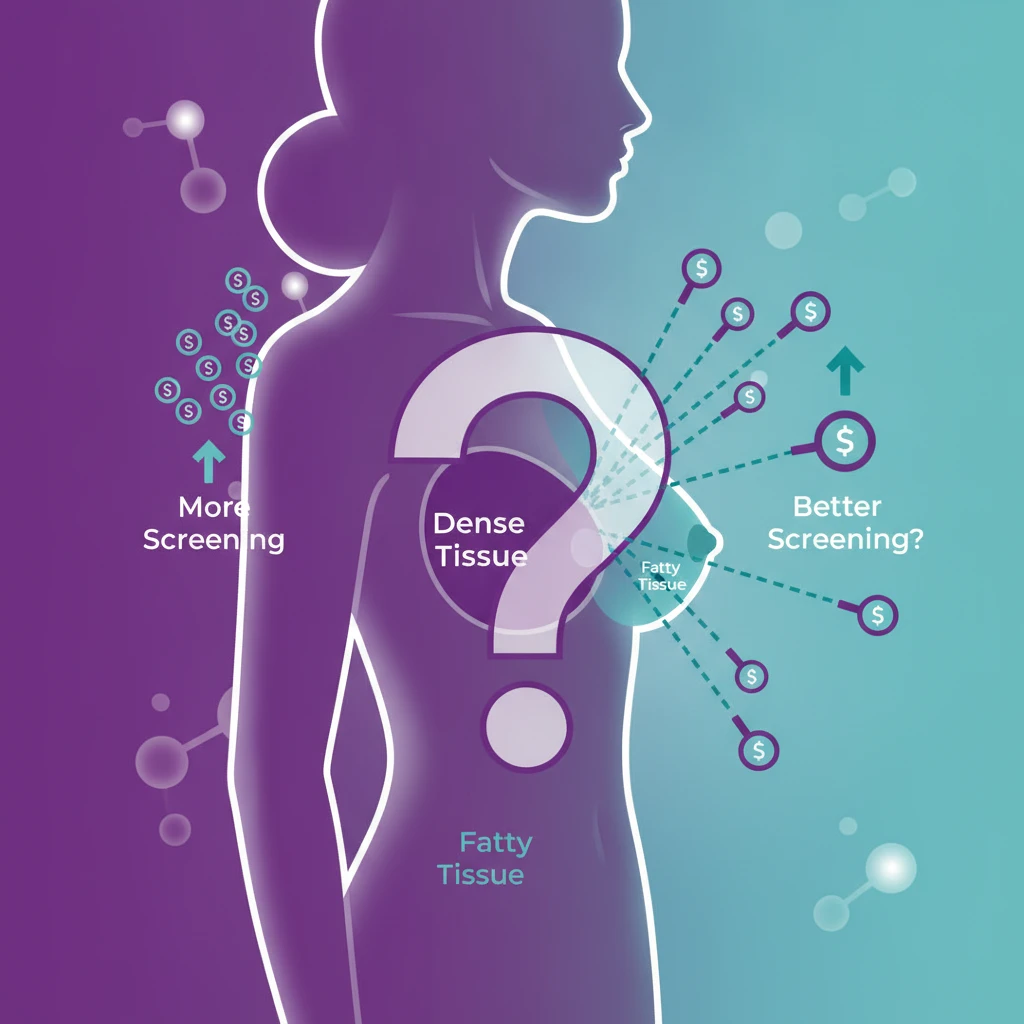

Breast density, a well-established risk factor for breast cancer and a confounder for mammographic detection, has prompted legislative action across Europe and North America. These laws typically require clinicians to inform patients about their breast density and, in some cases, recommend additional screening beyond standard mammography. The intent is clear: improve early detection for women with dense breasts, where cancer can be masked.
Breast density refers to the proportion of fibrous and glandular tissue compared to fatty tissue in the breast. It is a common finding, affecting a substantial percentage of women, and is typically assessed using a four-category scale (A, B, C, D) based on mammographic appearance. Categories C and D indicate dense breasts, which not only obscure potential tumours on mammograms but also independently confer an elevated risk of developing breast cancer. This dual challenge has driven the push for more comprehensive screening strategies.
The rationale behind breast density notification laws is straightforward: empower women with information about their personal risk factors and the limitations of mammography in dense tissue. These laws vary, with some simply requiring notification, while others mandate discussion of supplemental screening options such as ultrasound or MRI. The goal is to identify cancers that might otherwise be missed, potentially leading to earlier diagnosis and improved prognosis. But the implementation of these policies has raised questions about their effectiveness and the broader implications for healthcare systems.
The Impact on Screening Practices
The immediate effect of breast density legislation has been a measurable increase in the utilisation of supplemental screening modalities. Women informed of their dense breasts are more likely to undergo additional imaging, primarily ultrasound. This shift in practice is a direct consequence of the laws, as clinicians respond to mandates and patient inquiries. The increased screening volume naturally leads to a higher rate of findings, including both cancers and benign abnormalities, which then require further investigation.
But the question remains whether this increased screening translates into a meaningful clinical benefit. While more cancers are detected, many of these are small, early-stage cancers that might have been found by mammography at a later stage, or perhaps never become clinically significant. The challenge lies in distinguishing between cancers that truly benefit from earlier detection and those that represent overdiagnosis, leading to unnecessary biopsies, anxiety, and potential overtreatment. The Oxford Handbook of Oncology provides a concise overview of these complex screening considerations.
The Evidence Gap
Despite the widespread implementation of these laws, robust evidence demonstrating a reduction in advanced-stage breast cancer or breast cancer mortality specifically attributable to supplemental screening for dense breasts remains elusive. Observational studies and retrospective analyses often show an increase in cancer detection rates with supplemental ultrasound or MRI. For example, some data indicate that adding ultrasound to mammography can detect an additional 1.5 to 4.6 cancers per 1,000 women screened, depending on the population and density category. This is a clear increase in detection.
But detection alone is not the sole measure of success. A true benefit would be a reduction in the incidence of large tumours, nodal involvement, or distant metastases, ultimately leading to fewer deaths from breast cancer. The current evidence base, however, largely consists of studies that are not powered to assess these long-term outcomes. Randomised controlled trials, which would provide the highest level of evidence, are difficult and expensive to conduct for screening interventions, particularly when mortality is the endpoint. This leaves clinicians in a position where they are mandated to inform and recommend, but without definitive proof of improved patient survival.
The Downside of More Screening
Increased screening, while intuitively beneficial, carries inherent risks. The most significant concern is the potential for false positives. Supplemental imaging, especially ultrasound, has a lower specificity than mammography, meaning it generates more suspicious findings that turn out to be benign. These false positives lead to additional imaging, biopsies, and significant patient anxiety. The psychological burden of a cancer scare, even if ultimately unfounded, is not trivial.
There is also the risk of overdiagnosis, where cancers are detected that would never have caused symptoms or threatened a woman's life. Treating these indolent cancers exposes women to the harms of surgery, radiation, and chemotherapy without providing any survival benefit. The economic burden on healthcare systems is also substantial, as more imaging, biopsies, and treatments are performed. These are not minor considerations, and they complicate the straightforward narrative that more screening is always better.
The current clinical landscape suggests a disconnect between legislative intent and the available clinical evidence. While informing women about breast density is a step towards patient autonomy, the leap to mandating or strongly recommending additional screening without clear evidence of improved mortality outcomes warrants careful consideration. The focus should shift from simply detecting more cancers to detecting the right cancers, those that truly benefit from early intervention.
The proliferation of breast density laws has created a challenging environment for GPs and specialists. We are now obliged to discuss breast density and often recommend supplemental screening, even when the evidence for improved long-term outcomes is not fully established. This puts clinicians in a difficult position, balancing patient expectations, legal requirements, and the reality of screening benefits versus harms.
For patients, these laws can be a double-edged sword. While information is empowering, the recommendation for additional screening can induce significant anxiety and lead to unnecessary procedures. We must be transparent about the limitations of current evidence, explaining that while more cancers may be found, it is not yet clear if this translates to living longer or avoiding advanced disease. Managing these expectations is important for patient well-being.
The industry, particularly manufacturers of imaging equipment, benefits directly from these mandates. Increased demand for ultrasound and MRI machines, along with the associated consumables and radiologist time, represents a significant market expansion. But this commercial interest should not overshadow the need for rigorous, outcomes-based research to validate the true clinical utility of these widespread screening practices.
Policymakers should consider the full spectrum of evidence, including the potential for harm from overdiagnosis and false positives, before expanding mandates further. The goal of breast cancer screening is to reduce mortality and morbidity. Until we have definitive data showing that supplemental screening for dense breasts achieves these endpoints, we risk overmedicalising a significant portion of the female population.
- The Pivot Legislation has driven a significant increase in supplemental breast cancer screening for women with dense breasts.
- The Data While detection rates may rise with additional screening, a clear benefit in terms of reduced advanced cancer or mortality is not yet established.
- The Action Clinicians must weigh the benefits of increased detection against the risks of overdiagnosis and false positives when recommending supplemental screening.
ART-2026-1141
·08/26
Drafted with AI assistance, reviewed and approved by the editorial team. This publication is intended for healthcare professionals, researchers, and life science industry professionals. Content is provided for informational and educational purposes only and does not constitute medical advice.

Infectious disease, epidemiology, and global health equity. I have covered outbreaks from Ebola to COVID-19 to mpox. The stories I am most drawn to are where the science is clear and the response is slow.
Cite This Article
Reeves T, Lopes W. Breast density laws: more screening, but is it better screening?. The Life Science Feed. Published August 13, 2026. Updated August 13, 2026. Accessed August 13, 2026. https://thelifesciencefeed.com/oncology/breast-neoplasms/news/breast-density-laws-more-screening-but-is-it-better-screening.
Editorial & AI Standards
All content is researched from peer-reviewed, open-access sources: published trial data, clinical guidelines, and regulatory filings. AI tools are used solely to structure and summarise that evidence; no AI-generated conclusions appear without editor verification against the primary source.
Every article is reviewed by a named editor before publication. Source citations are listed in the References section. This content does not represent the views of any pharmaceutical company, medical device manufacturer, or healthcare provider.
Licence & Rights
© 2026 The Life Science Feed. All rights reserved. Unless otherwise indicated, all content is the property of The Life Science Feed and may not be reproduced, distributed, or transmitted in any form or by any means without prior written permission.
Medical Disclaimer
The information provided on The Life Science Feed is for educational and informational purposes only. It is not intended as a substitute for professional medical advice, diagnosis, or treatment. Always seek the advice of your physician or other qualified healthcare provider regarding any medical condition or treatment decision. Never disregard professional medical advice or delay in seeking it because of something you have read on this website.
References
1. Schifferdecker KE, Tosteson ANA, Kaplan C, et al. Knowledge and Perception of Breast Density, Screening Mammography, and Supplemental Screening: in Search of "Informed". J Gen Intern Med. 2020;35(6):1654-1660. doi:10.1007/s11606-019-05560-z
2. Kerlikowske K, Zhu W, Tosteson AN, et al. Identifying women with dense breasts at high risk for interval cancer: a cohort study. Ann Intern Med. 2015;162(10):673-81. doi:10.7326/M14-1465







