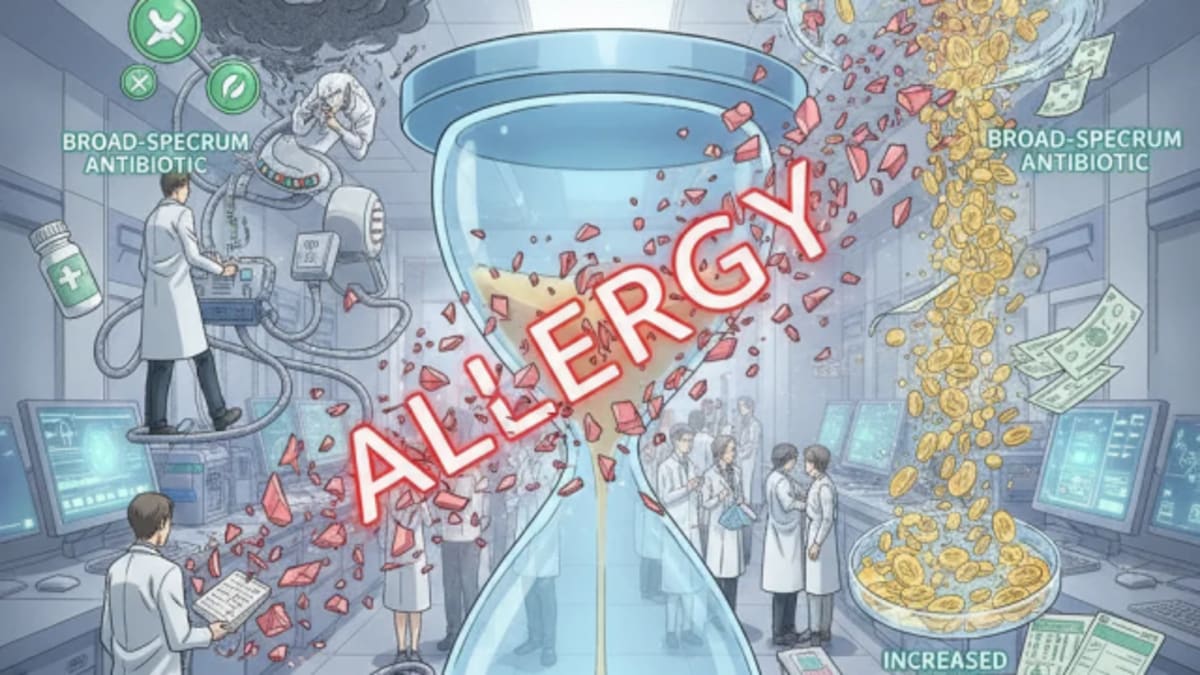
Penicillin allergy labels are common, affecting patient treatment outcomes and contributing to public health challenges like antimicrobial resistance. Mislabeled allergies often force clinicians to use alternative antibiotics, which can be less effective and carry more side effects. Evaluating these allergies is important for antibiotic stewardship, especially in inpatient settings where antibiotic use is high.1,2
Penicillin allergy labels, while prevalent, are often inaccurate. These mislabels lead to the use of broader-spectrum, more expensive, and potentially less effective antibiotics, which in turn fuels antimicrobial resistance and increases healthcare costs. For patients, this can mean prolonged hospital stays, increased risk of adverse events, and suboptimal treatment for their infections. The imperative to accurately assess and delabel these allergies is clear, driving efforts to streamline diagnostic pathways.1,2
Evaluating a penicillin allergy typically involves one of two main approaches: penicillin skin testing or direct oral challenge. The choice between these strategies depends on several factors, including the patient's risk stratification, the availability of specialized resources, the training and comfort level of healthcare providers, and patient preferences. Both methods aim to safely remove inaccurate penicillin allergy labels, thereby optimizing antibiotic prescribing practices.1,2
The Traditional Standard Versus a Simpler Approach
Penicillin skin testing has historically served as the criterion standard diagnostic approach for all-risk phenotypes. This method boasts an excellent safety record, making it a reliable tool for identifying true IgE-mediated penicillin allergies. But, skin testing requires specialized training, specific reagents, and dedicated resources, often limiting its widespread applicability, especially in general practice or smaller inpatient facilities. The procedure involves administering small amounts of penicillin allergens to the skin and observing for a localized reaction, which can be time-consuming and requires an allergist or a trained specialist.1,3
Direct oral challenge, in contrast, is a simpler procedure. It involves administering a therapeutic dose of penicillin or amoxicillin directly to the patient and observing for an allergic reaction. This method is particularly attractive for low-risk patients, where studies have shown it to be noninferior to skin testing. The appeal of direct oral challenge lies in its ease of implementation, requiring less specialized equipment and potentially fewer personnel. This makes it a more accessible option for many healthcare settings, including inpatient units and outpatient clinics, where allergy specialists may not always be readily available.1,2
Defining Low-Risk Patients for Direct Oral Challenge
Rigorous patient selection is paramount for the safe implementation of direct oral challenge. Low-risk patients are generally those with a remote history of penicillin allergy (more than 10 years ago), non-severe reactions (e.g., rash without urticaria, pruritus, or angioedema), or a family history of penicillin allergy without a personal history. Patients with a history of severe reactions, such as anaphylaxis, Stevens-Johnson syndrome, or toxic epidermal necrolysis, are typically excluded from direct oral challenge and should undergo skin testing or a more cautious graded challenge under specialist supervision. The careful stratification of risk ensures that direct oral challenge remains a safe and effective diagnostic tool.1,3
The process of risk stratification often involves a detailed patient history, including the type of reaction, the timing relative to penicillin exposure, and any subsequent exposures. This initial assessment helps clinicians determine the likelihood of a true IgE-mediated allergy. For instance, a patient reporting a childhood rash after penicillin, without any other systemic symptoms, would likely be classified as low-risk. Conversely, a patient with a documented history of immediate urticaria and angioedema would be considered higher risk, necessitating a different evaluation pathway. The hidden costs of a false penicillin allergy label highlight the importance of accurate risk assessment.1
Evidence Supporting Direct Oral Challenge
Several studies have explored the efficacy and safety of direct oral challenge, particularly in low-risk populations. A randomized trial published in the Journal of Allergy and Clinical Immunology: In Practice compared direct challenges to penicillin skin testing for outpatient low-risk penicillin allergy evaluations in pregnancy.3 This study, led by S. Patrawala and colleagues, aimed to determine if direct oral challenge could safely delabel penicillin allergies in this vulnerable population. The trial's findings indicated that direct oral challenge was noninferior to skin testing, offering a viable and less resource-intensive option for pregnant patients.3
Another article in the same journal, by D.L. McDanel and colleagues, discussed inpatient penicillin allergy evaluation, weighing the pros and cons of skin testing versus direct oral challenge.1 This review highlighted that while skin testing is the historical gold standard, direct oral challenge is a simpler, noninferior option for low-risk patients. The authors emphasized that both approaches share the goal of safely delabeling allergies to optimize antibiotic prescribing, but they differ significantly in process and resource requirements.1
A separate piece from A.P. Belmont and colleagues, also in the Journal of Allergy and Clinical Immunology: In Practice, specifically addressed navigating penicillin allergy evaluation in pregnant patients, comparing direct challenges to penicillin skin testing.2 This article reinforced the notion that direct oral challenge, when patient selection is rigorous, carries a comparable safety profile to skin testing in low-risk pregnant individuals. The public health implications of mislabeled allergies, particularly in high-utilization settings like inpatient care, make widespread and routine penicillin allergy evaluation integral for successful antibiotic stewardship.2
Practical Considerations and Limitations
While direct oral challenge presents a compelling alternative, its implementation requires careful consideration. The primary limitation is the increased risk if patient selection is not rigorous. Clinicians must possess adequate education and training to accurately stratify risk and manage potential reactions. The availability of immediate medical support, including epinephrine and resuscitation equipment, is essential during any oral challenge. This is particularly true in settings where staff may not be accustomed to managing acute allergic reactions.1
The logistical challenges of implementing widespread direct oral challenge programs also exist. While simpler than skin testing, it still requires dedicated observation periods, which can strain resources in busy clinical environments. But, the long-term benefits of delabeling allergies, such as reduced use of broad-spectrum antibiotics and improved patient outcomes, often outweigh these initial hurdles. The simplicity of oral interventions, when appropriate, can be a significant advantage.
The studies reviewed consistently point to the safety and efficacy of direct oral challenge in low-risk patients. For example, the randomized trial by Patrawala and colleagues demonstrated that among pregnant patients, direct oral challenge successfully delabeled penicillin allergies without significant adverse events.3 This suggests that for carefully selected populations, the perceived increased risk of direct oral challenge is manageable and comparable to that of skin testing. The key lies in robust screening protocols and adequate preparation for potential reactions. Clinicians seeking to deepen their understanding of diagnostic procedures and clinical management may find the Oxford Handbook of Clinical Immunology and Allergy a useful resource.
Still, the lack of specialized training among general practitioners and some hospitalists remains a barrier. Many healthcare providers are not comfortable performing or supervising direct oral challenges due to a perceived lack of expertise in allergy management. This highlights the need for educational initiatives to empower more clinicians to undertake these evaluations safely. Standardized protocols and clear guidelines can help bridge this knowledge gap, making delabeling more accessible.1
The Broader Impact on Antibiotic Stewardship
Successful antibiotic stewardship hinges on accurate allergy labels. When patients carry an inaccurate penicillin allergy label, they are often prescribed alternative antibiotics that may be less effective, more toxic, and contribute more significantly to the development of antimicrobial resistance. This cycle perpetuates the problem of dwindling effective antibiotic options, a major public health crisis. Delabeling these allergies allows for the appropriate use of penicillins, which are often first-line, highly effective, and well-tolerated antibiotics for many common infections.1,2
The routine evaluation of penicillin allergies, whether through skin testing or direct oral challenge, is therefore not just a matter of individual patient care, but a critical component of a broader strategy to combat antimicrobial resistance. Integrating these evaluation methods into routine inpatient and outpatient care can have a substantial positive impact on public health. The ongoing debate around oral therapies and their safety profiles further emphasizes the need for careful patient selection and monitoring in all drug challenges.
The challenge remains in scaling these efforts. While the evidence supports direct oral challenge for low-risk patients, widespread adoption requires systemic changes in healthcare delivery, including enhanced training, resource allocation, and integration into electronic health records. Without these broader changes, the benefits of simpler delabeling strategies will remain confined to specialized centers. The next step involves developing robust implementation frameworks that can be adopted across diverse clinical settings, ensuring that more patients can safely shed their inaccurate penicillin allergy labels.
The evidence is clear: direct oral challenge is a safe and effective method for delabeling low-risk penicillin allergies, particularly in inpatient and pregnant populations. Clinicians should confidently integrate this approach into their practice, especially when skin testing resources are scarce. Relying on outdated or unverified allergy labels only perpetuates the use of suboptimal antibiotics, contributing to resistance and poorer patient outcomes.
For general practitioners and specialists alike, understanding the nuances of risk stratification is paramount. A careful history is often sufficient to identify low-risk patients who can benefit from a direct oral challenge, avoiding the need for specialist referral. This shift can significantly reduce the burden on allergy clinics and improve access to appropriate antibiotic therapy.
The broader implications for antibiotic stewardship are substantial. By delabeling inaccurate allergies, we can revert to using first-line penicillins, which are often more effective and have a narrower spectrum of activity. This directly combats the rise of antimicrobial resistance, a critical public health concern that demands proactive strategies from every corner of medicine.
The challenge now lies in widespread education and implementation. Healthcare systems must invest in training programs to equip more clinicians with the skills and confidence to perform direct oral challenges safely. This is not merely an academic exercise; it is a practical necessity for improving patient care and safeguarding our antibiotic arsenal.
- The Pivot Direct oral challenge offers a noninferior, simpler alternative to penicillin skin testing for low-risk patients.
- The Data Both skin testing and direct oral challenge safely delabel penicillin allergies in low-risk patients, with comparable efficacy.
- The Action Clinicians should consider direct oral challenge as a primary strategy for low-risk penicillin allergy evaluation, particularly in settings with limited allergy specialist resources.
ART-2026-1347
·08/26
Drafted with AI assistance, reviewed and approved by the editorial team. This publication is intended for healthcare professionals, researchers, and life science industry professionals. Content is provided for informational and educational purposes only and does not constitute medical advice.

Infectious disease, epidemiology, and global health equity. I have covered outbreaks from Ebola to COVID-19 to mpox. The stories I am most drawn to are where the science is clear and the response is slow.
Cite This Article
Reeves T, Voss M. Direct oral challenge: a simpler path to delabeling low-risk penicillin allergies?. The Life Science Feed. Updated August 27, 2026. Accessed August 27, 2026. https://thelifesciencefeed.com/allergy/drug-hypersensitivity/research/direct-oral-challenge-penicillin-allergy-low-risk.
Editorial & AI Standards
All content is researched from peer-reviewed, open-access sources: published trial data, clinical guidelines, and regulatory filings. AI tools are used solely to structure and summarise that evidence; no AI-generated conclusions appear without editor verification against the primary source.
Every article is reviewed by a named editor before publication. Source citations are listed in the References section. This content does not represent the views of any pharmaceutical company, medical device manufacturer, or healthcare provider.
Licence & Rights
© 2026 The Life Science Feed. All rights reserved. Unless otherwise indicated, all content is the property of The Life Science Feed and may not be reproduced, distributed, or transmitted in any form or by any means without prior written permission.
Medical Disclaimer
The information provided on The Life Science Feed is for educational and informational purposes only. It is not intended as a substitute for professional medical advice, diagnosis, or treatment. Always seek the advice of your physician or other qualified healthcare provider regarding any medical condition or treatment decision. Never disregard professional medical advice or delay in seeking it because of something you have read on this website.
References
1. McDanel DL, Mitri EA, Li JT. Inpatient Penicillin Allergy Evaluation-Skin Testing Versus Direct Oral Challenge? J Allergy Clin Immunol Pract. 2026;41421418. https://pubmed.ncbi.nlm.nih.gov/41421418/
2. Belmont AP, Li L, Tsao LR. One Allergy, Two Paths: Navigating Penicillin Allergy Evaluation in Pregnant Patients, Direct Challenges Versus Penicillin Skin Testing in Pregnancy. J Allergy Clin Immunol Pract. 2026;41319903. https://pubmed.ncbi.nlm.nih.gov/41319903/
3. Patrawala S, Mustafa SS, Kraude R. A Randomized Trial Comparing Direct Challenges to Penicillin Skin Testing for Outpatient Low-Risk Penicillin Allergy Evaluations in Pregnancy. J Allergy Clin Immunol Pract. 2025;40645375. https://pubmed.ncbi.nlm.nih.gov/40645375/