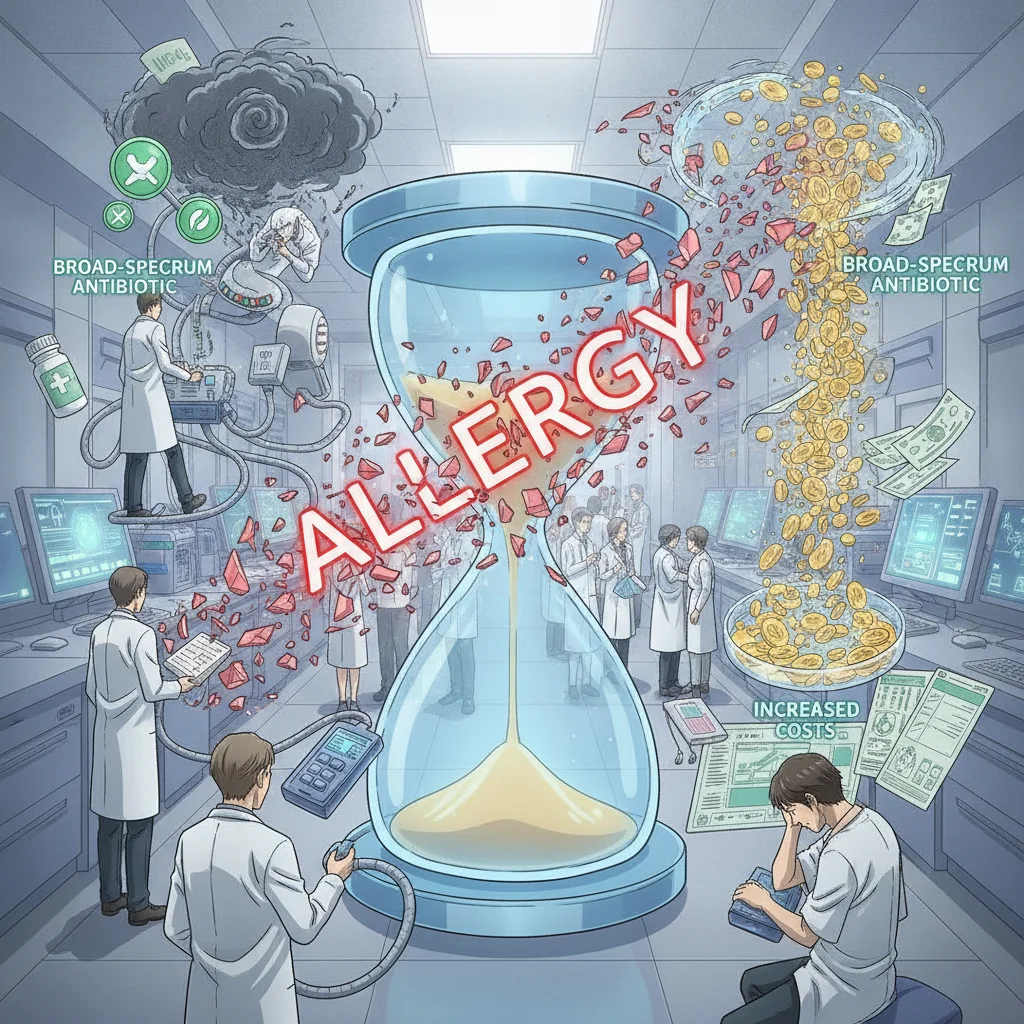

A patient's self-reported penicillin allergy, often unverified, frequently dictates antibiotic selection, leading to the use of broader-spectrum alternatives. This practice carries significant downstream consequences, including higher healthcare expenditures and a measurable increase in adverse clinical events. A retrospective audit from Qatar highlights the pervasive nature of this mislabeling and its systemic impact on patient care and public health.1
The widespread labeling of patients as penicillin allergic presents a substantial challenge to effective antimicrobial stewardship. When a patient's chart carries this label, clinicians often default to non-penicillin antibiotics, even when penicillin remains the most appropriate and effective treatment. This avoidance, driven by an abundance of caution, frequently results in the use of more expensive, less effective, or broader-spectrum agents, contributing to the escalating crisis of antimicrobial resistance. The problem is not merely theoretical; it manifests in tangible patient harms and increased healthcare costs.1
A retrospective audit conducted at a tertiary hospital in Qatar, published in the Qatar Medical Journal, meticulously examined the characteristics of penicillin allergy labeling among admitted patients. Researchers reviewed the medical records of 1,120 adult patients admitted between January 2019 and December 2020. The primary objective was to determine the prevalence and characteristics of penicillin allergy labels, specifically assessing whether these labels were supported by documented evidence of a confirmed allergic reaction or formal allergy testing. This detailed review provides a snapshot of how these labels are applied and maintained within a busy clinical environment.1
The Scope of Mislabeling
The audit revealed a striking prevalence of penicillin allergy labels, with 10.7% (N=120) of all admitted patients carrying such a designation in their medical records. This figure aligns with global estimates, which suggest that between 10% and 15% of the general population report a penicillin allergy. But the critical finding was the lack of verification for these claims. A staggering 93.7% (N=112) of these labels were unconfirmed, meaning there was no documented evidence of a true allergic reaction or formal allergy testing to support the claim. Only 6.3% (N=8) of patients with a penicillin allergy label had any form of documented confirmation.1
The majority of these unconfirmed allergies were self-reported by patients or their families, often based on vague or historical reactions that did not meet the criteria for a true IgE-mediated allergy. Common reported reactions included rash (45.8%), itching (20.8%), swelling (12.5%), and gastrointestinal upset (8.3%). These symptoms, while uncomfortable, are frequently non-allergic in nature or indicative of a mild, non-severe adverse drug reaction rather than a true hypersensitivity that would preclude future penicillin use. The audit did not detail the specific types of penicillin involved, but the general nature of the reported reactions suggests a broad and often indiscriminate avoidance.1
Clinical Consequences of Unverified Allergies
The consequences of these unverified labels are far-reaching, impacting patient safety, treatment efficacy, and the broader fight against antimicrobial resistance. When penicillin is avoided, clinicians often resort to alternative antibiotics, such as fluoroquinolones, macrolides, or vancomycin. These alternatives are frequently associated with a higher incidence of adverse drug reactions, increased treatment costs, and, critically, a greater propensity to drive the development of antimicrobial resistance. For example, the overuse of fluoroquinolones has been linked to Clostridioides difficile infection and the emergence of multidrug-resistant Gram-negative bacteria.1
Patients with a penicillin allergy label experienced a significantly longer hospital stay compared to those without the label. The median length of hospital stay for patients with an unconfirmed penicillin allergy was 10 days, compared to 7 days for patients without the label. This extended stay translates directly into higher healthcare costs and increased risk of hospital-acquired infections. The audit did not quantify the exact cost difference, but a 3-day increase in median stay for 120 patients represents a substantial burden on hospital resources.1
But the impact extends beyond inpatient care. The persistent avoidance of penicillin in outpatient settings can lead to suboptimal treatment for common infections, potentially resulting in treatment failures, recurrent infections, and the need for more complex interventions. For instance, a patient with a false penicillin allergy might receive a less effective antibiotic for streptococcal pharyngitis, increasing the risk of rheumatic fever. The antibiotic paradox is clear: avoiding penicillin often means using drugs that are less targeted and more likely to foster resistance.1
The Imperative for De-labeling
The audit highlights the urgent need for systematic penicillin allergy de-labeling programs. These programs typically involve a detailed allergy history, followed by skin testing or graded oral challenges for patients deemed low-risk. Studies have consistently shown that over 90% of patients who report a penicillin allergy can safely receive penicillin after appropriate evaluation. This de-labeling process allows for the reintroduction of first-line, narrow-spectrum penicillins, which are often more effective, better tolerated, and less expensive than alternative antibiotics.1
Implementing such programs requires a multidisciplinary approach, involving allergists, infectious disease specialists, pharmacists, and general practitioners. Education for both patients and healthcare providers is essential to overcome the ingrained fear of penicillin reactions, as the stakes are high for patient safety and effective treatment. Many clinicians, lacking formal allergy training, prefer to err on the side of caution, perpetuating the false allergy label. Providing clear guidelines and accessible pathways for allergy evaluation can empower providers to challenge these labels safely. The hidden costs of a false penicillin allergy label are too high to ignore.1
The audit also highlighted that only 1.7% (N=2) of the patients with a penicillin allergy label underwent formal allergy testing during their admission. This low rate suggests a significant missed opportunity for de-labeling within the hospital setting, where patients are readily available for evaluation and monitoring. Integrating allergy assessment into routine admission protocols could significantly improve the accuracy of patient records and optimize antibiotic prescribing practices. For clinicians managing complex patients, a comprehensive resource like the Oxford Handbook of Infectious Diseases and Microbiology (3rd ed) can provide practical guidance on antimicrobial therapy and allergy management.1
Limitations and Future Directions
The retrospective nature of this audit is an obvious caveat. It relied on existing medical record documentation, which may not always capture the full details of a patient's allergy history or the rationale behind specific antibiotic choices. The study was also conducted at a single tertiary hospital in Qatar, limiting the generalizability of its findings to other healthcare systems or patient populations. Cultural factors, local prescribing patterns, and the availability of allergy testing services can vary significantly across regions.1
But the core message remains robust: unconfirmed penicillin allergy labels are prevalent and detrimental. Future research should focus on prospective interventional studies to evaluate the effectiveness and cost-effectiveness of hospital-based penicillin allergy de-labeling programs. Measuring outcomes such as reduced antibiotic use, decreased rates of antimicrobial resistance, shorter hospital stays, and improved patient safety would provide compelling evidence for widespread implementation. Patient and provider perceptions of penicillin allergy could help identify barriers to de-labeling and inform targeted educational interventions.1
The audit did not differentiate between different types of penicillin or the severity of reported reactions, which could influence the risk stratification for allergy testing. A more granular analysis of reaction types and their correlation with confirmed allergies would refine de-labeling protocols. Still, the overwhelming proportion of unconfirmed labels suggests that a significant number of patients are unnecessarily avoiding a critical class of antibiotics.1
The Path Forward
The findings from Qatar reinforce a global consensus: false penicillin allergy labels are a public health problem. Addressing this issue requires a concerted effort to educate clinicians, implement standardized allergy assessment protocols, and integrate allergy de-labeling into routine clinical practice. By accurately identifying true penicillin allergies, healthcare systems can optimize antibiotic use, reduce the burden of antimicrobial resistance, and improve patient outcomes. The current practice of accepting unverified allergy claims without challenge is unsustainable and harmful.1
The persistent reliance on unverified penicillin allergy labels is a clinical failure, plain and simple. We are actively harming patients by denying them optimal, often first-line, antibiotic therapy. This isn't just about patient comfort; it's about driving antimicrobial resistance and increasing healthcare costs through longer hospital stays and the use of more expensive, less effective drugs.
GPs and specialists alike must challenge these labels. A patient's casual mention of a 'penicillin allergy' from childhood should trigger a systematic inquiry, not an automatic switch to a fluoroquinolone. Most of these reported reactions are not true IgE-mediated allergies, and a simple history or, where appropriate, a referral for testing, can often de-label a patient safely.
The industry, particularly pharmaceutical companies developing new antibiotics, benefits from this inertia. But the broader public health cost of resistance far outweighs any individual drug's market share. We need hospital systems to invest in dedicated allergy de-labeling programs, integrating them into admission protocols. This is not an optional 'nice-to-have'; it is a fundamental component of responsible antimicrobial stewardship.
Patients, too, need education. Many are unaware that their 'allergy' might be false or that avoiding penicillin carries its own risks. Empowering them with accurate information can facilitate the de-labeling process and ensure they receive the best possible care, rather than being shunted onto suboptimal antibiotic regimens.
- The Pivot Most penicillin allergy labels are unconfirmed, leading to unnecessary avoidance of first-line antibiotics.
- The Data 93.7% of penicillin allergy labels in one tertiary hospital were unconfirmed by formal allergy testing.
- The Action Clinicians should actively pursue penicillin allergy de-labeling, especially in inpatient settings, to optimize antibiotic stewardship.
ART-2026-1353
·08/26
Drafted with AI assistance, reviewed and approved by the editorial team. This publication is intended for healthcare professionals, researchers, and life science industry professionals. Content is provided for informational and educational purposes only and does not constitute medical advice.

Science writer covering the frontier between basic research and clinical practice. I am interested in the moment a mechanism becomes a therapy, and everything that can go wrong in between.
Cite This Article
Aldrich M, Lopes W. The hidden costs of a false penicillin allergy label. The Life Science Feed. Updated August 27, 2026. Accessed August 27, 2026. https://thelifesciencefeed.com/allergy/drug-hypersensitivity/insights/false-penicillin-allergy-label-costs-resistance.
Editorial & AI Standards
All content is researched from peer-reviewed, open-access sources: published trial data, clinical guidelines, and regulatory filings. AI tools are used solely to structure and summarise that evidence; no AI-generated conclusions appear without editor verification against the primary source.
Every article is reviewed by a named editor before publication. Source citations are listed in the References section. This content does not represent the views of any pharmaceutical company, medical device manufacturer, or healthcare provider.
Licence & Rights
© 2026 The Life Science Feed. All rights reserved. Unless otherwise indicated, all content is the property of The Life Science Feed and may not be reproduced, distributed, or transmitted in any form or by any means without prior written permission.
Medical Disclaimer
The information provided on The Life Science Feed is for educational and informational purposes only. It is not intended as a substitute for professional medical advice, diagnosis, or treatment. Always seek the advice of your physician or other qualified healthcare provider regarding any medical condition or treatment decision. Never disregard professional medical advice or delay in seeking it because of something you have read on this website.
References
1. Elajez R H, Bakdach D, Al-Adawi R. Labeling of penicillin allergy in patients admitted to a tertiary hospital in Qatar: A retrospective audit. Qatar Med J. 2022;2022(2):18. doi:10.5339/qmj.2022.18