
Hosted by James Carter & Sarah Mitchell

Transcription
You know how your phone calendar sometimes feels like it's just, well, dictating your entire life.
CO-HOST: Oh, absolutely.
Like you get an alert, you drop whatever you're doing. You commute to the place that you just checked the box.
CO-HOST: Right, yeah.
We do it with car oil changes, we do it with teeth cleanings. And, um, if you are one of the millions of people managing a chronic medical condition, you absolutely do it with your endless doctor visits.
CO-HOST: Yeah, it really becomes a routine you barely even process anymore. I mean, the repeating cycle of follow-up appointments, the waiting rooms.
The magazines from three years ago.
CO-HOST: Exactly. And the never-ending lab slips. It just becomes background noise in your life.
But at what point does that routine cross the line from being a critical life-saving safety net into just, you know, a bureaucratic exercise in box ticking.
CO-HOST: That's the real question.
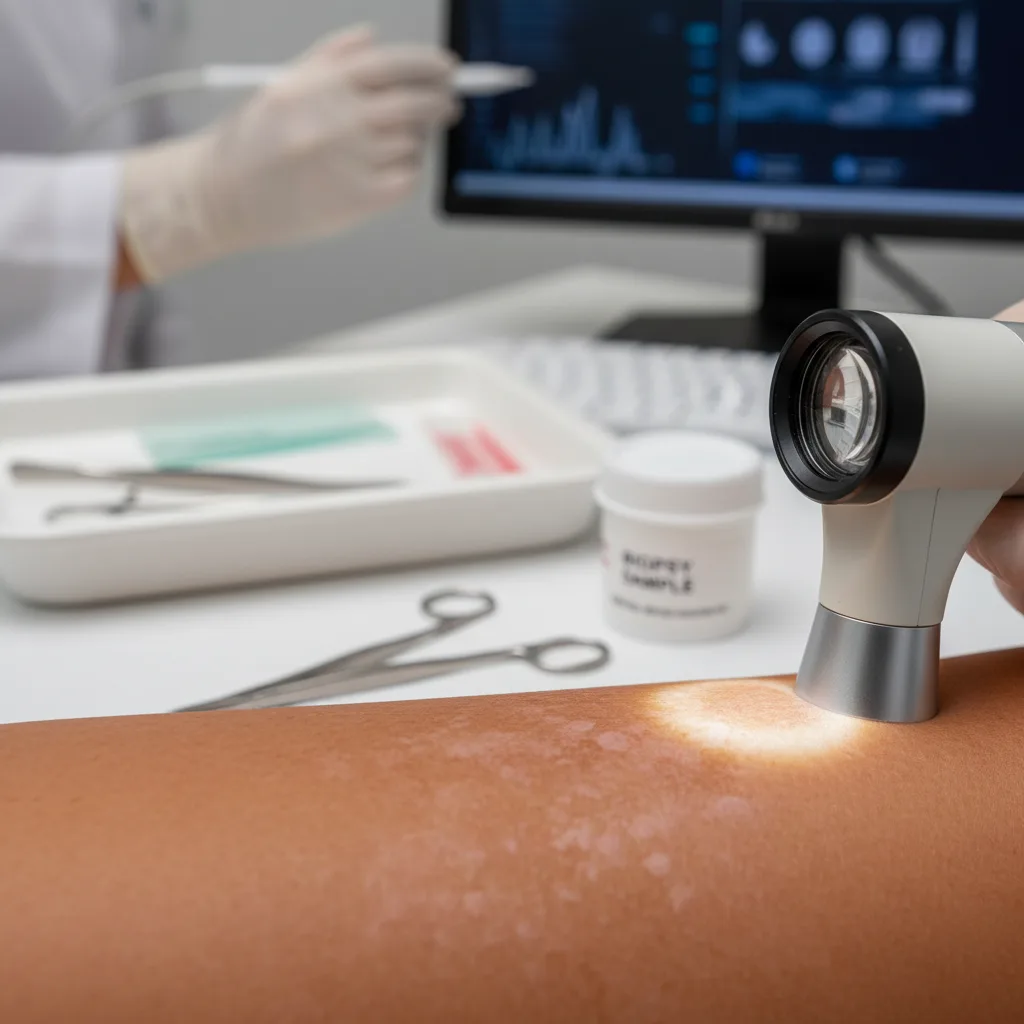
Right. So today, our mission for this deep dive is to explore that exact tension. We're looking at a really fascinating stack of clinical notes and expert guidelines, focused on optimizing monitoring protocols in psoriasis care.
CO-HOST: It's a great topic.
Yeah, like, how do doctors actually decide how much of your blood they need and how often they really need to see you?
CO-HOST: It's a compelling set of sources too, because it takes something that seems like a really simple, almost administrative question, you know, how often should a patient get their blood drawn? And it reveals how that answer dictates the entire lived experience of modern healthcare.
Okay, let's unpack this. Because before we can figure out how to monitor a disease, we really have to look at what the disease actually is.
CO-HOST: Right, the foundation.
Yeah, and honestly, if I see a flaky, itchy patch of skin, I'm thinking, I need to buy a better moisturizer. I am definitely not thinking about the health of my arteries.
CO-HOST: And that is the exact misconception that the clinical sources want to correct right out of the gate.
Oh, really?
CO-HOST: Yeah, I mean, psoriasis is widely misunderstood as just a topical issue, but it is fundamentally a chronic systemic inflammatory disease.
Systemic, meaning the whole body.
CO-HOST: Exactly. The skin clocks you see are just the tip of the iceberg. They're really just the most visible symptom of a system-wide biological error.
Well, treating psoriasis without looking at the rest of the body is like painting a house that has a crumbling foundation. But, you know, let's actually define what that biological error is. What is this inflammation doing under the hood?
CO-HOST: Sure.
Like why does the immune system suddenly decide to attack the skin?
CO-HOST: Well, it starts with your T cells. Those are basically the immune system soldiers. In a patient with psoriasis, these T cells get mistakenly activated in the dermis.
Okay, the skin layer.
CO-HOST: Right. And they start releasing these chemical messengers called cytokines.
Cytokines, got it.
CO-HOST: These cytokines basically shout at the surrounding skin cells, which are the keratinocytes, and they tell them to multiply rapidly.
Like too rapidly.
CO-HOST: Way too rapidly. Normally, skin cells turn over in about a month, but in psoriasis, they turn over in just a few days. So they pile up on the surface and that's what forms those characteristic thick, red, scaly plaques.
But if someone comes in with a skin flare-up, why are we suddenly worried about their heart? I mean, if that cellular miscommunication is happening locally in the skin of my elbow or my knee, it feels like a massive leap to go from a rash to cardiology.
CO-HOST: If we connect this to the bigger picture, chronic inflammation doesn't respect the boundary between the skin and the cardiovascular system.
Wait, really? It travels.
CO-HOST: It does. Those chemical messengers, those cytokines, they do not stay confined to the skin of your elbow. Imagine, um, a toxic chemical spill in a small, local creek that eventually feeds into a massive city's main water supply.
Okay, so the local problem becomes everyone's problem.
CO-HOST: Exactly. The localized problem rapidly becomes a systemic one. Those highly inflammatory cytokines enter your bloodstream and they circulate throughout your entire body. And when they travel through your blood vessels, they cause this sustained low-grade damage to the endothelium, which is the delicate inner lining of your arteries.
So the same exact chemicals causing the skin to overproduce are simultaneously irritating the inside of the blood vessels. Making them prone to plaque buildup and hardening.
CO-HOST: Yes, exactly. And that mechanism is why the comorbidities associated with psoriasis are just so severe.
I see.
CO-HOST: We're looking at drastically elevated rates of cardiovascular disease, metabolic syndrome and inflammatory arthritis, because, you know, the joints are also being bathed in those same inflammatory markers.
That sounds incredibly painful.
CO-HOST: It is. And there are even links to clinical depression driven by the systemic inflammation. That is why holistic monitoring is the absolute foundation of care.
Because you have to look at everything.
CO-HOST: Right. We are not just trying to clear up the skin. We're trying to stop the systemic damage to the vascular system.
Which brings a completely different weight to the treatments being prescribed. I mean, if you have a disease that is circulating through the whole body, the original heavy hitter treatments had to be systemic too.
CO-HOST: Oh, absolutely.
The sources point to a drug called methotrexate as the historical baseline for care. It's like, if the disease was a systemic fire, methotrexate was the water used to put it out.
CO-HOST: That's a good way to look at it. Methotrexate has been the cornerstone of dermatology for decades. It is incredibly effective, but you really have to understand how it works to understand why it demands such immense respect.
How does it work?
CO-HOST: Well, it's an antimetabolite. It essentially interferes with DNA synthesis to stop rapidly dividing cells.
Okay, so it stops the skin cells from piling up.
CO-HOST: Yes, but it doesn't only target the misbehaving immune cells, it suppresses cellular turnover quite broadly. And importantly, your liver is primarily responsible for metabolizing this powerful drug.
Uh oh. That sounds like a lot of work for the liver.
CO-HOST: It is. Over time, that metabolic burden can cause hepatotoxicity, meaning severe liver damage.
So to monitor that, doctors had to be incredibly aggressive, right? The guidelines used to require patients to come in for liver function tests and full blood counts every two to three months.
CO-HOST: Yes, highly frequent visits.
But it goes beyond just getting poked with a needle. The notes detail how doctors actually used to check for liver scarring or fibrosis. They used physical liver biopsies.
CO-HOST: Yeah, it was a highly invasive gold standard. You would literally take a hollow needle, pass it through the patient's abdomen and punch out a physical piece of the liver tissue to examine it under a microscope for architectural damage.
I'm sorry, what? That sounds completely barbaric for a routine checkup on a skin condition.
CO-HOST: It was intense.
Here's where it gets really interesting though, because the sources highlight a massive long overdue shift away from that surgical approach. The clinical guidelines, specifically from the British Association of Dermatologists, they now formally support using non-invasive fibrosis markers.
CO-HOST: Yes, thankfully.
They're replacing the biopsy with something called the ELF test. Yeah. But, um, how does a simple blood draw tell you what is happening to the structure of a solid organ like the liver?
CO-HOST: Think of it like trying to assess the structural integrity of a massive concrete dam upstream.
Okay.
CO-HOST: You don't actually have to drill a hole into the dam itself to see if it's breaking apart. Instead, you can just stand downstream and measure the specific type of concrete dust and debris floating in the river water.
Oh, wow. That makes so much sense.
CO-HOST: Right. The enhanced liver fibrosis test, or ELF test, works on that exact principle. It measures specific protein markers in your blood, like hyaluronic acid and certain tissue inhibitors, that are actively involved in building scar tissue.
Okay, so they're looking for the construction materials in the blood.
CO-HOST: Exactly. If those debris markers are highly elevated in your bloodstream, the clinician knows the liver is actively scarring.
That is brilliant. You are just reading the debris in the blood.
CO-HOST: Mhm.
And the guidelines say you can combine that ELF test with elastography.
CO-HOST: Yes. Elastography uses ultrasound waves. A healthy liver is soft and elastic, somewhat like a sponge.
Right.
CO-HOST: A scarred fibrotic liver is stiff, and sound waves bounce back much faster from a stiff surface than a soft one.
Because it's hitting a hard wall basically.
CO-HOST: Exactly. So by combining the chemical debris test in the blood with the physical bounce back of the ultrasound, clinicians get a highly accurate picture of liver health without ever needing a surgical biopsy.
That is such a victory for the patient's quality of life. I mean, no more needles in the abdomen. But does this mean doctors can just set it and forget it now? Like if the monitoring is just a specialized blood test and a quick ultrasound every year or two, couldn't a doctor just prescribe the methotrexate and let the patient go live their life?
CO-HOST: No, absolutely not. That is a dangerous trap.
Why keep them tethered to the clinic at all?
CO-HOST: Because, well, the method of gathering the data has improved, but the need for the data has not vanished.
Oh, I see.
CO-HOST: The sources explicitly warn against adopting a set and forget mindset. Methotrexate still taxes the liver. There are tragically real cases documented in these notes where patients suffered progressive, irreversible liver cirrhosis, simply because they fell off the radar.
Just from missing appointments.
CO-HOST: Yes, their routine monitoring lapsed, the subtle biochemical debris in their blood was missed and the physical damage just quietly accumulated over years.
So medical science solved the brutal biopsy problem for the old guard treatments. But, you know, the drugs themselves evolve. We eventually enter the biologic revolution.
CO-HOST: The huge turning point.
Yeah, as the medications move away from that broad suppression and get hyper-targeted, the risks completely shift. So the monitoring has to shift entirely too.
CO-HOST: Biologics changed everything. Instead of carpet bombing the immune system like methotrexate, they act like precision-guided missiles.
I love that analogy.
CO-HOST: They're engineered antibodies designed to seek out and neutralize one specific inflammatory protein while leaving the rest of the immune system largely intact.
Let's break down how that actually changes what doctors are looking for in your blood. The clinical notes start with anti-TNFs. These are the first major biologic class, and we have over 20 years of real-world data on them.
CO-HOST: Very well studied.
Right. So what exactly is a TNF?
CO-HOST: TNF stands for tumor necrosis factor. It is a major, overarching inflammatory cytokine. Essentially, it's a master alarm bell for your immune system.
Okay.
CO-HOST: When you use a biologic to block TNF, you very effectively calm the psoriasis down. But you also muffle the immune system's alarm system for containing certain latent infections.
Latent, meaning things you already have but are hiding.
CO-HOST: Mm-hmm.
Like tuberculosis and hepatitis B.
CO-HOST: Precisely. You might have been exposed to tuberculosis decades ago and your immune system built a tiny calcified wall around it to keep it dormant.
And the TNF keeps that wall strong.
CO-HOST: Yes. So if you block TNF, that wall can weaken and the infection can reactivate.
That's terrifying.
CO-HOST: Which is why the standard monitoring for anti-TNFs requires strict pre-treatment screening for those specific diseases. Once you clear that hurdle, you settle into an annual routine of checking blood counts, liver function, and blood pressure.
Okay, but then the science gets even more targeted. We move from the anti-TNFs to the IL-17 inhibitors.
CO-HOST: Right, a newer class.
Drugs like Secukinumab, Ixekizumab and Bimekizumab. The notes say that with these drugs, the liver isn't really the primary concern anymore. The risk shifts almost entirely towards specific types of infections. What is an IL-17?
CO-HOST: So IL stands for Interleukin. If cytokines are chemical messengers, Interleukins are the highly dedicated cellular phone lines.
Okay, phone lines.
CO-HOST: IL-17 is the specific phone line that your immune system uses to call for defensive troops against fungal infections, particularly at mucosal surfaces, like the lining of your mouth or your gut.
So if you engineer a biologic to cut the IL-17 phone line to stop the psoriasis inflammation.
CO-HOST: You inadvertently cut the communication line for fungal defense.
Oh, wow.
CO-HOST: Yeah, the patient becomes uniquely susceptible to things like candida, which are yeast infections. Clinicians also watch for potential inflammatory bowel disease exacerbations, because that mucosal lining in the gut is affected.
That makes sense.
CO-HOST: But what is remarkable here is the biochemical monitoring. There are no mandated routine blood tests after the initial pre-treatment baseline.
None.
CO-HOST: Nope. The doctor doesn't need your blood. They need to physically observe you for signs of a yeast infection.
Wow. And the targeting gets even cleaner with the IL-23 inhibitors, Guselkumab, Risankizumab. The forces describe these as having a remarkably clean safety profile. IL-23 is a different phone line altogether.
CO-HOST: Yes. IL-23 is further upstream in the inflammatory cascade. It regulates the psoriasis pathways, but blocking it doesn't completely obliterate the downstream mucosal defenses like blocking IL-17 does.
Oh, so it's a bit gentler on the immune system's other jobs.
CO-HOST: Exactly. It modulates the response, which preserves enough of your natural immune function to fight off the yeast while still clearing the skin plaques.
Okay, but wait. If the IL-23 inhibitors are operating that cleanly and the clinical trials show minimal collateral damage, why are we doing any blood tests at all?
CO-HOST: It's a fair question.
I mean, if I am a patient starting an IL-23, drawing my blood feels like checking the oil on an electric car. There is no internal combustion engine to burn the oil, so why are we lifting the hood and looking around?
CO-HOST: What's fascinating here is that the baseline checks aren't about checking the oil, they're about making sure you actually have an electric car to begin with.
Oh, I see.
CO-HOST: We do those initial blood tests to establish your biological fingerprint. We need to prove that the remarkably clean safety profile seen in the clinical trials actually holds true for your unique individual physiology.
Because everyone is different.
CO-HOST: Right. If your liver enzymes are already mysteriously elevated before you take a single pill, the doctor needs to know that at day zero.
Otherwise they'd blame the new drug.
CO-HOST: Precisely. Six months from now, they might mistakenly blame the clean biologic for a problem you already had. We must establish the baseline before we alter the immune system in any capacity.
That makes perfect sense. Day zero fingerprinting. So if we trace the trajectory here, we went from broad, heavy medications that required liver biopsies to precision biologics that just require a baseline check and a clinical review.
CO-HOST: It's an amazing progression.
The monitoring gets less invasive, the drugs get safer. It sounds like a complete medical triumph, except, um, the clinical notes throw a massive curveball into the timeline.
CO-HOST: Yeah, medicine rarely moves in a straight uninterrupted line of progress.
Never does.
CO-HOST: The curveball here comes in the form of a newer class of drugs called small molecules, specifically the JAK inhibitors.
Right, drugs like upadacitinib and deucravacitinib, which the notes technically classify as a TYK2 inhibitor, but it belongs to this same complex family. Just when monitoring seems to be getting easier and less invasive with biologics, these drugs put intense, rigorous blood monitoring right back under a massive spotlight.
CO-HOST: They really do.
Proving that newer doesn't always mean simpler. Why are they behaving differently than the biologics?
CO-HOST: It comes down to where the drugs operate. Biologics are large molecules. They circulate in the blood and block those messenger cytokines outside of the cell.
Outside.
CO-HOST: But JAK inhibitors are small molecules. They are tiny enough to physically cross the cell membrane and block the intracellular switchboard itself. They cut the wires inside the cell nucleus.
And blocking that internal switchboard requires intense cardiovascular monitoring. But here is the wild part of the clinical notes.
CO-HOST: The data driving this intense monitoring isn't even from dermatology patients.
No, it's not.
CO-HOST: It's driven by something called the oral surveillance trial.
What is that?
CO-HOST: This is a textbook example of how data from one demographic can profoundly disrupt the treatment of another. The oral surveillance trial was a massive study looking at a high-risk rheumatoid arthritis population.
Rheumatoid arthritis, not psoriasis.
CO-HOST: Right. And these were patients over 50 years old who already had at least one major cardiovascular risk factor.
Right, an older, higher risk demographic.
CO-HOST: And in that specific group, the JAK inhibitors showed an increased risk of MACE, major adverse cardiovascular events, like heart attacks, as well as malignancies and venous thromboembolism, which are blood clots.
Yes, very serious risks.
CO-HOST: But dermatology patients, particularly those with psoriasis, are frequently much younger. They do not share that same baseline cardiovascular risk.
So what does this all mean? Why are young, relatively healthy skin patients suddenly trapped in this intense cardiovascular monitoring cycle based on data from a completely different demographic?
CO-HOST: This raises an important question about how regulatory bodies, like the FDA in the US or the EMA in Europe, handle drug safety. They utilize class-wide warnings.
Class-wide.
CO-HOST: Yes. Regulators don't just look at the age of the patient in the trial. They look at the mechanism of the drug itself.
Meaning if cutting that specific intracellular wire causes a heart issue in an older arthritis patient, the FDA assumes the biological potential exists to cause a heart issue in a younger psoriasis patient.
CO-HOST: Precisely. It is guilt by molecular association. Even if the absolute risk for the young psoriasis patient is mathematically microscopic, the mechanism is identical.
Wow.
CO-HOST: Therefore, the regulators mandate that the black box warnings must apply universally across all patients taking any drug in that class.
Which means the clinical guidelines have to follow suit to protect the clinician and the patient. The British Association of Dermatologists and the European Dermatology Forum strictly mandate pre-treatment cardiovascular risk assessments for these JAK inhibitors.
CO-HOST: It's unavoidable.
You need your lipids monitored at three months and then annually. You need regular screening for hematological blood abnormalities, and if you have an active malignancy, it is a strict contraindication. You can't take it.
CO-HOST: It really highlights a profound daily tension between empirical trial data and clinical reality. As a dermatologist, you might look at a 25-year-old athlete sitting in front of you and think their personal risk of a major adverse cardiovascular event is practically zero.
Right, they're young and healthy.
CO-HOST: But you cannot ignore a mechanism-based warning just because your patient looks healthy. You have to monitor their lipids strictly to protect them from this statistical unknown.
That must be so frustrating for the patient. So let's look at the sheer chaos of a modern dermatology clinic.
CO-HOST: It is chaotic.
You have old school methotrexate patients who need specialized ELF tests to check the debris in their liver. You have biologic patients who just need you to look for yeast infection, and you have young JAK inhibitor patients who need aggressive cardiovascular lipid tracking.
CO-HOST: All in the same waiting room.
How does a doctor look at this landscape and actually map out a calendar that doesn't completely overwhelm the patient with appointments?
CO-HOST: The only way to survive that complexity is to abandon the old one size fits all model. Historically, doctors just told everyone to come back every three months and maybe stretched it to six months if they were doing well.
Just a standard block of time.
CO-HOST: Right. But the new paradigm highlighted in our sources is called risk stratified monitoring.
It's basically tailoring the calendar to the specific molecular risk of the drug and the patient.
CO-HOST: Exactly.
The notes offer a great contrast here. Imagine a young patient on one of those super clean IL-23 inhibitors. They have been in stable remission for three full years.
CO-HOST: Bringing that specific patient into the clinic every six months for routine blood work is clinically useless. The diagnostic yield, the mathematical probability of catching a significant abnormality is incredibly low.
They're just wasting their Tuesday afternoon.
CO-HOST: Pretty much. But contrast that with an older patient who is taking methotrexate. They also happen to have diabetes and non-alcoholic fatty liver disease.
Oh, that's a lot going on.
CO-HOST: That patient doesn't get to skip appointments. They need highly frequent, incredibly vigilant monitoring because their margin for error is razor thin.
Risk stratification makes perfect logical sense. But pulling it off requires a massive logistical overhaul. I mean, how do you keep an eye on the stable patients if you aren't forcing them into the clinic? This is where the technology piece of the clinical notes becomes so empowering for the patient.
CO-HOST: It's a game changer.
We are shifting away from passive waiting room healthcare into active patient-driven data.
CO-HOST: Technology is the vital bridge that allows us to safely extend these clinic intervals for low-risk patients. We are seeing the widespread roll-out of remote monitoring tools. Clinics are integrating patient reported outcome or PRO apps right into their workflow.
I found the remote PASI scoring really fascinating. For listeners who don't know, PASI stands for Psoriasis Area and Severity Index. It's a calculation of how much of your body is covered in plaques and how red and scaly they are.
CO-HOST: Yes.
Traditionally, you have to strip down in a brightly lit clinic so a doctor can calculate it.
CO-HOST: Which nobody enjoys. But now, using secure medical apps, a patient can take high-resolution photos of their own lesions and submit them directly to their file. The doctor can assess the PASI score remotely.
That is so convenient.
CO-HOST: You don't have to leave work, drive across town and sit in a waiting room just for a doctor to look at your arm and say, looks stable, see you in six months.
You are actively generating the real-time data that keeps you safe. You take the photo, you fill out the daily symptom questionnaire on the app, and you trigger a teleconsult only if the data shows a problem.
CO-HOST: It fundamentally shifts the power dynamic, putting more control in the patient's hands. However, the sources emphasize a critical caveat.
Which is?
CO-HOST: Clinical guidelines are a floor, not a ceiling. The technology is meant to enhance the clinical relationship, not replace it. The nightmare scenario in risk stratified monitoring is a patient falling victim to under monitoring because a clinic relied too heavily on an app and stretched an interval too far.
Oh, right, like they just slipped through the cracks.
CO-HOST: Exactly. We discussed how dangerous it is to miss the liver debris markers on methotrexate. But the notes also explicitly warn about missing early hematological blood toxicity on JAK inhibitors simply because a remote appointment got pushed back and the lab work was forgotten.
Wow. So the tech gives us incredible convenience, but it cannot become an excuse to let the safety net fray.
CO-HOST: Never.
So let's quickly summarize what we've covered, because it's a lot. Monitoring differs wildly by drug class.
CO-HOST: Very wildly.
We've got non-invasive ELF tests replacing liver biopsies for the older drugs like methotrexate. We've got biologics that mostly just need clinical observation. And then we have JAK inhibitors requiring strict cardiovascular and lipid tracking, despite the cleaner drug data. Plus, individualized tech assisted monitoring is really the future here.
CO-HOST: That's a perfect summary.
What does this massive evolution actually mean for you, the person listening right now? The next time your calendar pings you with an alert for a doctor's appointment, don't just blindly go in and check the box. You now have the vocabulary to ask questions based on the mechanism of your treatment.
CO-HOST: Exactly. When you are sitting in the exam room, ask your clinician what specific mechanism they are monitoring for. Are you on an older systemic drug where they need to track liver debris with an ELF test?
Or are you on a biologic where a specific cellular phone line was cut, requiring them to just watch for localized infections?
CO-HOST: Right. Or are you taking a small molecule that requires cardiovascular vigilance due to class-wide regulatory warnings?
When you understand the why behind the blood draw, you stop being a passive subject of the healthcare bureaucracy and become an active partner in your own clinical outcomes. You're participating in a highly targeted safety strategy designed specifically for your biology.
CO-HOST: And, you know, as we trust these remote apps and patient-driven data points more and more, it leaves us with one final, fascinating prospect to consider.
What's that?
CO-HOST: Well, if algorithms and secure photos are already proving they can accurately track the severity of a skin flare-up today, how long until your smartphone effectively becomes your primary triage doctor?
Right. Will we reach a point in the near future where your phone passively processes your daily biometrics, analyzes a submitted photo, and only pages the human specialist when the algorithm detects a dangerous biological shift that you hadn't even noticed yet? It really makes you wonder, when you open your calendar five years from now, will it be you scheduling that doctor's appointment, or will it be your phone telling you it is finally time to go in? Think about that the next time you silence an alert. We'll see you on the next deep dive.
Free Clinical Resources
Episode Infographic
Key data, mechanisms, and clinical takeaways distilled into a single shareable page. Save it for reference or use it in your next team discussion.
Clinical Flashcards
Core concepts from this episode in flashcard format, structured for spaced repetition, pre-consultation review, or CPD reflection with your team.
More from: Psoriasis Deep Dive Series

Replacing Biologic Injections With Oral Pills
Deucravacitinib (the first approved TYK2 inhibitor) offers a new oral option for moderate-to-severe psoriasis without the cardiovascular safety concerns attached to pan-JAK inhibitors. Sarah Mitchell and James Carter examine how the oral therapy landscape is evolving and what it means for patients who refuse injections.

Why Half Of Psoriasis Patients Quit
Up to half of psoriasis patients discontinue their treatment within a year. The reasons are complex: side effect fear, injection fatigue, visible improvement masking ongoing disease. The solutions require as much psychology as pharmacology. Sarah Mitchell and James Carter examine the adherence crisis and what works.

Is It Safe To Switch Biosimilars?
The NOR-SWITCH trial established that switching from reference infliximab to a biosimilar is safe. Multiple subsequent studies have confirmed this across adalimumab and other biologics. Sarah Mitchell and James Carter examine the switching evidence, the nocebo effect, and how the biosimilar dividend is reshaping access to care.
ART-2026-186
·08/26
Drafted with AI assistance, reviewed and approved by the editorial team. This publication is intended for healthcare professionals, researchers, and life science industry professionals. Content is provided for informational and educational purposes only and does not constitute medical advice.

Thirty years in health journalism, the last fifteen in life sciences. I have reported from every major medical congress and watched blockbuster drugs get revised after approval. I cover what the data says.
Cite This Podcast
Carter J, Mitchell S. Psoriasis monitoring landscape guide. The Life Science Feed. Published May 28, 2026. Updated August 3, 2026. Accessed August 27, 2026. https://thelifesciencefeed.com/dermatology/plaque-psoriasis/insights/psoriasis-monitoring-landscape-guide.
Editorial & AI Standards
All content is researched from peer-reviewed, open-access sources: published trial data, clinical guidelines, and regulatory filings. AI tools are used solely to structure and summarise that evidence; no AI-generated conclusions appear without editor verification against the primary source.
Every article is reviewed by a named editor before publication. Source citations are listed in the References section. This content does not represent the views of any pharmaceutical company, medical device manufacturer, or healthcare provider.
Licence & Rights
© 2026 The Life Science Feed. All rights reserved. Unless otherwise indicated, all content is the property of The Life Science Feed and may not be reproduced, distributed, or transmitted in any form or by any means without prior written permission.
Podcast Disclaimer
This podcast is produced for educational and informational purposes only. The conversation between hosts represents a discussion of published clinical evidence and is not intended as clinical advice, a substitute for professional medical judgment, or a recommendation for any specific treatment. Healthcare professionals should rely on their own clinical training, current guidelines, and individual patient assessment when making treatment decisions. The views expressed are those of the hosts and do not constitute endorsement of any specific therapy, product, or manufacturer.
References
Chalmers RJ, Kirby B, Smith A, et al. Replacement of routine liver biopsy by procollagen III aminopeptide for monitoring patients with psoriasis receiving long-term methotrexate. Br J Dermatol. 2005;152(3):444–450. https://doi.org/10.1111/j.1365-2133.2004.06407.x
Kalb RE, Fiorentino DF, Lebwohl MG, et al. Risk of serious infection with biologic and systemic treatment of psoriasis. JAMA Dermatol. 2015;151(9):961–969. https://doi.org/10.1001/jamadermatol.2015.0718
Maybury CM, Jabbar-Lopez ZK, Wong T, Dhillon AP, Barker JN, Smith CH. Methotrexate and liver fibrosis in psoriasis: a systematic review of observational studies. Br J Dermatol. 2014;171(1):17–29. https://doi.org/10.1111/bjd.12941
Menter A, Strober BE, Kaplan DH, et al. Joint AAD-NPF guidelines for management of psoriasis with biologics. J Am Acad Dermatol. 2019;80(4):1029–1072. https://doi.org/10.1016/j.jaad.2018.11.057
Poizeau F, Oussedik E, Bettoli V, et al. Long-term safety of biologics for psoriasis — a comparison across drug classes. J Eur Acad Dermatol Venereol. 2022;36(S1):3–16. https://doi.org/10.1111/jdv.17881
Puig L, Barker J, Gollnick H, et al. Recommendations for the use of methotrexate in psoriasis: a European consensus-based study. J Eur Acad Dermatol Venereol. 2012;26(2):166–174. https://doi.org/10.1111/j.1468-3083.2011.04236.x







